
Cleanroom HVAC & Air Handling
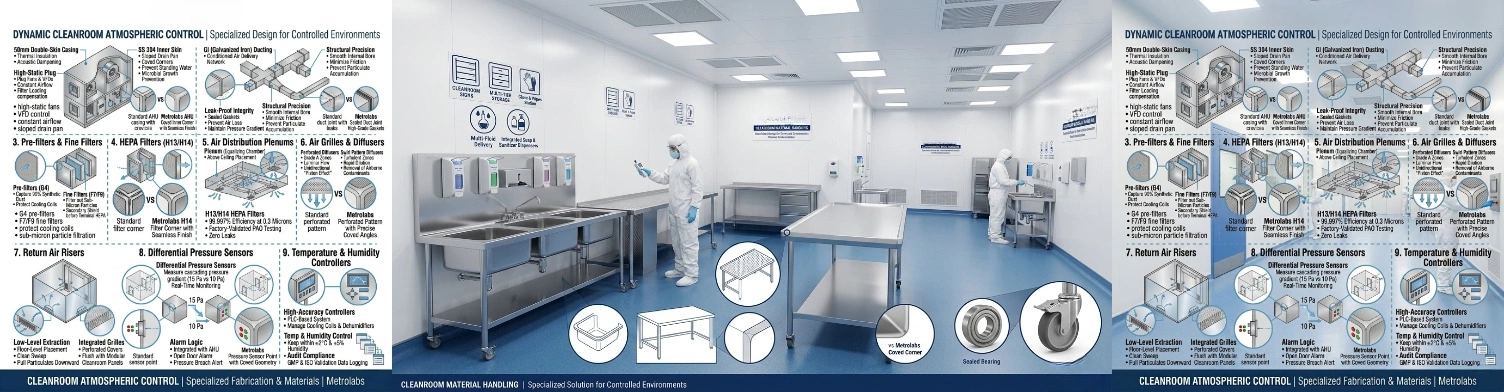
Cleanroom HVAC & Air Handling: High-Accuracy Atmospheric Control
In a sterile facility, the HVAC (Heating, Ventilation, and Air Conditioning) system is the most critical structural component. It does more than regulate temperature; it is the primary engine for contamination control, pressure stabilization, and moisture management. Metrolabs provides high-accuracy Cleanroom Air Handling Units (AHU) and integrated climate systems designed to maintain the rigorous ISO-class environments required for pharmaceutical, biotech, and electronic manufacturing.
Our systems are engineered for long-term performance, ensuring that your facility remains a “Clean Shell” protected from external particulates and internal cross-contamination.
The Core of the Cleanroom: Advanced AHU Engineering
In a controlled environment, the HVAC system acts as the respiratory system of the facility. Metrolabs provides high-accuracy atmospheric control solutions, ensuring that your “Clean Shell” maintains the specific pressure, purity, and climate levels required for ISO-class compliance.
Below is the structural breakdown of our advanced engineering components.
AHU (Air Handling Unit)
The AHU is the primary engine of the cleanroom. Our units are constructed with a 50mm double-skin casing for thermal insulation and acoustic dampening. Aseptic Interior: The inner skin is typically made of SS 304, featuring a sloped drain pan and coved corners to prevent standing water and microbial growth. Dynamic Performance: Equipped with high-static plug fans and VFDs to ensure constant airflow even as filters begin to load.
HVAC Ducting (GI)
Our GI (Galvanized Iron) Ducting is the delivery network for conditioned air. Leak-Proof Integrity: Every joint is sealed with high-grade gaskets to prevent air loss and maintain the pressure gradient. Structural Precision: Designed with a smooth internal bore to minimize friction and prevent the accumulation of particulates.
Air-tight Doors
Metrolabs Air-tight Doors are fabricated from double-skinned SS 304 or SS 316L with a high-density infill for thermal and acoustic insulation. EPDM Gasketing: Features specialized non-shedding gaskets recessed into the door leaf to maintain a consistent seal. Seamless Joints: All corners are interlocked and ground smooth to provide a snag-free surface for cleanroom suits and personnel.
View Panels (Double Glazed)
Visibility is essential for safety and monitoring within the "Clean Shell." Our View Panels provide transparency without compromising sterility. Flush Integration: Double-glazed toughened safety glass is mounted flush with the door or wall surface, creating a continuous, easy-to-clean vertical plane. De-Humidified Chambers: The internal cavity is filled with desiccant to prevent condensation, ensuring clear visibility across varying temperature zones.
Pre-filters & Fine Filters
To ensure long-term performance of the system, we utilize a tiered filtration strategy within the AHU. Pre-filters (G4): Captures 90% of synthetic dust to protect the internal cooling coils. Fine Filters (F7/F9): Filters out sub-micron particles, acting as a secondary shield before the air reaches the terminal HEPA units.
HEPA Filters (H13/H14)
The HEPA Filter is the final barrier against contamination, providing 99.997% efficiency at 0.3 microns. Terminal Placement: Often installed in the ceiling at the point of air entry to ensure only ultra-pure air enters the sterile zone. Integrity Tested: Every filter is factory-validated using PAO (Polyalphaolefin) testing to ensure zero leaks.
Air Distribution Plenums
The Plenum acts as a pressurized "equalizing chamber" above the ceiling. Uniform Distribution: It ensures that air is delivered at a consistent velocity across multiple diffusers, preventing "dead zones" or turbulent air pockets.
Air Grilles & Diffusers
These components manage the final delivery of air into the room. Laminar Flow: Perforated diffusers are used in Grade A zones to create a unidirectional "piston effect" of air. Swirl Pattern: Used in turbulent zones to ensure rapid dilution and removal of airborne contaminants.
Return Air Risers
To maintain a "clean sweep" of the room, air must be removed efficiently. Low-Level Extraction: Return Air Risers are positioned near the floor to pull particulates downward and away from the work surface. Integrated Grilles: Features easy-to-clean perforated covers that align flush with our Modular Cleanroom Panels.
Differential Pressure Sensors
Maintaining a "cascading" pressure gradient is essential to prevent cross-contamination.Real-Time Monitoring: These sensors measure the pressure difference between rooms (e.g., 15 Pa vs 10 Pa).Alarm Logic: Integrated with the AHU to alert personnel if a door is left open or if a pressure breach occurs.
Temperature & Humidity Controllers
Sensitive processes require a stable climate.High-Accuracy Control: Our PLC-based systems manage cooling coils and dehumidifiers to keep temperature within 2°C and humidity within 5%. Audit Compliance: Automatically logs environmental data for GMP and ISO validation.
Technical Summary
| Component | Function | Material Standard |
| Ducting | Air Transport | GI / Aluminum / SS |
| Filtration | Particulate Removal | G4, F9, H14 |
| Control | Climate Stability | PLC with HMI |
| Sensors | Pressure Integrity | Digital / Magnehelic |
The Metrolabs Advantage
At Metrolabs, we focus on the high-accuracy fabrication of the entire air path. Our HVAC systems are fully compatible with Building Management Systems (BMS) and are tested to withstand room-wide VHP (Vaporized Hydrogen Peroxide) sterilization cycles.
Technical Insight: For high-stakes zones, we recommend the use of Terminal HEPA Housings with integrated test ports. This allows your team to perform “In-Situ” integrity testing (PAO tests) without disrupting the room’s structural seals.