
Cleanroom Instrument Trolleys — Safe & Efficient Sterile Instrument Transport
Metrolabs provides end-to-end solutions for sterile environments — designing, manufacturing, supplying, and installing high-performance cleanroom instrument trolleys that meet the rigorous demands of pharmaceutical, biotech, and clinical research facilities. Our trolleys maintain the highest levels of hygiene while providing a stable, mobile platform for sensitive diagnostic, surgical, and analytical instruments across every ISO class.
Why Instrument Trolleys Require Precision Engineering — Not Just Stainless Shelves
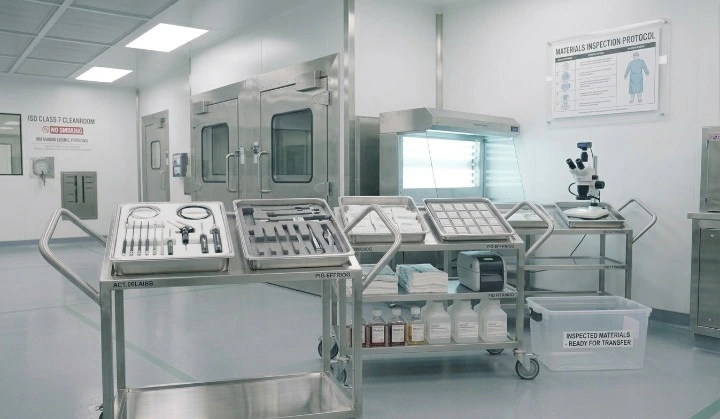
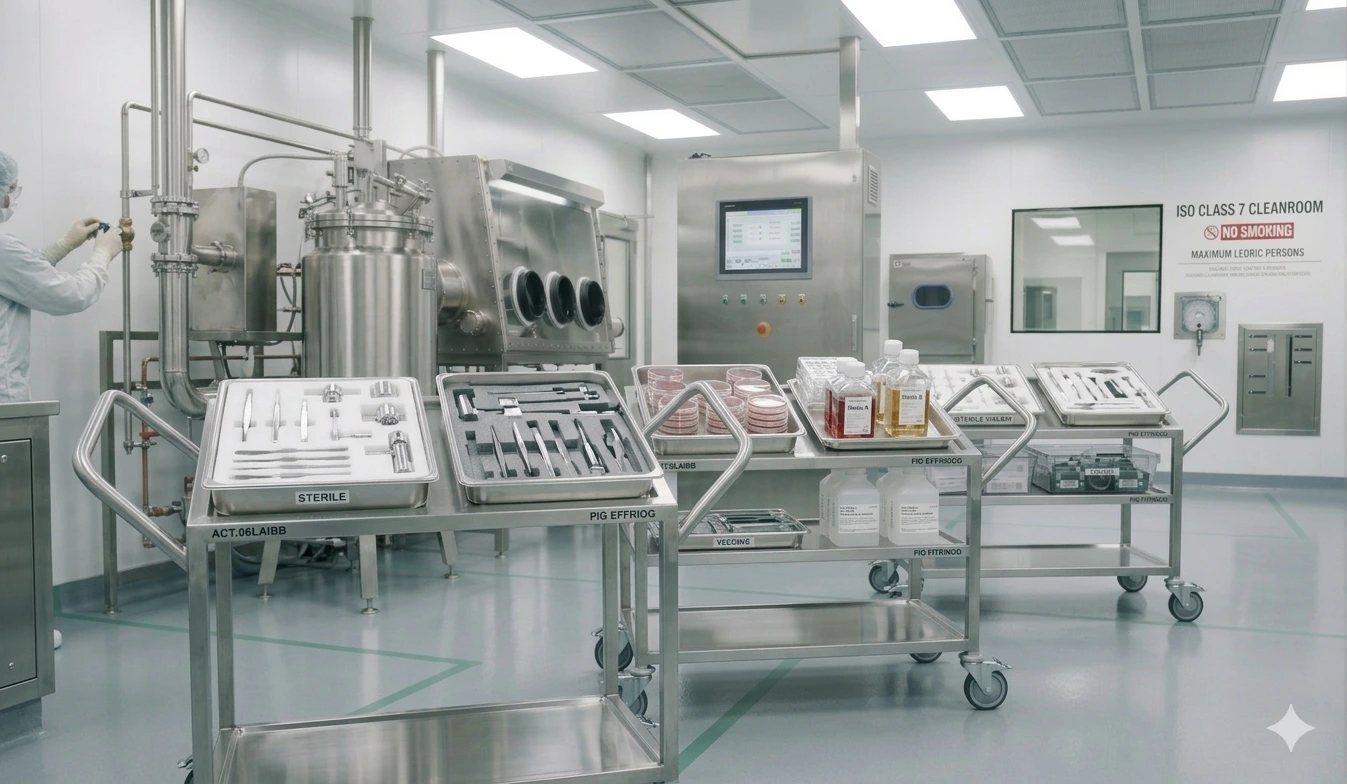
A sensitive analytical instrument or surgical tool placed on a standard trolley is exposed to vibration, sliding risk, and particle contamination from the trolley itself. Metrolabs instrument trolleys eliminate every one of these by purpose-engineering each component for the instrument it will carry.
Three-Sided Guard Rails — The Safety Standard That Prevents Instrument Incidents
An instrument on an unsecured trolley shelf becomes a projectile in the event of a corridor collision — in a pharmaceutical cleanroom, an instrument falling from a trolley shelf creates a GMP incident, a potential breakage of glass or contamination of a primary packaging surface, and a personnel safety hazard. Three-sided guard rails — on the left, right, and rear of the instrument platform and each shelf tier — provide physical containment that prevents any instrument from sliding off the shelf during normal transit, corridor corner turns, and in the event of a low-speed collision with a wall or door frame. The guard rail tubes are SS 316L, with a rounded outer surface that protects the instrument body from contact damage and protects personnel from injury. The rails are removable for instrument loading and unloading via a quarter-turn SS locking mechanism — the rail can be dropped or swung open without tools, allowing the instrument to be placed on the platform from any direction, then the rail is re-engaged to secure the instrument for transit.
Anti-Vibration Platform — Protecting Calibrated Instruments During Transit
High-accuracy laboratory instruments — analytical balances, spectrophotometers, microscopes, calibration references, and portable particle counters — contain precision mechanical, optical, and electronic components that are sensitive to vibration and shock at specific frequency ranges. Transit vibration from cleanroom floor surface irregularities (expansion joints, drain covers, threshold strips between zones) is transmitted directly from the caster wheels through the frame uprights to the shelf platform — and from the shelf platform to the instrument placed on it. The anti-vibration platform interposes a vibration isolation system between the shelf surface and the frame — neoprene compression isolators at each shelf support point, specified to achieve a natural frequency below the critical frequency of the most sensitive instrument carried on the trolley. For an analytical balance (critical frequency typically 5–8 Hz), a 45 Shore A neoprene compound is specified; for optical instruments (critical frequency typically 10–20 Hz), a 60 Shore A compound. The result is that the instrument rides on the trolley at a significantly reduced vibration amplitude compared to the floor vibration input.
Integrated Drawers — Accessories at Point of Use Without Secondary Carts
Every analytical instrument and diagnostic tool requires accessories — spare test cartridges, calibration weights, connection cables, pipette tips, reagent vials, tool sets, user manuals, and cleaning materials — that must be available at the point of instrument use for the measurement workflow to proceed without the operator needing to leave the instrument to retrieve items from a separate storage location. Standard trolleys address this by placing items on a lower shelf — requiring the operator to bend forward to retrieve small items from a flat shelf where they can roll and become difficult to find. Metrolabs instrument trolleys integrate SS 316L drawers with soft-close full-extension slides directly into the trolley body — each drawer pulls fully open to provide complete access to the drawer contents without bending or reaching. The drawer body is SS 316L with a mirror or hairline-polished interior — wipeable with IPA throughout, including the drawer base and sides. The soft-close mechanism prevents the drawer from slamming shut during transit vibration, which would create metallic impact noise and could knock items off the instrument platform.
Argon-Welded Seamless Construction — No Moisture Dead Spots
Standard stainless steel welding uses MIG welding or basic TIG welding in ambient air — a process that creates oxide discolouration (weld spatter and heat tint) on the weld bead and surrounding surface, a surface texture at the joint zone that is significantly rougher than the parent material, and an uneven bead profile with visible underfill or overlap that creates micro-crevices at the joint edge. Metrolabs uses argon-shielded TIG welding — argon gas is used as the shielding medium for the entire weld area (both front and purge-shielding the back of the joint) to prevent atmospheric oxygen from reaching the weld pool. This produces a weld bead that is bright, oxide-free, and metallurgically homogeneous — the same chromium oxide passive layer as the parent material forms over the weld rather than the Fe₂O₃ scale that forms on air-welded stainless. After welding, every joint is ground flush with the surrounding surface and polished to the same finish as the parent material — so the joint is visible as a surface feature but not as a rough edge or crevice.
Four Specialised Instrument Trolley Configurations — Matched to Instrument Type & Workflow
Metrolabs customises instrument trolleys for the specific instrument, ISO class, and operational requirements of every regulated cleanroom sector:
Diagnostic & Analytical Instrument Trolleys — Anti-Vibration Platform Standard
Precision-engineered trolleys for the transport and point-of-use operation of high-accuracy analytical instruments — portable spectrophotometers, analytical balances, pH meters, particle counters, conductivity meters, and calibration references — in pharmaceutical manufacturing suites, QC laboratories, and cleanroom environments where the instrument is routinely moved between use locations. The instrument trolley serves a dual function — a transit platform that protects the instrument during movement, and an operating station that provides a stable, vibration-isolated surface at the point of measurement. The anti-vibration platform provides the stable operating surface — neoprene isolators between the instrument shelf and the frame attenuate the building vibration that reaches the operating position through the floor structure, allowing a portable balance placed on the trolley to provide repeatable weighing results equivalent to a fixed anti-vibration table. Three-sided guard rails secure the instrument during transit and prevent it from being knocked off the platform at the operating position. Integrated lower shelves store reference standards, reagents, and consumables required for the measurement workflow. Available as single-tier instrument platform with lower storage, or double-tier for two instruments.
Surgical Instrument Trolleys — OT & CSSD Grade with Full Autoclavability
High-specification instrument trolleys for operating theatre (OT), CSSD, and surgical instrument handling environments — where the trolley must be sterile before use, not merely clean, and where the design must support the surgical instrument handling workflow from CSSD sterilisation through OT preparation to intra-operative instrument staging. Metrolabs surgical instrument trolleys are fully autoclavable at 134°C / 3 bar — all components including the caster wheel bearings (PEEK-cage rated to 150°C), the drawer slide mechanisms (SS 316L rod-and-bushing rather than ball-bearing slides which retain moisture), and any under-shelf baskets (SS 316L perforated formed sheet) can be processed in the same autoclave cycle as the instruments they carry. The trolley top surface is a mirror-electropolished SS 316L plate — the preparation surface for surgical instrument layout and draping. The top surface has an integral marine-edge perimeter to contain fluid from soaked instrument trays. Three-sided rails fold flat for instrument tray loading (unlike fixed rails which require lifting the tray over the rail). Available in Mayo trolley (single top-tier, adjustable height), instrument preparation trolley (two-tier with drawer), and kick bucket/bowl stand combination configurations.
Electronic & ESD-Protected Instrument Trolleys — Semiconductor & Electronics Grade
Specialist instrument trolleys for the transport and use of electronic test and measurement instruments — oscilloscopes, spectrum analysers, network analysers, probe stations, semiconductor process monitors, and ESD-sensitive calibration equipment — in semiconductor cleanrooms and electronics manufacturing environments where electrostatic discharge (ESD) is both a product damage risk and an equipment reliability concern. The ESD-protected instrument trolley integrates three ESD control mechanisms: an SS 316L grounding chain from the frame lower cross-member to the floor, providing continuous earthing during transit; conductive or static-dissipative caster wheels (10⁵–10⁶ ohm) providing a parallel grounding path through the wheel compound; and a static-dissipative instrument platform surface (10⁵–10⁶ ohm resistivity) that dissipates any charge accumulating on the instrument body before it can discharge to a grounded conductive element. The anti-vibration platform is standard on the ESD trolley — electronic test instruments contain precision optical, RF, and mechanical components that are sensitive to vibration at the same frequency ranges as analytical instruments. Cable management: integrated SS 316L cable routing channels on the frame sides with smooth-bore SS snap guides prevent power and signal cables from dragging on the floor during transit, a common cable damage mechanism that also creates contamination from cables sweeping cleanroom floors.
Clinical & Point-of-Care Instrument Trolleys — Hospital & NABH Compliant
Mobile instrument stations for clinical laboratory environments — hospital pathology laboratories, clinical chemistry and haematology suites, blood bank facilities, and point-of-care testing stations — where the trolley carries analyser instruments (haematology analysers, blood gas analysers, coagulation analysers), sample processing equipment (centrifuges, vortex mixers), and clinical diagnostic tools between patient care areas and the laboratory. Clinical instrument trolleys have a different contamination risk profile from pharmaceutical manufacturing trolleys — the primary contamination risk is biological (blood and body fluid spill from failed sample containers or instrument waste lines) rather than particulate, requiring a construction that facilitates thorough decontamination with hospital-grade biocidal disinfectants (chlorine-based, QAC-based, and hypochlorite solutions) in addition to standard IPA. Metrolabs clinical instrument trolleys use SS 316L throughout with an electropolished finish — the same surface standard used in pharmaceutical cleanrooms — because hospital-grade chlorine disinfectants are aggressively corrosive to SS 304 but are within the corrosion resistance range of SS 316L. A liquid-tight lipped tray at the base of the trolley captures any biological spill before it reaches the hospital floor. The push-handle design is engineered for one-handed operation — clinical staff frequently transport the trolley while carrying a sample rack, a patient chart, or a PPE component in the other hand.
Six Engineering Features That Define Every Metrolabs Instrument Trolley
Every Metrolabs cleanroom instrument trolley is built to these standards — making it a precision-engineered instrument handling system rather than a stainless steel shelf on wheels:
Argon-Welded Seamless — No Moisture or Contaminant Harbours
Argon-shielded TIG welding — with argon purge gas protecting both the front and back of every weld joint — produces a bright, oxide-free weld bead with the same passive chromium oxide layer as the parent SS 316L material. Every joint is then ground flush with the surrounding surface and polished to match the parent material finish, eliminating the rough, porous surface texture at the joint zone that air-welded stainless creates. The result is a trolley body with no crevices, no rough edges, and no surface discontinuities — every surface is as smooth and wipeable as the parent material. Standard argon-welded joints are tested by visual inspection and liquid penetrant dye testing before dispatch, confirming complete fusion with no micro-porosity.
Brushed or Mirror EP Finish — Maximum Decontamination Ease
Metrolabs offers two surface finish options for instrument trolleys: a high-quality brushed finish (Ra 0.4–0.8μm, produced by directional abrasive finishing with consistent grain direction throughout the unit — all surfaces wiped in the same direction as the grain for maximum cleaning effectiveness); and an electropolished mirror finish (Ra <0.2μm, for Grade A/B pharmaceutical applications and ISO Class 3–5 semiconductor environments). The brushed finish is specified for hospital and clinical environments where the primary concern is resistance to harsh chemical disinfectants rather than sub-micron surface smoothness — the directional grain provides a surface that is easy to inspect visually for residue and easy to wipe in a single direction. The mirror EP finish is specified for environments where the contamination standard requires the sub-micron surface smoothness that prevents bacterial adhesion and provides a visual reference for contamination identification. Both finishes are available on the same trolley frame — EP finish on the instrument platform and shelf surfaces, brushed finish on the frame tubes.
Medical-Grade Silent Casters — Noise-Dampening Non-Marking
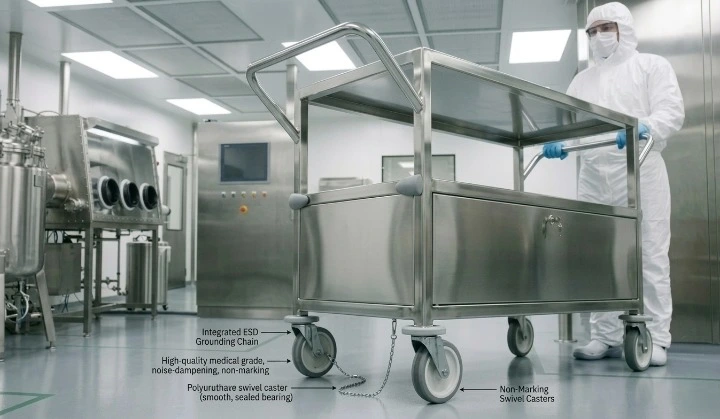
Metrolabs instrument trolleys use synthetic noise-dampening medical-grade swivel casters — PU or TPU wheel compound (not black rubber — non-marking on all hospital and cleanroom floor coatings) with a sealed precision ball-bearing swivel mechanism and a polyamide or SS 316L wheel bracket. The noise-dampening compound specification is selected to minimise the sound transmission from the wheel-to-floor contact zone, reducing the transit noise contribution from the trolley casters to below 40 dB(A) at 1 m/s — inaudible in a clinical environment over ambient ventilation noise. Non-shedding: the PU/TPU compound has been tested to confirm zero visible particle shedding on vinyl, epoxy, and polished concrete cleanroom and hospital floor coatings under 500+ km of simulated transit. Casters are compatible with steam sterilisation (for autoclavable surgical trolley configurations) and with floor cleaning machine passage.
Bumper Protection — Protecting Trolley & Cleanroom Walls
Instrument trolleys in corridor transit face a predictable mechanical hazard — the rear of the trolley (the push-handle end) is the last part visible to the operator during a corridor corner turn, and frequent low-speed contact between the trolley rear and cleanroom panel walls, door frames, and pass-through chamber edges occurs in normal operation. Standard trolley corners (a right-angle SS tube end) can gouge and dent cleanroom panel surfaces, requiring costly panel repair, and the trolley itself suffers deformation at the frame corner that creates a surface discontinuity. Metrolabs fits injection-moulded or machined polyoxymethylene (POM) or polyurethane bumper guards at each lower frame corner — a rounded-profile impact absorber that distributes the contact force across a large area, preventing both panel damage and trolley deformation. The bumper material is specified to be non-shedding (no visible particle generation under impact loading), non-marking (white or natural-colour compound that does not leave rubber marks on panel surfaces), and chemically resistant to standard cleanroom disinfectants.
ESD Safety — Anti-Static Grounding Chain or Conductive Wheels
Metrolabs instruments trolleys integrate ESD protection to prevent electrostatic discharge from damaging sensitive electronic instruments or igniting volatile chemical vapours in environments where both risks are present. Two ESD control mechanisms are standard: an anti-static grounding chain — a woven SS 316L chain attached to the frame lower cross-member and hanging to floor-contact level, providing a continuous conductive path from the trolley frame to the cleanroom floor ground throughout transit; and conductive or static-dissipative caster wheels (10⁵–10⁶ ohm surface resistivity) providing a parallel conductive path through the wheel compound to the flooring. The trolley frame is manufactured from non-magnetic SS 316L, which is itself an effective conductor at the charge dissipation rates required for ESD protection. For semiconductor environments, the instrument platform surface is specified with a surface resistivity of 10⁵–10⁶ ohm — dissipating charge slowly enough to prevent fast-rise-time ESD events but quickly enough to prevent static accumulation above the threshold that causes wafer damage.
Ergonomic Handling — Lightweight Robust for Full PPE Operation
Instrument trolleys are manoeuvred by personnel wearing full cleanroom PPE — multiple glove layers, overboots, coverall, hood, and face mask — in environments where gowning constraints reduce grip strength, tactile sensitivity, and peripheral vision. A trolley that requires significant pushing force or has a handle at an uncomfortable height creates operator fatigue and the GMP deviations that arise from it. Metrolabs specifies a starting force below 8N and rolling force below 4N for a fully loaded 100kg instrument trolley — lower than the material transfer cart specification because instrument trolleys carry lower loads but require more precise manoeuvring around instrument workstations and into narrow zone access doors. The ergonomic push-handle is designed for one- or two-handed operation, with an oval-section SS 316L tube (28mm outer diameter — smaller than the material transfer cart handle for instrument trolley precision manoeuvring) positioned at a height customised for the operating PPE stack and the cleanroom door width.
Metrolabs Instrument Trolley — Technical Standards
Every Metrolabs instrument trolley is fabricated, finished, and documented to these technical parameters:
| Feature | Metrolabs Standard | Instrument Protection Benefit |
|---|---|---|
| Material (Grade A/OT) | SS 316L — argon-welded EP | Autoclavable — mirror inspectable |
| Material (Grade C–8)✓ | SS 304 argon-welded — brushed | IPA / QAC / PAA compatible |
| Welding | Argon-shielded TIG — ground flush | No moisture dead spots — no crevices |
| Guard Rails | Three-sided — removable quarter-turn | Instrument containment during transit |
| Anti-Vibration | Neoprene platform isolators — 45/60 Shore A | Instrument protected from floor vibration |
| Drawers | SS 316L — soft-close full-extension | Accessories at point of use — no slamming |
| Casters | Medical-grade PU — noise-dampening | Non-marking — non-shedding — silent |
| ESD | SS chain + conductive casters | Static discharge eliminated throughout |
Instrument Trolleys Across Every Sterile Zone and Regulated Sector
ISO-compliant mobile instrument stations for pharmaceutical, clinical, semiconductor, and research environments:
Pharmaceutical GMP
SS 316L EP instrument trolleys for QC laboratory and production suite analytical instruments. Anti-vibration platform for portable balances and spectrophotometers. Full GMP IQ documentation at handover.
Hospital & OT
Fully autoclavable surgical instrument trolleys — Mayo trolleys, instrument preparation trolleys, and bowl stands. Mirror EP surface. NABH compliant. One-handed handle for clinical staff use.
Semiconductor Fabs
ESD-protected instrument trolleys for electronic test and measurement equipment in ISO Class 3–5 fabs. 10⁵–10⁶ Ω conductive platform. SS grounding chain. Cable management channels standard.
Biotech & ATMP
SS 316L EP instrument trolleys in ATMP GMP suites. Anti-vibration platform for analytical instruments. Three-sided guard rails for bioreactor monitoring instruments. VHP and autoclave compatible.
Clinical Pathology
SS 316L chlorine-resistant instrument trolleys for hospital pathology labs. Liquid-tight base tray for biological spill containment. One-handed push-handle. NABH compliant. Hypochlorite wipe-down safe.
Electronics Cleanrooms
ESD-protected trolleys for test and measurement instrument transport. Non-magnetic SS frame. Conductive casters and grounding chain. Anti-vibration platform for optical and electronic instruments.
NABL Research Labs
SS 304 or SS 316L instrument trolleys for NABL-accredited testing labs. Anti-vibration platform for analytical balances and spectrophotometers. Integrated drawers for accessories. Passivation certification supplied.
Food & Beverage QC
SS 316L instrument trolleys for FSSAI food quality control labs — portable analyser transport, in-line sampling equipment staging, and QC instrument transit to production floor test points.
Turnkey Cleanroom Solutions — Design, Manufacture, Supply & Install
Metrolabs provides end-to-end solutions for instrument trolleys — from initial design consultation through manufacturing, delivery, installation, and GMP documentation:
Turnkey Solutions — Design Consultation to Final Installation
Metrolabs manages the complete lifecycle of your instrument trolley — from the initial design consultation (confirming instrument dimensions, weight, sensitivity, ISO class, and workflow) through detailed engineering drawing review and sign-off, precision fabrication, quality inspection, delivery, installation, and IQ documentation. The design consultation includes a recommendation on the appropriate vibration isolation specification based on the specific instruments to be carried — a recommendation that no standard catalogue trolley can provide.
Compliance Ready — ISO Class 3 Through Class 8
Metrolabs instrument trolleys are designed to support ISO Class 3 through ISO Class 8 environments — the full range of cleanroom classifications from ultra-clean semiconductor manufacturing to standard pharmaceutical manufacturing. The base SS 316L argon-welded trolley satisfies ISO Class 6–8 requirements; adding mirror electropolishing, ESD grounding, and vibration-isolated platforms elevates it to ISO Class 3–5 specification. ASTM A967 passivation certification and SS MTCs are supplied with every trolley for inclusion in the facility IQ documentation.
Ergonomic Handling — Lightweight Yet Robust
Metrolabs designs instrument trolleys for lightweight robustness — specifying the minimum frame section and shelf thickness that provides the required structural rigidity and load capacity, while minimising the trolley mass that must be accelerated and decelerated by the operating personnel in full PPE. A 100kg-capacity instrument trolley is designed to weigh below 25kg empty — allowing one person to manoeuvre it safely. Starting force is below 8N and rolling force below 4N at full rated load on a flat epoxy cleanroom floor, confirmed at trolley handover.
Chemical Resistance — Long Service Life in Disinfectant Environments
Metrolabs instrument trolleys are tested against common laboratory and hospital disinfectants — 70% IPA, 1000 ppm hypochlorite, 0.5% PAA, standard QAC solutions, and VHP at 1000 ppm — confirming that surface finish, frame material, drawer slides, guard rail hardware, and bumper material all maintain their physical and chemical properties after 500 decontamination cycles. Chemical resistance certification is available for inclusion in the facility validation documentation.
Metrolabs vs Standard Instrument Trolleys
From Design Consultation to Installed & IQ-Documented Instrument Trolley
Metrolabs manages the complete instrument trolley supply process — from design consultation through custom fabrication, delivery, and full IQ documentation:
Design Consultation & Spec
Instruments to be carried (dimensions, weight, sensitivity), ISO class, sterilisation requirements (IPA/autoclave/VHP), ESD requirement, guard rail type (fixed/removable), drawer count, bumper requirement, and surface finish confirmed. Vibration isolation specification matched to the most sensitive instrument. Custom dimensioned drawing produced and signed off.
Precision Fabrication
Frame argon-welded. All joints ground flush. Guard rails fabricated and fitted. Anti-vibration platform assembled with neoprene isolators. Drawers fabricated with soft-close SS slides. Bumper guards fitted. Casters installed. ESD grounding chain attached. EP or brushed finish applied. ASTM A967 passivation performed. Dye-test and load test completed. MTCs issued.
Commissioning & Testing
Trolley delivered degreased and passivated. Guard rail quarter-turn function tested. Drawer soft-close verified. Anti-vibration isolator natural frequency confirmed. ESD resistance measured and documented. Push force measured (<8N start, <4N rolling, rated load). Caster brake tested. For autoclavable: first autoclave cycle certificate issued.
IQ Documentation Package
Dimensions, MTCs, ASTM A967 passivation cert, anti-vibration specification, ESD resistance test record, push-force test record, load test record, guard rail test record, autoclave cert (if applicable), chemical resistance cert, and delivery photos compiled for GMP facility validation submission.
Instrument Trolleys Compliant Across Every Major Regulated Standard
WHO GMP & EU Annex 1
WHO GMP and EU Annex 1 require all cleanroom mobile equipment to be smooth, non-porous, non-shedding, and compatible with decontamination. Argon-welded SS 316L trolleys with seamless joints, non-marking casters, and VHP-compatible construction satisfy all WHO GMP and EU Annex 1 mobile equipment requirements for pharmaceutical grades A through D.
WHO GMP · EU Annex 1NABH — Hospital Standards
NABH hospital accreditation requires OT and pharmacy mobile equipment to be smooth, non-porous, and compatible with hospital-grade disinfection. Metrolabs SS 316L instrument trolleys with autoclavable configurations, mirror EP surfaces, and chlorine-resistant construction satisfy all NABH requirements for hospital OT and clinical laboratory environments.
NABH · OT GradeIEC 61340-5 ESD
IEC 61340-5 specifies ESD protection requirements for cleanroom equipment in electronics manufacturing. Metrolabs conductive casters (10⁵–10⁶ ohm) and SS grounding chains satisfy IEC 61340-5-1 for semiconductor instrument trolleys in Class 3–5 environments. Non-magnetic SS 316L frame construction is confirmed at manufacturing.
IEC 61340‑5 ESDISO 14644-4 & 21 CFR
ISO 14644-4 requires cleanroom equipment to be compatible with decontamination methods and not generate particles during normal use. Metrolabs argon-welded, seamless-joint, non-shedding instrument trolleys satisfy ISO 14644-4 for all class 3–8 applications. ASTM A967 passivation and MTC certificates satisfy US-FDA 21 CFR pharmaceutical equipment documentation requirements.
ISO 14644‑4 · ASTM A967 · 21 CFRFactory & Office
4, SIDCO-MICRO, Thirumudivakkam,
Chennai – 600 132, Tamil Nadu
🗺 Open in Google Maps ↗
Phone
Website & GSTN
www.metrolabs.biz
www.schoollabfurniture.com
GSTN: 33AASFM3382K1ZT
Ready to Equip Your Cleanroom with High-Performance Instrument Trolleys?
Contact Metrolabs for a free design consultation. Our specialists will assess your instrument types, weights, ISO class, and workflow requirements — then design, manufacture, supply, install, and document your instrument trolleys with full IQ documentation at delivery.
🔋 Request a Free Instrument Trolley Quote
Quote Request Received!
Our cleanroom instrument trolley team will contact you within 24 working hours.
Immediate: 9840931231