
Cleanroom Material Transfer Carts — Contamination-Free Transport Across Every Sterile Zone
Cleanroom material handling demands a specialised approach where minimising particulate generation is the primary goal. Metrolabs material transfer carts are engineered specifically to prevent contamination in pharmaceutical, semiconductor, and biotech facilities — built with non-shedding materials, electropolished mirror finishes, sealed bearings, and easy-clean geometries that meet ISO standards from Class 8 down to the most demanding ISO Class 3 ultra-clean environments.
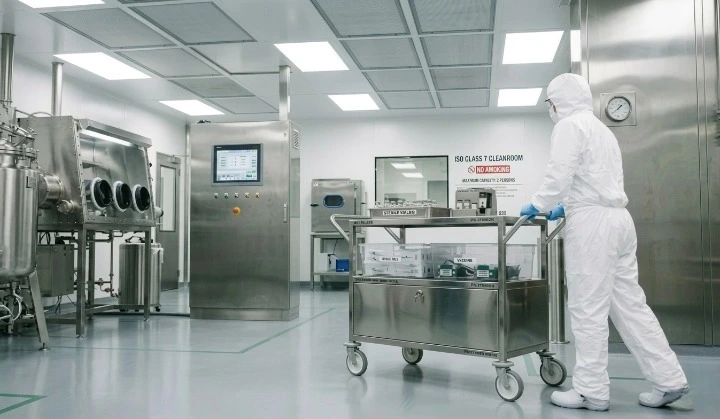
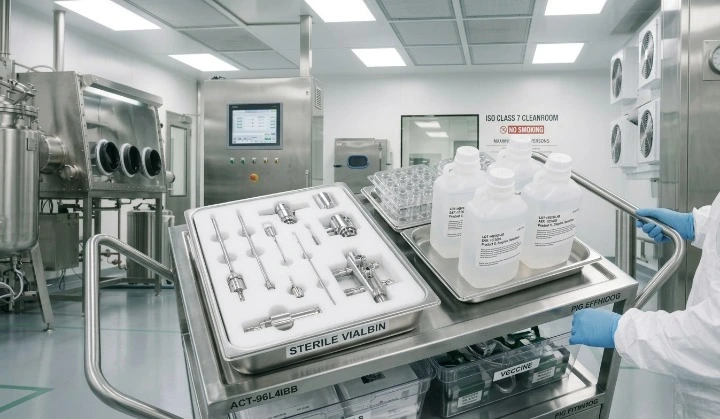
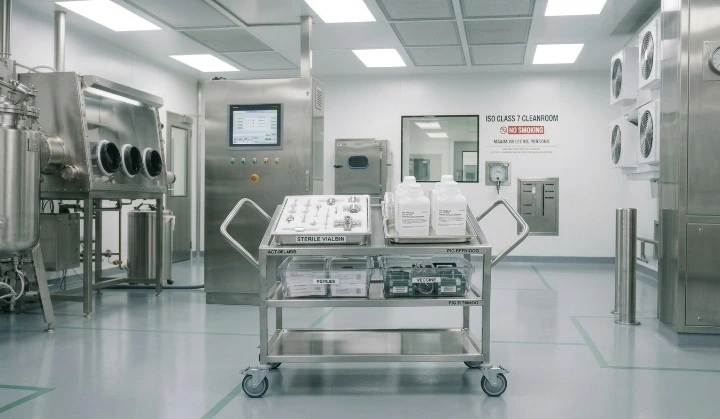
Why Material Transfer Carts Require Cleanroom-Specific Engineering Across Every Component
A material transfer cart contacts the floor, air, personnel gloves, and stored materials during every trip — making it a mobile contamination vector unless every material and design choice is made specifically for the controlled environment.
Electropolished Finish — The Surface Standard That Prevents Bacterial Colonisation
Standard stainless steel has an Ra of 0.8–1.6μm — smooth to the eye but containing microscopic valleys that provide physical anchoring sites for bacteria and spores. Once a micro-organism anchors in a surface crevice it is protected from standard wiping disinfection — the cloth passes over without contacting the organism inside. Metrolabs carts are electropolished to Ra <0.2μm — an eight-fold improvement that removes the microscopic features to which biofilm anchors. At Ra <0.2μm organisms that contact the surface cannot anchor before the IPA wipe removes them. This is the same surface standard as pharmaceutical Grade A/B workbench tops — now applied to the mobile equipment transiting between grades. The mirror-bright surface also makes contamination immediately visible, supporting the visual inspection-based cleaning verification that GMP SOPs require.
Sealed Bearings — Preventing Lubricant Outgassing in the Cleanroom Atmosphere
Conventional caster bearings are lubricated with petroleum-based grease — a lubricant that slowly outgasses volatile organic compounds (VOCs) at room temperature. In a cleanroom, particularly a semiconductor fab or pharmaceutical aseptic suite, the VOC contribution from multiple cart bearings accumulates to a measurable level. Silicone VOCs from grease can deposit on semiconductor wafer surfaces, and petroleum-based VOCs can interfere with biological assays at concentrations below human detection threshold. Metrolabs carts use sealed bearings with pharmaceutical-grade grease fully encapsulated by the bearing seal — the lubricant cannot migrate to the bearing exterior, and the VOC outgassing rate from the sealed system is below the detection limit of standard TOC testing in cleanroom air.
ESD Protection — Eliminating Static Discharge During Material Handling
ESD is a contamination and safety hazard in multiple cleanroom sectors simultaneously — in semiconductor manufacturing a discharge can destroy circuit patterns on dozens of wafers; in pharmaceutical manufacturing static charges attract airborne particles to the cart surface; in a laboratory handling volatile solvents a static discharge from an insulating cart is a fire ignition risk. Metrolabs integrates ESD protection through two mechanisms: a woven SS grounding chain providing a continuous conductive path that drains charge to earth; and conductive casters (surface resistivity 10⁵–10⁶ Ω) providing a parallel conductive path through the wheel compound to the cleanroom flooring. ESD resistance is measured and documented at cart handover and included in the IQ documentation package.
Spring-Damped Casters — Protecting Biological Samples and Microelectronics in Transit
When a cart crosses a floor expansion joint, zone threshold, or drain cover, the leading wheels experience a sharp vertical displacement — a shock impulse transmitted directly to stored items. For cell culture flasks (where shock can detach adherent cell layers), crystallisation experiments (where shock seeds premature crystal formation), or microelectronic components (where shock fractures wire bonds), this transit shock is a GMP-relevant event. Spring-damped casters — a standard swivel caster with a calibrated coil spring plus a damping washer between the swivel mount and wheel axle — absorb the vertical impulse at the wheel before it propagates to the frame, attenuating shock amplitude to below the threshold that affects sensitive biological and electronic materials.
Four Application-Specific Cart Configurations — Matched to Material Type & ISO Class
Metrolabs customises material transfer carts for the specific material sensitivity, ISO class, and handling requirements of every regulated sector:
Gowning Carts — Organised PPE Storage at the Cleanroom Entry Point
Dedicated carts for the organised storage and distribution of cleanroom garments — frocks, coveralls, masks, bouffant caps, boot covers, and gloves — at the gowning room entry point. The gowning cart is configured with individual compartments arranged in the gowning sequence order from bottom to top. Each compartment holds one specific PPE item type for one shift quantity, eliminating the need for the operator to handle multiple garments to find the correct item. A flush-face name plate holder at each compartment identifies contents without adhesive labels that could delaminate and shed into the gowning environment. The top tier provides a mirror-polished SS 316L shelf for staging items during the gowning sequence. The cart body is SS 316L with electropolished interior surfaces — all compartment interiors can be spray-wiped with IPA or QAC without garments absorbing disinfectant residue from surface micro-crevices, because the EP finish has no such features. Spring-damped casters prevent garment disturbance from floor vibration during transit from laundry to gowning area.
Vial & Tray Carts — Multi-Tiered Delicate Pharmaceutical Glass Transport
Specialist carts for the safe transport of pharmaceutical vials, ampoules, syringes, cartridges, and filled primary packaging containers — the most fragile and highest-value items transported within pharmaceutical manufacturing suites. Standard shelves allow vials to slide and contact each other during transit — vial-to-vial contact is a breakage risk for glass and a surface contamination risk for all primary packaging. Metrolabs vial and tray carts incorporate moulded PTFE or silicone tray inserts (removable, autoclavable, VHP compatible) that hold vials in individual pockets preventing contact between adjacent units, with pocket spacing matched to standard pharmaceutical tray dimensions for the specific vial size. Lipped marine-edge shelf perimeters (20mm) contain the tray against lateral movement during transit. Spring-damped casters attenuate floor shock during zone threshold crossings and floor joins. For Grade A/B zone entry: fully autoclavable configuration with PEEK-cage bearings (150°C) and PTFE seals.
Wafer Pod Carts — Vibration-Dampened Semiconductor FOUP Transport
Highly specialised carts for the transport of Front Opening Unified Pod (FOUP) and Front Opening Shipping Box (FOSB) wafer carriers in semiconductor manufacturing cleanrooms — ISO Class 3–5 environments where wafer pods contain 300mm silicon wafers at the 7nm node and below, where a single vibration event above approximately 0.5g can cause wire bond fracture or photoresist pattern distortion. The wafer pod cart satisfies three simultaneous requirements: dimensional compatibility with FOUP kinematic coupling pins — precision-machined SS 316L kinematic coupling inserts in the shelf surface that mate with the three FOUP base kinematic pins, positively locating each FOUP and preventing lateral movement during transit; ESD control — all cart surfaces in contact with the FOUP at 10⁵–10⁶ Ω surface resistivity, continuously grounded through conductive casters and SS grounding chain; and vibration control — multi-stage isolation combining spring-damped casters and viscoelastic damping pads under each FOUP kinematic insert, providing >20 dB vibration attenuation above 10 Hz.
Chemical Transport Carts — Liquid-Tight Lipped Shelves & Base Sump
Rugged carts for the safe transit of reagent bottles, solvent containers, acid and base solutions, and bulk chemical intermediates within cleanroom and controlled-access chemical handling areas. Chemical transport differs from general material transit in one critical dimension: the consequence of a container failure is not particle contamination but chemical contamination — a reagent spill during transit contaminates the cleanroom floor, damages adjacent items, and creates a personnel safety hazard. Metrolabs chemical transport carts incorporate a marine-edge liquid-tight sump tray at the cart base — a pressed SS 316L tray with a continuous welded perimeter forming a liquid-tight basin that captures the contents of any single failed container without liquid reaching the cleanroom floor. The sump volume is specified at a minimum of 110% of the largest single container volume on the cart. Individual shelf lipped perimeters (20mm — higher than the standard 8mm marine edge) provide secondary containment at each shelf level. ESD grounding is standard — flammable solvent transport carts are continuously earthed through the grounding chain, meeting COSHH requirements for portable chemical handling equipment.
Six Precision Engineering Features of Every Metrolabs Material Transfer Cart
Every Metrolabs cart is built to these standards — making it a genuine contamination control component rather than a commercial cart placed in a cleanroom:
SS 316L Electropolished — Ra <0.2μm Mirror Finish
Electropolishing removes 20–40 microns of metal from the SS 316L surface through electrochemical dissolution, selectively removing surface protrusions — peaks, burrs, tool marks, inclusions — to produce Ra <0.2μm, smoother than a typical machined bearing surface. The process also chrome-enriches the surface layer, leaving a chromium oxide passive film more corrosion-resistant than the non-EP substrate. The mirror-bright surface makes contamination immediately visible — smudge marks, fingerprints, and residue are apparent under gowning room lighting, supporting visual inspection-based cleaning verification required by pharmaceutical GMP SOPs. For semiconductor applications, the EP surface eliminates all features that could trap and then release particles onto wafer surfaces during transport.
Perforated Shelving — Vertical Laminar Flow Through the Cart
Metrolabs carts use ∅25mm / 45mm pitch perforated SS 316L shelves — approximately 30% open area allowing the cleanroom’s HEPA-filtered vertical laminar air to continue flowing through the cart shelving. Items on a perforated-shelf cart receive continuous HEPA-quality airflow during both transit and when the cart is parked — preventing particle accumulation that solid shelving creates in stagnant air pockets below the shelf. For applications where liquid containment is required, lipped shelves combine a raised perimeter bead with a perforated field interior — the containment function of the lip with the airflow function of the perforation pattern. Shelves are fully removable via the smooth-bore peg adjustment system — the shelf can be extracted and autoclaved or VHP-treated in the same cycle as the materials it transports.
ESD Grounding — Integrated Chain & Conductive Casters
Metrolabs integrates ESD grounding as a designed feature across the complete cart assembly. The SS 316L grounding chain attaches to a permanent fixing point on the lower frame cross-member, maintaining a conductive path to the cleanroom floor ground throughout transit. Conductive casters (10⁵–10⁶ Ω surface resistivity) provide a parallel conductive path from the frame through the wheel compound to the flooring, ensuring that a single-path failure does not interrupt grounding. The ESD system is tested at cart handover with a measured resistance confirmation below 10⁶ Ω from frame top to floor ground — the test record included in the IQ documentation package.
Spring-Damped Sealed-Bearing Casters — Silent Non-Shedding Transit
Cart casters combine three performance requirements: vibration isolation (spring-damped mechanism rated for cleanroom floor shock frequency spectrum), non-marking performance (PU/TPU compound — not black rubber — leaving no marks on specialised cleanroom flooring coatings), and sealed-bearing construction (pharmaceutical-grade grease fully encapsulated — zero outgassing, zero lubricant migration to wheel surface or floor contact zone). The spring mechanism uses a calibrated coil spring with a damping washer that prevents the spring from oscillating after the impulse, avoiding the repeated bouncing an undamped spring creates. Transit noise is below 40 dB(A) at 1 m/s — the quietest caster specification available for cleanroom mobile equipment.
Ergonomic Effortless Gliding — Designed for Full PPE Operation
Cleanroom carts are operated by personnel wearing multiple PPE layers — two pairs of gloves, overboots, coverall, hood, goggles, and face mask — in an environment where gowning constraints restrict movement, reduce grip sensitivity, and limit peripheral vision. A cart requiring significant pushing force creates operator fatigue leading to the shortcuts that are the most common sources of GMP deviations. Metrolabs carts are designed for starting force below 10N and rolling force below 5N for a 200kg loaded cart on a flat epoxy cleanroom floor — achieved through the combination of 125/150mm PU casters (large diameter, low rolling resistance), precision ball-bearing swivels (minimum turning resistance), and a stiff frame that prevents rack-and-caster binding. The ergonomic push-bar height is customised for the operating PPE stack height — typically 100mm higher than standard to account for overboot and coverall leg bulk.
Modular Versatility — ISO Class 3–8 Scalable, Adjustable Shelves
Metrolabs carts are designed for modular reconfigurability — adjustable shelf heights on a 25mm pitch peg system allow rapid reconfiguration for different container heights and material types without modifying the cart structure. The same cart configured with two 400mm clear-height tiers for 25-litre carboys can be reconfigured in minutes to four 150mm clear-height tiers for vial trays. ISO class scalability: the base SS 316L passivated cart satisfies ISO Class 6–8 requirements; adding electropolishing, ESD grounding, and FOUP kinematic inserts elevates it to ISO Class 3–5 semiconductor specification; adding autoclavable casters and VHP-compatible seals satisfies pharmaceutical Grade A/B. Cart accessories are interchangeable between carts of the same frame width, allowing a standard cart inventory to be configured per production schedule.
Metrolabs Material Transfer Cart — Technical Standards
Every Metrolabs cart is fabricated, finished, and documented to these technical parameters:
| Feature | Metrolabs Standard | ISO / GMP Benefit |
|---|---|---|
| Grade A–5 Material | SS 316L — EP Ra <0.2μm | Biofilm-inhibiting — mirror inspectable |
| Grade C–8 Material✓ | SS 304 passivated — Ra <0.8μm | IPA / QAC / PAA compatible |
| Surface Finish | Electropolished mirror — Ra <0.2μm | Bacterial adhesion prevented |
| Shelf Type | Perforated ∅25mm or lipped 8–20mm | Airflow continuity or liquid containment |
| Caster Type | Spring-damped PU — sealed bearings | Sample protection — zero outgassing |
| ESD Grounding | SS chain + conductive casters | Static discharge eliminated — wafer safe |
| ISO Compatibility | Class 3–8 (basic to ultra-clean) | Single supplier for all cleanroom grades |
| Ergonomic Force | <10N start / <5N rolling (200kg) | Full PPE operable — no fatigue deviation |
Material Transfer Carts Across Every ISO Class and Regulated Sector
From ISO Class 8 basic cleanrooms to ISO Class 3 ultra-clean semiconductor fabs — contamination-free material handling for every controlled environment:
Pharmaceutical GMP
SS 316L EP carts for raw material to production transit, vial tray carts for aseptic filling lines, gowning carts at Grade B anteroom entry. VHP compatible. Full GMP IQ documentation at handover.
Semiconductor Fabs
FOUP/FOSB wafer pod carts with kinematic coupling and ESD grounding for ISO Class 3–5 fabs. Spring + viscoelastic isolation >20 dB attenuation above 10 Hz. Conductive casters throughout.
Biotech & ATMP
SS 316L EP carts for cell therapy GMP suites — media and reagent transit, vial tray carts for ATMP filling, spring-damped carts for biological sample and bioreactor accessory transport.
Aseptic Manufacturing
Autoclavable vial and tray carts with PTFE tray inserts for aseptic filling line component transit. Gowning carts for Grade B anteroom PPE management. ESD grounding for IPA handling.
Hospital & CSSD
SS 316L EP carts for hospital CSSD and OT material handling. Gowning carts for theatre PPE staging. Vial and specimen transport with spring damping. NABH compliant documentation.
Chemical Handling
Chemical transport carts with 20mm lipped shelves and base sump for reagent and solvent distribution. ESD grounding for flammable solvent safety. COSHH compliant throughout.
Food & Beverage
SS 316L EP carts for FSSAI high-care food production ingredient and packaging transit. Non-marking casters for specialised production flooring. IPA wipe-down compatible throughout.
NABL Research Labs
SS 304 passivated carts for NABL-accredited labs — reagent and sample transit, spring-damped for analytical equipment transport. Passivation certification supplied.
ISO Class-Scalable Design, Sterilisation Readiness & Audit-Ready Documentation
Metrolabs focuses on precision fabrication and modular design to ensure your material transfer carts meet the compliance standard of every zone they visit:
ISO Class Scalability — One Supplier for Class 8 to Class 3
Metrolabs designs carts with a scalable specification — the base SS 316L passivated cart satisfies ISO Class 6–8; adding electropolishing, ESD grounding, autoclavable casters, and kinematic FOUP inserts elevates the same frame to ISO Class 3–5 semiconductor specification. A facility operating across multiple ISO classes maintains a single cart standard with different accessory configurations rather than procuring from multiple vendors at different quality levels.
Sterilisation-Ready — IPA, Autoclave, and VHP Compatible
Every material specification in Metrolabs carts is selected for compatibility with the full decontamination method range — 70% IPA wipe-down, 0.5% PAA spray, autoclave 134°C / 3 bar (PEEK bearings + PTFE seals), and VHP 1000 ppm. The same cart IPA-wiped at every zone transit can be autoclaved before Grade A entry and VHP-treated during room decontamination cycles without any component degradation.
Non-Shedding Throughout — Degreased & Passivated at Dispatch
Every Metrolabs cart is IPA-degreased and ASTM A967 citric acid passivated before packaging and dispatch — ready for immediate cleanroom entry without additional cleaning. Material test certificates (MTCs), passivation certificates, ESD resistance measurement records, and autoclave cycle certification (if applicable) are supplied at handover for direct inclusion in the facility IQ documentation.
Ergonomic Low-Force Design — Reducing GMP Deviation Risk from Operator Fatigue
Starting force below 10N and rolling force below 5N for a 200kg loaded cart are verified at cart handover and documented in the IQ package. This eliminates operator fatigue that causes GMP deviations — a cart that is easy to manoeuvre in full PPE throughout a full shift is a cart that personnel use correctly, without the shortcuts that arise when physical difficulty meets a time constraint.
Cleanroom Transfer Cart vs Standard Industrial Cart
From Material Assessment to Commissioned & IQ-Documented Transfer Cart
Metrolabs manages the complete cart supply process — from material and zone assessment through fabrication, commissioning, and IQ documentation:
Material & Zone Assessment
Materials transported (type, fragility, ESD sensitivity), ISO classes of all zones transited, floor coating type, sterilisation requirements (IPA/autoclave/VHP), ESD grounding requirement, and shelf configuration confirmed. Cart specification and dimensioned drawing produced and signed off.
Fabrication & Electropolishing
Frame TIG welded. Tube ends cap-welded. Shelves laser-cut. Push-bar welded seamlessly. Caster brackets welded. EP / ASTM A967 passivation to Ra <0.2μm. Sealed bearings installed. ESD grounding chain fitted. Load test and brake test performed. ESD resistance measured. MTCs issued.
Commissioning & Testing
Cart delivered degreased and passivated. ESD resistance verified (<10⁶ Ω frame-to-floor). Push force measured (<10N start, <5N rolling, 200kg loaded). Spring damping function verified. Shelf load test confirmed. For autoclavable carts: first autoclave cycle certificate issued. Floor marking test confirmed.
IQ Documentation Package
Dimensions, MTCs, ASTM A967 passivation cert, EP surface roughness record, ESD resistance test record, push-force test record, load test record, autoclave cert (if applicable), and delivery photos compiled as cart IQ documentation for GMP/ISO facility qualification submission.
Material Transfer Carts Compliant Across Every Regulated Cleanroom Standard
ISO 14644-4 Class 3–8
ISO 14644-4 requires cleanroom mobile equipment to be compatible with decontamination methods and not generate particles during normal use. Metrolabs EP, TIG-welded, passivated carts with sealed bearings and non-shedding casters satisfy ISO 14644-4 requirements across all ISO classes 3–8. Perforated shelves address ISO 14644-4 airflow design requirements directly.
ISO 14644‑4 Class 3–8IEC 61340-5 ESD
IEC 61340-5 specifies ESD protection requirements for cleanroom equipment in electronics manufacturing. Metrolabs conductive casters (10⁵–10⁶ Ω) and SS grounding chains satisfy IEC 61340-5-1 requirements for Class 3–5 semiconductor cleanrooms. ESD resistance measurement documentation supplied at cart handover and included in the IQ package.
IEC 61340‑5 ESDWHO GMP & EU Annex 1
WHO GMP and EU Annex 1 require cleanroom mobile equipment to be non-porous, non-shedding, smooth, and compatible with sterilisation. SS 316L EP carts with sealed bearings and autoclavable configurations satisfy all WHO GMP and EU Annex 1 mobile equipment requirements for pharmaceutical grades A through D.
WHO GMP · EU Annex 1COSHH & 21 CFR
Chemical transport cart configurations (lipped shelves + base sump ≥110% volume) satisfy COSHH engineering control requirements for hazardous chemical containment during transit. ASTM A967 passivation and MTC documentation satisfy US-FDA 21 CFR pharmaceutical equipment construction requirements. IQ documentation package structured for FDA qualification submissions.
COSHH · ASTM A967 · 21 CFRFactory & Office
4, SIDCO-MICRO, Thirumudivakkam,
Chennai – 600 132, Tamil Nadu
🗺 Open in Google Maps ↗
Phone
Website & GSTN
www.metrolabs.biz
www.schoollabfurniture.com
GSTN: 33AASFM3382K1ZT
Ready to Equip Your Cleanroom with ISO-Certified Transfer Carts?
Contact Metrolabs for a free consultation. Our specialists will assess your material type, ISO class, transit route, ESD requirements, and sterilisation method — then fabricate, supply, and document your carts with full IQ documentation at delivery.
🔌 Request a Free Transfer Cart Quote
Quote Request Received!
Our cleanroom logistics team will contact you within 24 working hours.
Immediate: 9840931231