
Cleanroom Dynamic Pass Box (DPB) — Active HEPA Filtration Gateway Between Classified & Non-Classified Areas
A Dynamic Pass Box is a self-contained structural unit installed between classified and non-classified areas, operating with vertically HEPA-filtered airflow to maintain cleanliness and minimise contamination during material transfer. Unlike a static pass box which relies on a pressure differential alone, the Dynamic Pass Box actively creates a Grade A (Class 100) environment within its chamber — scrubbing the surface of every item transferred with clean air before the inner door is opened.
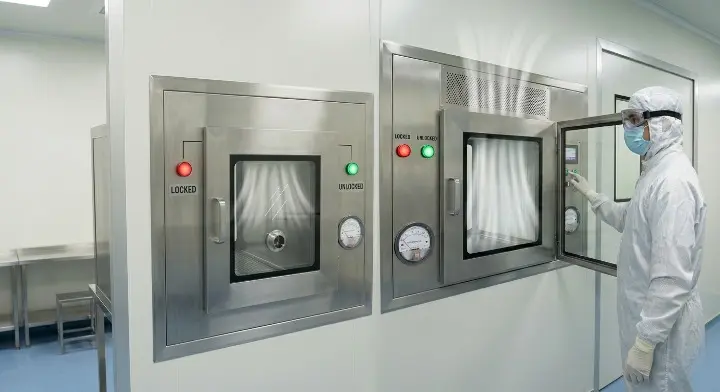
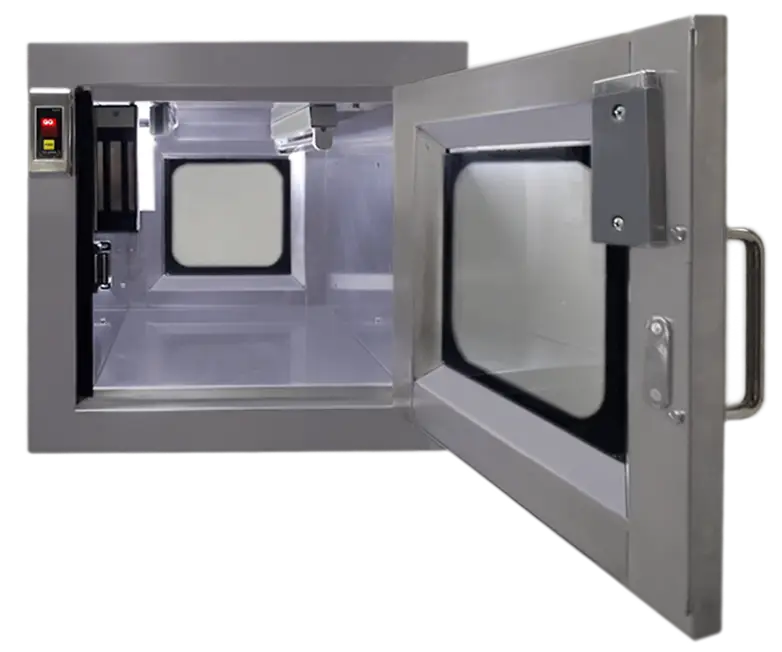
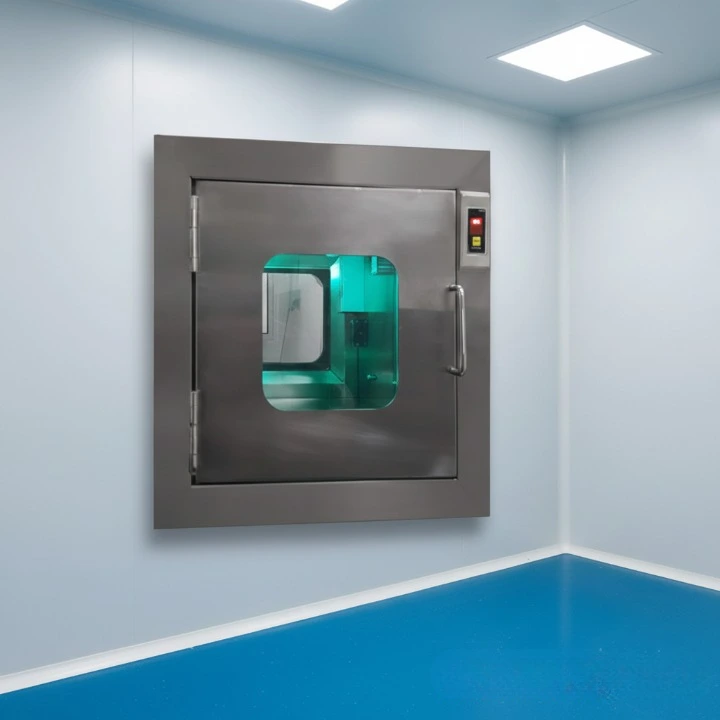
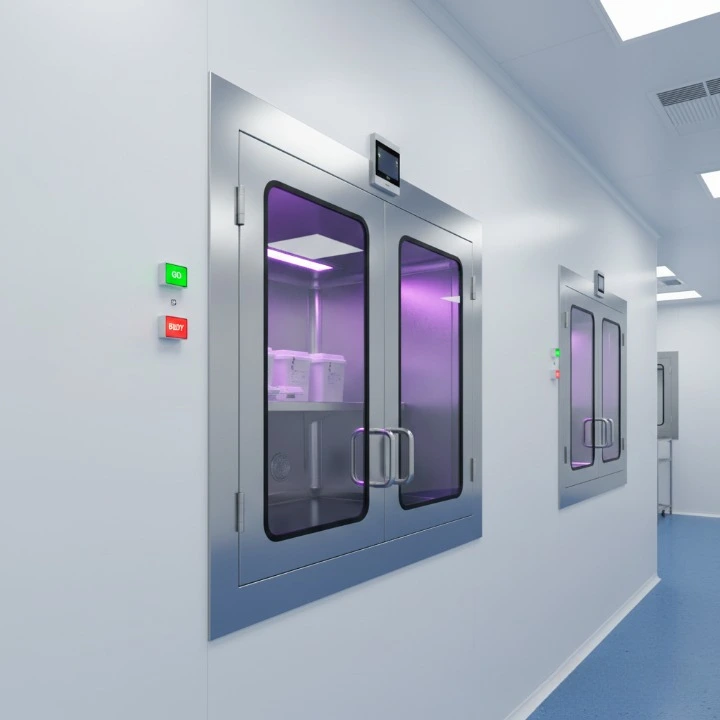
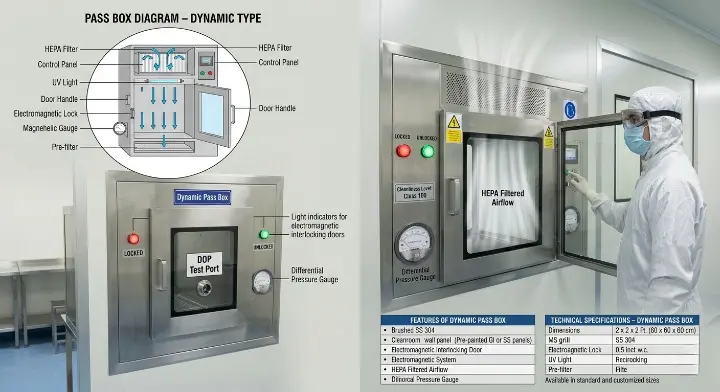
Pass Box — The Controlled Transfer Gateway Between Sterile Zones
A pass box is one of the fundamental cleanroom systems used to transfer materials from one area to another through a controlled environment, in order to prevent airborne cross-contamination. The primary function of a pass box is to transfer material safely without raising contamination concerns — any particulate matter present on the material surface is minimised during the transfer operation before the material crosses the zone boundary.
📌 The Interlocking Door Mechanism — The Core Safety Feature
The interlocking door mechanism is the key contamination-prevention feature of a pass box. When the door on one side is open, the opposite-side door remains locked — ensuring that the two rooms connected by the pass box are never simultaneously open to a common air channel. This mechanical or electromagnetic rule prevents the pressure differential between the two rooms from being breached at any point during the transfer event, maintaining the ISO class integrity of both zones throughout material handling operations.
Pass boxes are also widely known as cleanroom pass-throughs, clean transfer windows, and transfer hatches. They are used in microbiology laboratories, pharmaceutical manufacturing, food processing, chemical industries, and all cleanroom environments where material must move between zones of different cleanliness classification.
How the Dynamic Pass Box Actively Creates a Grade A Environment at Every Transfer
The core engineering distinction between a dynamic and static pass box is that the dynamic unit does not rely on the ambient cleanroom environment to maintain cleanliness during transfer — it generates its own Grade A environment actively, independent of the surrounding rooms.
Recirculatory Airflow — The Grade A Self-Generating System
The motor-blower (mounted with a suspension arrangement to prevent vibration transmission to the cabinet body) draws air from the pass box chamber interior through floor-level return grilles, passes it through the G4 pre-filter (which captures particles above 5 micron — protecting the H14 HEPA membrane from early loading), then forces it through the H14 HEPA filter which removes 99.97% of particles at 0.3 micron MPPS, and delivers it back into the chamber in a downward vertical pattern. This closed-loop recirculatory system continuously improves the air quality in the chamber throughout the transfer cycle — the particle count falls toward Grade A (ISO Class 5) within minutes of the outer door being closed. The G4 pre-filter is replaceable without removing the H14 HEPA filter, allowing the HEPA to maintain its rated efficiency throughout its full service life.
Electromagnetic Interlocking — Sequential Access with Fail-Safe Logic
The electromagnetic door interlocking system uses a logic controller PCB that monitors both doors and enforces the sequential access rule: only one door can be open at any time. When Door A (dirty side) is opened, the PCB activates the electromagnetic lock on Door B (clean side) until Door A is closed and latched. LED status indicators (Red = locked, Green = available) on both door frames communicate the interlock state to personnel on both sides. The controller is powered from a battery-backed UPS — in a power failure the UPS maintains lock power for a minimum of 4 hours. Fail-safe mode: power loss results in both locks engaging, not releasing.
UV-C Germicidal Lamp — Automated Surface Sterilisation
The UV-C germicidal lamp is activated during the idle period between transfer cycles, when both doors are closed and interlocked. The lamp activates automatically after a programmed delay (typically 5–10 minutes), runs for the programmed cycle time (typically 15–60 minutes), then deactivates and initiates a blower purge cycle that clears any ozone before the next transfer. The lamp is interlocked with both doors — it cannot activate when either door is open. An optional hour meter tracks cumulative lamp hours for planned replacement, and an optional UV intensity sensor alerts when output falls below 70% of rated.
Magnehelic Gauge — Continuous Filter Health Monitoring
The magnehelic gauge measures the pressure differential across the H14 HEPA filter. A clean filter has a low differential (typically 15–25 Pa at operating airflow); as it loads over its service life the differential increases (typically to 80–100 Pa at end-of-life). The gauge is visible on the front panel without opening any service door, letting personnel monitor filter health during each transfer cycle. An optional differential pressure switch provides an automatic visual alarm when the threshold is exceeded, ensuring replacement before airflow velocity and filtration efficiency fall below the Grade A maintenance threshold.
Eight Engineering Features of the Metrolabs Dynamic Pass Box
Every Metrolabs Dynamic Pass Box is built to these engineering standards — making it a self-contained cleanroom environment, not a hatch with a blower:
H14 HEPA Filter System — 99.97% Filtration Efficiency
The H14 HEPA filter (rated to EN 1822 — 99.97% minimum efficiency at 0.3 micron MPPS) is installed in the canopy in a gel-seal or knife-edge frame that prevents unfiltered air bypassing the filter perimeter. Combined with the G4 pre-filter on the recirculation return, the system maintains Grade A air quality throughout the transfer cycle.
Motor-Blower with Suspension Arrangement — Low Noise
The centrifugal or EC motor blower is mounted in the canopy with vibration isolation mounts that decouple blower vibration from the cabinet structure — preventing resonant vibration and noise transmitted through the cleanroom wall panel. Blower speed is selected to achieve the required HEPA face velocity (typically 0.45–0.9 m/s) at minimum noise.
Electromagnetic Interlocking Doors — Fail-Safe Logic
Heavy-duty electromagnetic locks on both doors, connected to a logic PCB enforcing one-door-open-at-a-time. Both doors are SS 316L-framed with double-glazed toughened safety glass vision panels, flush-mounted (zero-ledge). Medical-grade silicone gaskets compress to an airtight perimeter seal. Battery-backed UPS — power loss defaults to both locks engaged.
UV-C Germicidal Lamp — Programmable Auto-Cycle
Mounted in the upper interior corners for 360° irradiation coverage of all interior and transferred-item surfaces. Door-interlocked: cannot activate when either door is open. Programmable cycle timer (default 30 minutes, adjustable 15–60). Auto purge cycle clears ozone before the next transfer. Optional hour meter for planned replacement.
SS 304 / 316L Construction — Rugged & Durable
Interior chamber in SS 304 (standard) or SS 316L (optional), with all internal corners coved to a large radius to prevent particle and moisture accumulation. Surface brushed or mirror-polished to Ra <0.8μm (or Ra <0.5μm for SS 316L EP). All internal welds ground flush and polished. Engineered for repeated daily cycles, IPA wipe-downs, and periodic VHP decontamination.
LED Tube Light Illumination — Full Visibility
LED illumination inside the chamber provides full visibility during loading and unloading — personnel on both sides can confirm item identity and position through the double-glazed glass panels, and verify the chamber is empty before the next cycle. The fitting is flush-mounted in the ceiling — no protruding fixture, no shadow zones, and no heat generation that could affect temperature-sensitive products.
Flush Mounting — Zero-Ledge Wall Integration
Designed to install flush with the cleanroom panel wall surface on both sides — door frames specified to the panel thickness so the pass box face is flush on both classified and non-classified sides. No external dust-collecting ledge, no recessed face, and no exposed structural frame members. The panel-to-pass-box junction is sealed with pharmaceutical-grade silicone on both sides.
Easy to Operate & Maintain — Audit-Ready
Designed for daily operation by non-specialist personnel: load items, close dirty-side door, wait for Grade A confirmation, open clean-side door, unload. All controls on the front panel. Filter, UV-C lamp, and blower maintenance are front-access — no special tools and no cleanroom shutdown. Factory PAO/DOP test before dispatch, with certificates for GMP audit and ISO qualification.
Dynamic Pass Box — Standard Technical Specification
Metrolabs Dynamic Pass Box standard specification — customisable at any parameter to meet your facility requirement:
| Specification | Details |
|---|---|
| Design Type | Dynamic — Active HEPA Filtration |
| Cleanliness Level✓ Grade A | Class 100 / ISO Class 5 |
| Standard Internal Dimension | 2×2×2 Ft (60×60×60 cm) |
| Custom Sizes | Available as per customer requirements |
| MOC (Standard) | Stainless Steel 304 |
| Illumination | LED Tube Light — flush-mounted |
| Air System | Motor-Blower with Suspension Arrangement |
| Pre-Filter | G4 — 95% efficiency down to 5 micron |
| HEPA Filter | H14 — 99.97% — protected by SS grills |
| Door System | Two-side doors · Glass window · SS handles & hinges · EM interlocking |
| Standard Fittings | UV light · Door status LED · Blower on/off switch |
| Power Supply | 220 Volts / 50 Hz |
Configure Your Dynamic Pass Box — Optional Upgrades
Every Metrolabs Dynamic Pass Box can be configured with optional accessories to match your specific facility requirements, GMP documentation needs, and ISO class:
SS 316 / SS 316L MOC
Upgrade from standard SS 304 for VHP-intensive environments and Grade A/B pharmaceutical suites. Superior pitting corrosion resistance against chloride disinfectants.
Differential Pressure Gauge
Magnehelic ΔP gauge on the front control panel — monitors HEPA filter loading continuously with visual replacement indicator.
DOP Test Port
Upstream and downstream sampling ports for PAO or DOP filter integrity testing during commissioning and routine qualification.
Flange for Panel Mounting
Structural flange for secure bolting to the modular cleanroom panel frame — ensures flush, airtight mounting without silicone-only sealing.
Test Certificates (PAO/DOP)
Factory-performed HEPA filter integrity test with full report — confirms installation integrity and measured efficiency. Required for GMP IQ.
Calibration Certificate
Traceable calibration certificate for the magnehelic gauge and fitted instrumentation. Required for GMP instrument qualification documentation.
Door Buzzer Alarm
Audible door-open alarm when a door remains open beyond the configured time (default 30 seconds). Alerts personnel to an incomplete transfer.
UV-C Light Hour Meter
Cumulative lamp operating hour counter on the control panel. Enables planned replacement at 8,000–10,000 hours before output falls below threshold.
Dynamic Pass Boxes Across Every ISO Class and Regulated Sector
H14 HEPA Grade A active filtration for every cleanroom where materials cross classification boundaries:
Pharmaceutical GMP
Grade C-to-Grade B material entry. H14 HEPA Grade A active scrubbing. EM interlock fail-safe. EU Annex 1 (2022) compliant with full GMP IQ documentation.
Aseptic Manufacturing
Vial, ampoule, stopper, and closure component entry into aseptic Grade A/B suites. UV-C idle germicidal cycle. Grade A confirmation before clean-side release.
Biotech & ATMP
Cell culture media, reagents, and single-use component transfer into ATMP and cell therapy GMP suites. VHP-compatible SS 316L option available.
Semiconductor Fabs
Wafer cassette and process component transfer across ISO class boundaries in semiconductor cleanrooms. ESD-safe interior specification on request.
Hospital & CSSD
Sterile-to-non-sterile zone transfer in hospital pharmacy cleanrooms, CSSD, and oncology drug preparation suites. NABH compliant with documentation.
BSL Containment
Dual-HEPA units (H14 on both supply and exhaust) for BSL-2 and BSL-3 containment transfer — preventing hazardous agent escape during handling.
Microbiology Labs
Sample and reagent transfer into Class II Biosafety Cabinets and testing areas. UV-C germicidal idle disinfection. Standard or custom dimensions.
Food & Beverage
High-care food production zone material entry — packaging, ingredients, and sample removal. FSSAI high-care compliance with active HEPA filtration.
Dynamic Pass Box vs Static Pass Box vs Standard Hatch
Zero-Ledge Flush Mounting — No External Dust-Collecting Protrusions
Every Metrolabs Dynamic Pass Box is designed to be installed level with the cleanroom panel wall surface — the door frame is flush with the panel face on both sides, no external dust-collecting ledges exist on the cleanroom side of the panel, and the pass box-to-panel junction is sealed with pharmaceutical-grade silicone. This design eliminates the most common contamination audit finding associated with pass boxes — the ledge at the top of the pass box frame where dust accumulates between cleaning cycles.
Silent Operation — Optimised Aerodynamics, Vibration-Isolated Blower
Optimised internal aerodynamics — the blower inlet and HEPA filter plenum are designed to maintain laminar air entry into the blower at all operating speeds, minimising aerodynamic noise from turbulence at the inlet. Combined with the vibration-isolation suspension mounting, the pass box operates with minimal noise contribution to the cleanroom environment — ensuring that the hygiene stations adjacent to the pass box can be used without disturbance from pass box blower noise.
Audit-Ready Documentation — Factory-Validated for ISO & GMP
Every Metrolabs Dynamic Pass Box is factory-validated for airflow velocity (measured at the HEPA filter face and at the door opening) and filter integrity (PAO/DOP test confirming no bypass around the filter perimeter) before dispatch. The factory test report, material test certificates (MTCs), ASTM A967 passivation certificate, and calibration certificates (if applicable) are supplied at handover as part of the IQ documentation package — structured for direct inclusion in ISO qualification and GMP audit submissions.
Pressure Gradient Management — Higher Internal Pressure for Clean Sweep
The Metrolabs Dynamic Pass Box maintains a higher internal pressure than the surrounding rooms — ensuring a constant outward clean sweep when doors are accessed. The motor-blower is set to deliver a chamber pressure typically 5–15 Pa above both the classified and non-classified room pressures — so when either door is opened, the air flow is always outward from the clean chamber into the room, never inward from the room into the clean chamber. This prevents any room-air ingress during the door-open period of the transfer cycle.
From Specification to Factory-Tested & IQ-Documented Dynamic Pass Box
Metrolabs manages the complete pass box supply and commissioning process:
Specification & Design
ISO classes of both rooms confirmed. Transfer material type assessed. MOC, internal dimensions, optional features, power supply, and mounting configuration confirmed. Dimensioned drawing produced and signed off.
Fabrication
Interior chamber fabricated with coved corners. HEPA canopy and blower housing built. Blower installed with vibration mounts. H14 filter with gel-seal frame. G4 pre-filter fitted. EM interlock PCB tested. UV-C lamp interlocked. Polished and passivated. MTCs issued.
Factory Test & Validation
Airflow velocity measured at HEPA face and door opening. PAO/DOP integrity test confirms no bypass. EM interlock function tested on both door sequences. UV-C interlock and LED indicators tested. Full transfer cycle simulated. Test report produced.
IQ Documentation
SS MTCs, ASTM A967 passivation cert, H14 EN 1822 filter cert, PAO/DOP test report, airflow measurement record, EM interlock test record, and installation photos compiled for GMP IQ qualification submission at handover.
Factory & Office
4, SIDCO-MICRO, Thirumudivakkam,
Chennai – 600 132, Tamil Nadu
Ready to Install a Dynamic Pass Box in Your Cleanroom?
Contact Metrolabs for a free consultation. Our specialists will confirm your ISO class requirements, transfer material type, internal dimensions, optional features, and documentation requirements — then fabricate, factory-test, and supply your Dynamic Pass Box with complete IQ documentation at delivery.
🔌 Request a Free Dynamic Pass Box Quote
Share your ISO class, dimensions, and optional feature requirements — our specialists respond within 24 working hours.