
Cleanroom Static Pass Box — The Essential Pressure-Seal Gateway Between Clean Areas
A Static Pass Box, also known as a Passive Pass Box, is the primary structural barrier for material transfer between two cleanroom areas of the same ISO class — or from a cleaner zone to a non-sterile zone. Unlike the Dynamic Pass Box, the Static Pass Box operates without an air supply or extraction system. It relies instead on the maintained pressure differential between the two connected rooms and the hermetic integrity of its interlocking seal to prevent any exchange of room air during material transfer.
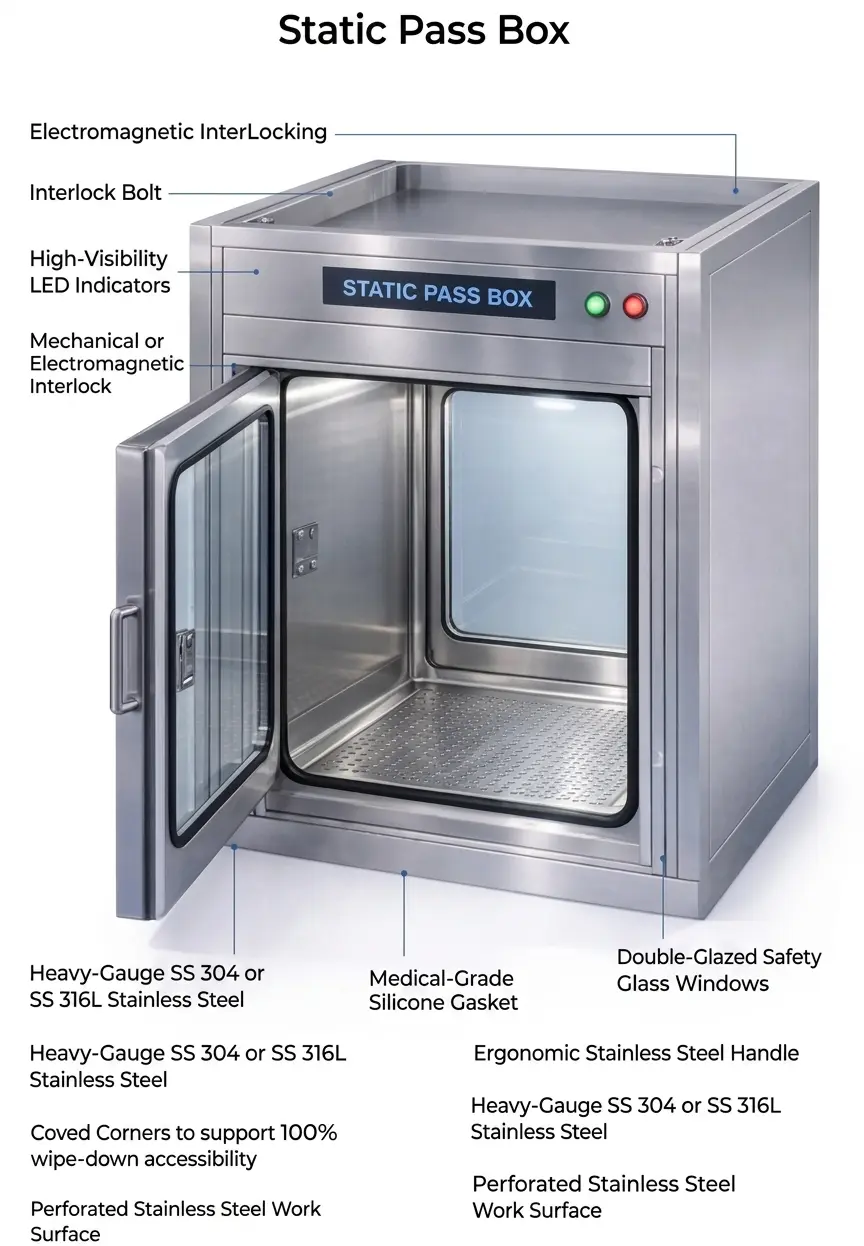
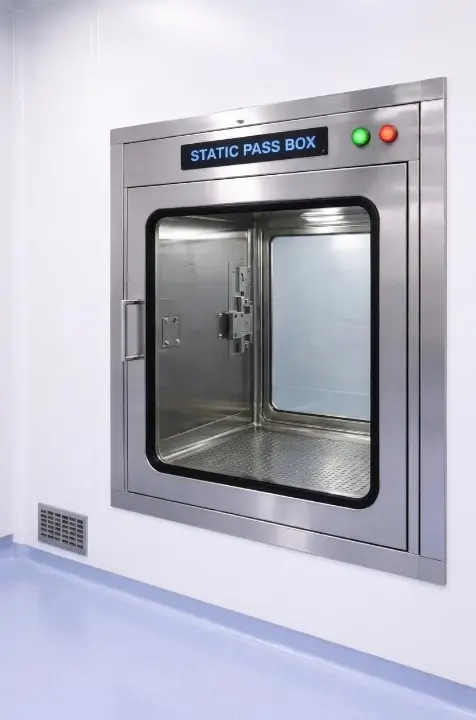
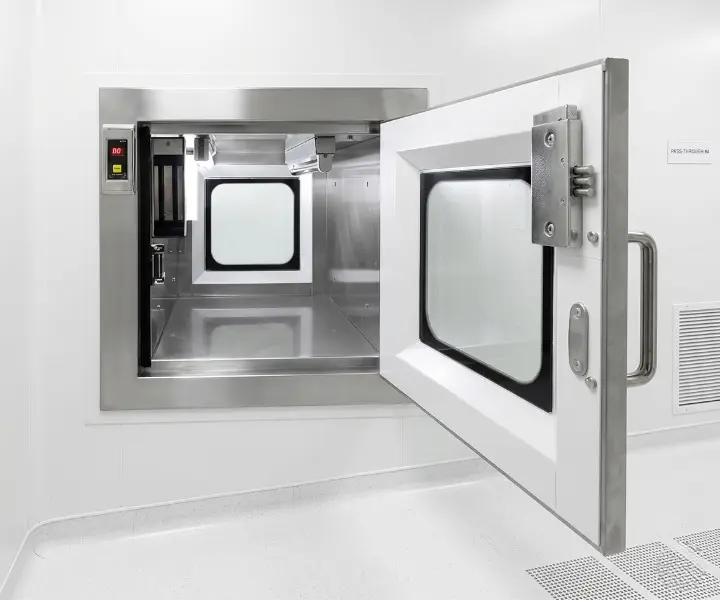
Passive Pressure-Seal Gateway — Structural Barrier Without Active Air Circulation
A Static Pass Box (also called a Passive Pass Box) is installed between two cleanroom areas to enable material transfer between zones while preventing direct personnel movement between them — maintaining the ISO class integrity of both zones during the transfer event. The key distinction from a Dynamic Pass Box is that the Static Pass Box has no air supply or extraction system — it does not generate its own internal air environment. Instead, it relies on the pressure differential maintained between the two rooms and the hermetic sealing of its interlocking door system to prevent cross-contamination during transfer.
🔒 The Static Pass Box Principle — Pressure Protection Through Hermetic Integrity
In a cleanroom with a maintained pressure cascade — where the Grade A/B production suite is held at a higher pressure than the Grade C/D corridor — the primary risk during material transfer is the momentary air exchange that occurs when a person opens a door between the two pressure zones. The Static Pass Box eliminates this risk by providing a transfer pathway that never simultaneously connects both zones to open air — the interlocking system ensures only one door can be open at any moment, and the medical-grade silicone gaskets ensure the closed door provides an airtight seal at the door-to-frame junction.
When the transfer is completed correctly — outer door closed, items in chamber, outer door latched, inner door opened — no air from the outer zone ever enters the inner zone. The chamber air is not drawn into the inner zone during the inner door opening because the inner zone is at higher pressure than the chamber — the air flow during opening is always outward from the clean zone into the chamber, never inward.
How the Static Pass Box Maintains Zone Integrity — Four Engineering Mechanisms
The static pass box achieves contamination control through four engineered mechanisms — not through active filtration, but through structural integrity at every component that could be a pathway for air or particulate exchange between zones.
Electromagnetic Interlocking — The Primary Contamination Prevention Mechanism
A logic PCB monitors both door-position switches and both electromagnetic locks, enforcing a single rule: only one door can be open at any time. When Door A is opened, the PCB activates the lock on Door B until Door A is fully closed and latched, confirmed by the door-position switch. This ensures the chamber interior is always sealed from at least one zone — so the pressure differential is never exposed to a through-pathway. The PCB is powered from a battery-backed UPS; power loss defaults to both locks engaged, not released. The optional mechanical interlocking provides the same rule through a purely mechanical cam-and-lever mechanism for facilities where power reliability is a concern.
Medical-Grade Silicone Gaskets — Airtight Hermetic Door Sealing
The doors seal against continuous ring gaskets moulded to the frame perimeter, fabricated from a silicone compound specified for the cleanroom chemical environment: VHP-compatible at 1000 ppm, resistant to IPA and QAC disinfectants, and non-outgassing. When closed, the gasket compresses approximately 25%, forming an airtight seal — the pressure differential cannot create an air pathway through the gasket at the 10–15 Pa typically maintained in pharmaceutical cascades. Double-glazed toughened safety glass viewing panels are mounted flush with the door frame and sealed with the same pharmaceutical-grade silicone, maintaining a zero-ledge surface as wipeable as the surrounding SS face.
Aseptic Interior Geometry — Coved Corners for Total Wipe-Down Accessibility
The internal chamber is fabricated from SS 304 or SS 316L with all internal corners coved to a continuous large radius — floor-to-wall, wall-to-ceiling, and all four vertical junctions are radiused, eliminating the sharp 90-degree angles where dust, moisture, and micro-organisms settle and become protected from the cleaning cloth. A right-angle corner creates a shadow zone at the vertex that receives disinfectant spray but not the mechanical wiping action required to remove established biofilm. The coved corner lets the cloth follow through in a single pass. Internal surface is brushed (standard) or mirror-polished to Ra <0.8μm.
UV-C Germicidal Lamp — Automated Surface Sterilisation Between Cycles
The UV-C lamp mounted in the upper interior provides surface disinfection of the chamber and any items placed in it during the idle period, when both doors are closed and interlocked. It activates automatically after a programmable delay, runs for the programmed cycle time (typically 15–60 minutes), then deactivates. The lamp is interlocked with both doors — UV-C cannot activate when either door is open, and both doors are locked during operation. UV-C cut-off safety: if either door is opened during an active cycle, the lamp deactivates immediately. An optional hour meter tracks cumulative lamp hours for planned replacement.
Six Engineering Features of the Metrolabs Static Pass Box
Every Metrolabs Static Pass Box is built to these standards — making it a high-performance containment unit rather than a simple wall hatch:
EM / Mechanical Interlocking — Sequential Access, Fail-Safe
Electromagnetic or mechanical door interlocking, configurable at order. The EM option uses a logic PCB with battery-backed UPS (power loss defaults to both doors locked). The mechanical option uses a cam-and-lever mechanism independent of electrical power — suitable where supply reliability is a concern. Both enforce the same sequential access rule, confirmed by door-position switch and LED indicators. SS-framed doors with double-glazed toughened glass vision panels flush with the frame.
Medical-Grade Silicone Gaskets — Airtight VHP-Compatible Seal
Continuous ring silicone gaskets on both door frames, providing an airtight seal at every point of the door-to-frame junction. Compound specified for VHP compatibility at 1000 ppm, IPA/QAC resistance, and non-outgassing. Approximately 25% compression when latched — sufficient to seal against the 10–15 Pa differential of pharmaceutical cascades. Gasket replacement is a routine task — installed in a standard channel, replaceable without disturbing the door mounting.
UV-C Germicidal Lamp — Safety-Interlocked Idle Disinfection
UV-C lamp mounted in the upper interior — covers all chamber surfaces and items placed during idle periods. Programmable timer via the control panel (15–60 minutes). UV-C safety cut-off: if either door is opened during an active cycle, the lamp deactivates immediately, protecting personnel from exposure. The lamp cannot activate unless both doors are confirmed closed. Optional hour meter for planned replacement. The safety logic is standard, not an optional extra.
Coved Interior — 100% Wipe-Down, Non-Shedding Surface
The internal chamber is SS 304 (standard) or SS 316L (optional) with all internal corners coved to a continuous large radius — eliminating the right-angle junctions where particles and micro-organisms accumulate and become protected from cleaning cloth contact. The brushed or mirror-polished surface (Ra <0.8μm standard) resists aggressive disinfectants — IPA, QAC, PAA, chlorine solutions, and VHP. All internal welds ground flush and polished.
Red / Green LED Status Indicators — Clear Communication
High-visibility Red/Green LED indicators are mounted on both door panels, flush with the door face, giving clear visual communication to personnel on both sides: Green indicates the door is available to open; Red indicates it is locked by the interlock. This dual-sided system prevents the most common user error — attempting to open the locked door before the other has been fully closed, which in mechanical systems results in forcing and damaging the mechanism.
Zero-Ledge Flush Mounting — Seamless Panel Integration
Designed to install level with the cleanroom panel wall surface on both sides — door frames specified to the panel thickness so the pass box face is flush on both sending and receiving sides. No external dust-collecting ledge, no recessed face, no exposed structural frame members. The panel junction is sealed with pharmaceutical-grade silicone on both sides — a continuous, inspectable seal verifiable at each cleaning cycle. An optional flange fitting is available for panel systems requiring positive mechanical attachment.
Static Pass Box — Standard Technical Specification
Metrolabs Static Pass Box standard specification — customisable at any parameter:
| Specification | Details |
|---|---|
| Design Type | Static / Passive — No Air Circulation |
| Cleanliness LevelN/A | Relies on Room Pressure Differential |
| Standard Internal Dimension | 2×2×2 Ft (60×60×60 cm) |
| Custom Sizes | Available as per application requirements |
| MOC (Standard) | Stainless Steel 304 |
| Illumination | LED Tube Light — flush-mounted |
| Air System | Not Available — Passive / Static Design |
| Filters | Not Available |
| Door System | Two-side doors · Glass window · SS handles & hinges · EM interlocking |
| Standard Fittings | UV light · Red/Green LED indicators · SS handles & hinges |
| Power Supply | 220 Volts / 50 Hz |
Configure Your Static Pass Box — Optional Upgrades
Metrolabs Static Pass Boxes are available with optional accessories and specialised configurations to match your facility requirements, GMP documentation needs, and cleanroom architecture:
SS 316 / SS 316L MOC Upgrade
Upgrade from standard SS 304 for VHP-intensive environments and Grade A/B suites. Superior pitting corrosion resistance against chloride-containing disinfectants.
Flange for Panel Mounting
Structural flange for secure bolting to the modular panel structural frame — ensuring flush, airtight mounting without silicone-only sealing.
Test Certificates
Dimensional inspection certificate, MTC for all SS components, UV-C intensity record, EM interlock function test record, and installation photographs for GMP IQ.
Mechanical Door Interlocking
Purely mechanical cam-and-lever mechanism — no electrical components. Same sequential-access rule as the EM system. Suitable for power-unreliable environments.
Door Buzzer Alarm
Audible door-open alarm when a door remains open beyond the configured time (default 30 seconds). Alerts personnel on both sides to an incomplete transfer.
UV-C Light Hour Meter
Cumulative lamp operating hour counter on the control panel. Enables planned replacement at 8,000–10,000 hours before germicidal output falls below threshold.
Lead-Lined Configuration
Specialised lead-lined units for radiopharmaceutical suites and X-ray laboratories where radiation shielding is required at the transfer point.
Polypropylene Interior
PP interior lining for highly corrosive chemical reagents — concentrated acids, alkalis, and solvents that would damage stainless steel over time.
Custom RAL Powder Coat
Powder-coated exterior in any RAL colour to match your cleanroom partition system, gowning colour coding, or corporate colour standards.
Static Pass Boxes Across Every ISO Class and Regulated Sector
Compact, economical, and hermetically reliable transfer gateways for every cleanroom where pressure integrity — not active decontamination — is the contamination control requirement:
Pharmaceutical GMP
Grade B-to-B and Grade C-to-C material transfer. Pressure cascade integrity maintained. UV-C idle disinfection. Full GMP IQ documentation at handover.
Hospital Pharmacy
Sterile preparation room material transfer. NABH compliant. UV-C germicidal standard. SS 316L option for chlorine-disinfectant environments.
Microbiology Labs
BSL-2 laboratory material entry and sample removal. UV-C idle disinfection. EM interlock. Standard or custom dimensions for larger equipment.
Biotech & ATMP
Same-class zone transfer in ATMP manufacturing. VHP-compatible SS 316L option. Mechanical interlock option for VHP-cycle areas.
Hospital & CSSD
Sterile instrument transfer between CSSD processing and sterile storage. NABH compliant. Lead-lined option for radiopharmaceutical integration.
Research Laboratories
NABL-accredited and academic research lab transfer. Compact and economical. UV-C idle disinfection. EM or mechanical interlock as required.
Food & Beverage
FSSAI high-care zone material entry — packaging, ingredients, and tools. Compact easy-clean design. UV-C disinfection between cycles.
Chemical Industries
Reagent, sample, and tool transfer in chemical manufacturing cleanrooms. Polypropylene interior option for highly corrosive environments.
High-Accuracy Fabrication — Built for High-Frequency Use
Metrolabs focuses on high-accuracy fabrication and long-term performance — our static pass boxes are built to withstand the high-frequency use of busy pharmaceutical and research environments:
Zero-Ledge Wall-Flush Mounting — Seamless Panel Integration
Every Metrolabs Static Pass Box is designed to be installed level with the cleanroom panel wall surface — the door frame flush with the panel face on both sides, the junction sealed with pharmaceutical-grade silicone, and no external dust-collecting ledges. This eliminates the most common contamination audit finding associated with pass boxes — the ledge or step at the top of the frame where dust accumulates between cleaning cycles.
Custom Sizing — From Petri Dishes to Bulk Containers
Metrolabs manufactures chambers to exact dimensional requirements — whether a compact 300×300×300mm unit for small sample vials, or an oversized 1200×600×600mm unit for bulk container transfer in raw material receipt. Standard size is 2×2×2 Ft; custom sizes are available with no minimum quantity requirement.
Aesthetic Integration — Matched to Your Cleanroom Architecture
Powder-coated options are available to match the cleanroom’s colour scheme and maintain a professional, uniform appearance. Pass boxes can be matched to the RAL colour of the surrounding modular panel system — ensuring the unit is a visually integrated component of the cleanroom rather than an industrial insert.
Ergonomic Transfer Height — Straight-Line Protocol
Metrolabs recommends mounting the pass box at a height supporting ergonomic straight-line transfers — the item moved horizontally from sending shelf to chamber to receiving shelf without lifting, tilting, or repositioning. Straight-line transfers reduce door-open time, reduce drop risk, and support correct procedure without extensive operator training.
Static Pass Box vs Dynamic Pass Box vs Standard Hatch
Static vs Dynamic: Choose the Static Pass Box for same-class transfers where pressure integrity is the contamination control requirement. Choose the Dynamic Pass Box when materials are crossing from a lower to a higher ISO class and require active HEPA Grade A decontamination of item surfaces before entry. See Dynamic Pass Box →
From Specification to Installed & Documented Static Pass Box
Metrolabs manages the complete static pass box supply process:
Specification & Design
ISO classes of both rooms confirmed. Transfer material type assessed. MOC, dimensions, interlock type, optional features, and mounting configuration confirmed. Dimensioned drawing produced and signed off before fabrication.
Precision Fabrication
Interior chamber fabricated with coved corners. Exterior body SS 304 brushed. EM interlock PCB installed and tested. Silicone gaskets fitted. Double-glazed glass panels flush to frame. UV-C lamp interlocked. LED indicators fitted. ASTM A967 passivation performed.
Installation & Commissioning
Installed into the panel aperture, flush-mounted on both sides. Junction sealed with pharmaceutical-grade silicone. EM interlock function tested on both door sequences with fail-safe power loss test. UV-C interlock and cut-off safety verified. LED sequence verified.
IQ Documentation
SS MTCs, ASTM A967 passivation cert, EM interlock test record, UV-C interlock test record, lamp intensity measurement, gasket specification, LED test record, and installation photographs compiled for GMP qualification at handover.
Factory & Office
4, SIDCO-MICRO, Thirumudivakkam,
Chennai – 600 132, Tamil Nadu
Ready to Install a Static Pass Box in Your Cleanroom?
Contact Metrolabs for a free consultation. Our specialists will confirm your ISO class requirements, transfer material type, internal dimensions, optional features, and documentation requirements — then fabricate and supply your Static Pass Box with full IQ documentation at delivery.
🔒 Request a Free Static Pass Box Quote
Share your ISO class, dimensions, interlock type, and optional feature requirements — our specialists respond within 24 working hours.