
Cleanroom Air Control Systems — The Brain of Your Sterile Environment
In a sterile facility, the air is the primary vehicle for both safety and contamination. Metrolabs provides high-accuracy Air Control Systems engineered to act as the brain of your cleanroom — managing the delicate balance of pressure, filtration, and airflow to ensure that your facility remains a Clean Shell protected from particulate intrusion. Our systems synchronise structural components with digital control logic to maintain a stable, aseptic environment for pharmaceutical, biotech, and semiconductor manufacturing.
Dynamic Pass Box · Static Pass Box · Pass-Through Cabinets — Engineered for Every Transfer Scenario
Metrolabs provides three distinct air control transfer systems — each engineered for a specific material transfer scenario, ISO class transition, and facility requirement:
Dynamic Pass Box — Active Filtration for ISO Class Transitions
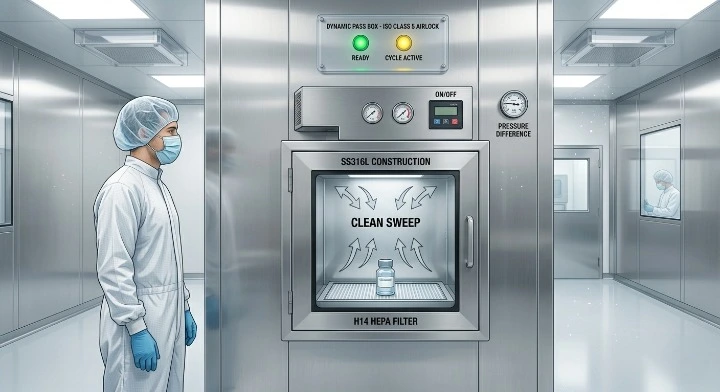
The Dynamic Pass Box is an advanced structural unit that acts as a localised cleanroom environment — designed specifically for material transfer between a non-classified area and a sterile zone, or between two different ISO classes, where the materials entering the cleanroom must be actively decontaminated of particles from the lower-class environment before they cross the classification boundary. Unlike the static pass box, which relies on the maintained pressure differential between two rooms and the mechanical integrity of its interlocking system to prevent cross-contamination, the dynamic pass box actively creates a Grade A environment (ISO Class 5 equivalent) within its interior chamber during the transfer cycle — washing the surface of every item transferred with clean air at the highest cleanliness standard before the inner door is opened. The H14 HEPA filtration unit (mounted in the pass box canopy) draws air through a G4 pre-filter that captures large particles, then through the H14 HEPA filter that removes 99.995% of particles at 0.3 micron — delivering air to the transfer chamber interior at Grade A particle count. A motor blower recirculates this filtered air through the chamber in a closed-loop downward pattern, sweeping particle contamination from the item surfaces toward the floor return grilles where it is captured by the G4 pre-filter on the recirculation inlet. The result is that an item transferred from an unclassified corridor can have its exposed surface areas brought to Grade A cleanliness within 3–5 minutes of the outer door being closed — the transfer cycle is complete when the particle counter integrated into the pass box HMI confirms that the chamber particle count has fallen below the ISO Class 5 threshold.
Static Pass Box — Hermetic Integrity for Same-Class Transfers
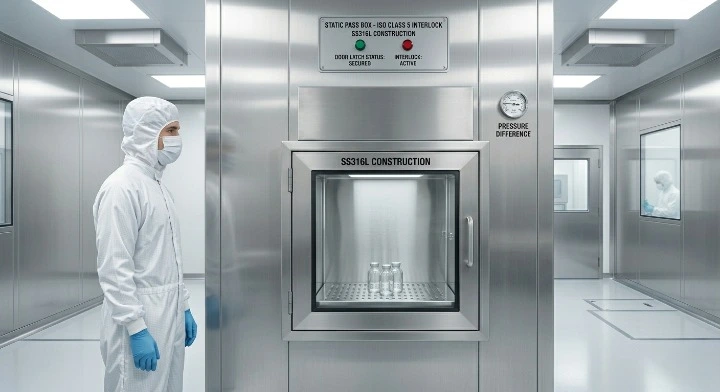
The Static Pass Box is a high-integrity structural barrier engineered for material transfer between two rooms of the same ISO class — where the goal is not to change the contamination status of the transferred items (which are already at the cleanroom standard) but to physically separate the two rooms during the transfer event, preventing the exchange of room air between the two spaces. The static pass box achieves this through hermetic sealing and electromagnetic door interlocking — two mechanisms that together ensure the pressure gradient of the facility is never breached during any transfer event. Hermetic sealing: both doors of the static pass box seal against medical-grade silicone gaskets — a continuous ring gasket moulded to the door frame perimeter, compressed by the door closing mechanism to achieve an airtight seal at the door-to-frame junction. The silicone compound is specified for VHP compatibility (1000 ppm concentration) and chloride-containing disinfectant resistance. When both doors are closed, the pass box interior is a sealed chamber completely isolated from both rooms. Electromagnetic door interlocking: the two doors of the pass box are linked by an electromagnetic interlock system that prevents both doors from being open simultaneously — opening either door automatically engages the electromagnetic lock on the opposite door, so the pass box interior cannot simultaneously connect both rooms at any point during the transfer event. The interlock logic is fail-safe — power failure defaults to both doors locked (not both unlocked), ensuring that the facility pressure cascade is maintained even during a power interruption. The internal chamber is fabricated from SS 316L with coved R10 all internal corners, electropolished to Ra <0.5μm — allowing complete wipe-down sterilisation with IPA or QAC without any corner crevice remaining inadequately cleaned.
Pass-Through Cabinets — High-Volume Bulk Material & Trolley-Compatible
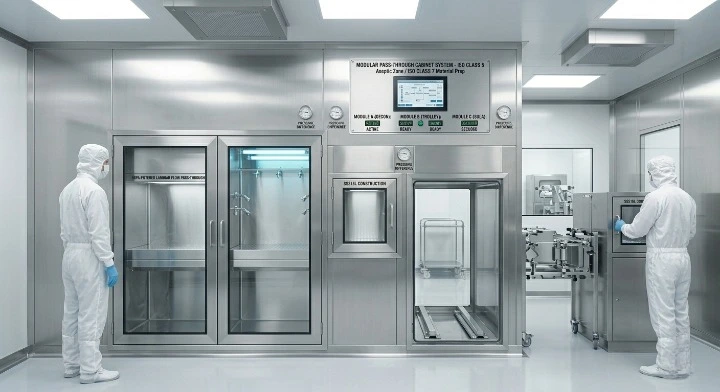
When a pharmaceutical or biotech facility requires the movement of bulk supplies, heavy equipment, raw material drums, or cleanroom SS trolleys between two zones, the standard pass box format — with its limited internal volume (typically 600×600×600mm for a standard pass box) — is not physically capable of accommodating the items being transferred. The Pass-Through Cabinet provides the necessary scale and structural strength for high-volume industrial cleanroom logistics — available in custom dimensions from 900×900mm to 2400×1800mm internal clear volume, with a floor-mounted design that is engineered to be installed level with the cleanroom floor. Level floor installation allows wheeled trolleys, drum lifters, and fork-lift-compatible pallets to transit the pass-through cabinet without lifting — the trolley rolls directly from the clean corridor, through the pass-through cabinet, and into the cleanroom without any lifting, tilting, or step that would create a contamination or ergonomic hazard. The floor of the pass-through cabinet is fabricated from heavy-gauge (3mm minimum) SS 316L, reinforced below with a welded SS structural framework, and rated for wheeled loads up to 2000kg — adequate for all standard pharmaceutical manufacturing material handling equipment. The reinforced construction uses heavy-gauge stainless steel throughout to withstand the impact loads of high-volume industrial material handling use. Available in Dynamic configuration (with integrated HEPA filtration for class-crossing transfers) or Static configuration (with electromagnetic interlocks for same-class large-scale material movement).
Six Engineering Features Across All Metrolabs Air Control Systems
Every Metrolabs air control system is built to these standards — making it a precision environmental regulation component rather than a simple transfer hatch:
Electromagnetic Interlocking — Logic-Based Pressure Protection
Every Metrolabs pass box and pass-through cabinet uses an electromagnetic interlock system linked by logic-based control — a controller that monitors both door status (open/closed) and both lock status (engaged/disengaged) and enforces the interlock rule: only one door can be open at any time. The logic controller is a dedicated door control PCB — not a software rule in a shared building management system that could be overridden by a non-authorised operator or a software update. The PCB is mounted within the pass box body, powered from a dedicated circuit, with a battery-backed UPS that maintains door lock status during power interruptions. Fail-safe mode: power loss defaults to both doors locked — the interlock does not disengage during a power failure, ensuring that the facility pressure cascade is maintained regardless of electrical supply interruption. Red/Green LED status indicators on both door panels provide clear at-a-glance communication to personnel on both sides of the pass box — Green indicating the door is available to open, Red indicating it is locked by the interlock.
H14 HEPA Filtration — Grade A Active Air Scrubbing
The dynamic pass box H14 HEPA filter (EN 1822 rated — 99.995% filtration efficiency at 0.3 micron MPPS) is mounted in the canopy of the pass box unit with a G4 pre-filter on the recirculation inlet to extend HEPA filter service life by capturing coarser particles before they reach the HEPA membrane. The HEPA filter installation uses a sealed knife-edge / gel-seal frame that prevents any bypass of unfiltered air around the filter perimeter — the only air that enters the pass box chamber interior is air that has passed through the H14 HEPA membrane. Filter replacement is from the front of the unit (no special tools, no cleanroom-side access required) — the filter access panel is SS 316L, flush-mounted to the cabinet face, and secured by quarter-turn cam fasteners. A differential pressure gauge across the filter monitors filter loading — the HMI displays a filter replacement alert when the pressure drop exceeds the replacement threshold, preventing continued use of a loaded filter that reduces the effective filtration efficiency.
UV-C Germicidal Lamps — Automated Surface Disinfection
All Metrolabs pass boxes include integrated UV-C germicidal lamps as standard — mounted in the upper interior corners of the chamber to provide 360° irradiation coverage of all interior surface areas and of the surfaces of transferred items when the chamber is idle (both doors closed, interlock engaged, pass box not in active transfer mode). The UV-C lamps are interlocked with both doors — the lamps cannot be activated when either door is open, and both doors are locked during UV-C operation. The UV-C cycle timer is set from the HMI (typically 15–60 minutes for standard pharmaceutical applications, matching the idle period between transfer cycles). At the end of the UV-C cycle, the lamps deactivate automatically and a purge cycle (HEPA-filtered air circulation for the dynamic pass box, or a timed wait for the static pass box) clears any ozone generated by the UV-C lamps before the next transfer cycle begins. UV-C lamp intensity is monitored by an integrated UV sensor — the HMI displays a lamp replacement alert when the measured intensity falls below 70% of the lamp rated output, ensuring that the germicidal effectiveness of the UV-C cycle is maintained throughout the lamp service life.
Touchscreen HMI — Real-Time Environmental Health Monitoring
The Metrolabs touchscreen HMI (7-inch or 10-inch colour touchscreen, IP65-rated for cleanroom environment) provides facility managers with a comprehensive at-a-glance view of the air control system status: door status (open/closed/locked) for both doors; UV-C cycle status (running/complete/fault); HEPA filter differential pressure (current value and trend); particle counter reading (for dynamic pass boxes with integrated particle sensors); transfer cycle count and transfer log (date/time of each transfer event); alarm history; and system fault codes. The HMI panel is flush-mounted to the pass box body — the face of the touchscreen panel is flush with the surrounding SS surface, with no protruding bezel, no gap at the panel edge, and a smooth silicone seal at the panel perimeter. The mounting hardware is concealed — no visible screws or brackets on the panel face. The HMI data log is accessible via a USB port on the side panel (for data download) or via Ethernet connection (for integration with the facility building management system or environmental monitoring system).
SS 316L Aseptic Chamber — Zero-Ledge Interior Construction
The interior chamber of every Metrolabs pass box and pass-through cabinet is fabricated from SS 316L with coved R10 all internal corners — a single-piece pressing from a flat SS sheet that forms the floor, walls, and ceiling transitions in a single operation, eliminating any internal weld at the corner junctions. All internal corners are a continuous R10 radius, allowing the cleaning cloth to wipe the corner in a single pass without repositioning, and allowing the spray from a VHP injection nozzle to reach the corner surface without obstruction. The internal surface is electropolished to Ra <0.5μm — the same surface standard as pharmaceutical Grade A workbench tops — providing the sub-micron smoothness that prevents bacterial adhesion and makes contamination immediately visible on inspection. The external body is SS 304 brushed finish — the same material and finish specification as the surrounding cleanroom panel system, ensuring that the pass box presents a visual continuity with the panel surface rather than appearing as an industrial unit inserted into a cleanroom wall.
VHP Sterilisation Mode — HVAC Damper Override & Integration
VHP sterilisation of cleanrooms requires the complete isolation of the room HVAC supply and return air circuits from the rest of the facility air handling system — VHP vapour entering the main AHU would damage HEPA filters, humidifiers, and heat exchangers throughout the facility. Metrolabs air control systems include a VHP sterilisation mode — a specialised override setting activated from the HMI or from a remote signal from the facility VHP generator that closes all HVAC supply dampers, closes all return air dampers, opens the VHP bypass dampers (which route VHP through the room and back to the generator for closed-loop recirculation), and locks the pass box interlocks in the double-locked state. The mode is confirmed by the HMI with a visual and audible alert before activation, and requires a supervisor-level access code to activate and to deactivate. At the end of the VHP cycle, the VHP aeration mode automatically opens the supply and return dampers in a controlled sequence to flush the room with fresh HEPA-filtered air until the hydrogen peroxide concentration falls below the safe re-entry threshold — confirmed by the integrated H₂O₂ sensor signal to the HMI.
Metrolabs Air Control Systems — Transfer Standard
Every Metrolabs air control system is fabricated, finished, and documented to these technical parameters:
| Feature | Metrolabs Transfer Standard | Benefit |
|---|---|---|
| Interlocking | Electromagnetic / logic-based PCB | Prevents both doors opening — pressure protected |
| Interior Material✓ Std | SS 316L — R10 coved — EP Ra <0.5μm | Total wipe-down sterilisation — no biofilm |
| HEPA (Dynamic) | H14 — 99.995% at 0.3μm — gel-seal | Grade A chamber environment during transfer |
| Sterilisation | UV-C germicidal — programmable HMI | Automated idle-period surface disinfection |
| Control Interface | 7″/10″ touchscreen HMI — IP65 flush | Real-time environmental monitoring and logging |
| VHP Mode | HVAC damper override — H₂O₂ sensor | Room-wide VHP cycle without HVAC damage |
| Fail-Safe | Power loss — both doors locked | Facility pressure maintained through power failure |
| Indicators | Red/Green LED — both sides of pass box | Clear personnel communication — no errors |
Air Control Systems Across Every Regulated Cleanroom Sector
HEPA Grade A, electromagnetically interlocked, and VHP-ready transfer systems for every ISO class and regulated sector:
Pharmaceutical GMP
Dynamic pass boxes for Grade C-to-Grade B material transfer with H14 HEPA Grade A active scrubbing. Static pass boxes for same-class Grade B transfers. Pass-through cabinets for bulk raw material receipt. Full GMP IQ documentation at handover.
Aseptic Manufacturing
Dynamic pass boxes for vial, ampoule, and component transfer into aseptic Grade A/B suites. UV-C germicidal cycle between transfers. Electromagnetic interlocks fail-safe. VHP mode for room-wide sterilisation programme integration.
Semiconductor Fabs
Dynamic pass boxes for wafer pod transfer across ISO class boundaries. H14 HEPA Grade A chamber environment. Static pass boxes for tool transfer between same-class bays. ESD-safe interior specification available.
Biotech & ATMP
Dynamic pass boxes for cell culture media and reagent transfer into ATMP manufacturing suites. UV-C germicidal standard. VHP mode integration for closed-room sterilisation. Pass-through cabinets for bioreactor accessory logistics.
Hospital & CSSD
Static pass boxes for sterile instrument transfer between CSSD and OT suites. NABH compliant. Electromagnetic interlock fail-safe. UV-C germicidal idle-period sterilisation. Pass-through cabinets for trolley-compatible sterile tray logistics.
BSL Containment
Dynamic pass boxes for BSL-2 and BSL-3 material transfer with active decontamination. Hermetic silicone gaskets for containment integrity. UV-C germicidal standard. VHP mode for containment decontamination programme integration.
Research Laboratories
Static pass boxes for NABL-accredited lab sample transfer. Dynamic pass boxes for cleanroom research grade material entry. Touchscreen HMI for transfer event logging. UV-C germicidal standard for idle-period surface decontamination.
Food & Beverage
Dynamic pass boxes for high-care food production zone material entry with active HEPA filtration. Static pass boxes for same-zone packaging transfer. Pass-through cabinets for bulk ingredient transit. FSSAI high-care zone compliance.
High-Accuracy Hardware & Software — Supporting Your ISO & GMP Certification Path
Metrolabs focuses on the high-accuracy fabrication of both the hardware and the control logic that governs your air — delivering complete, documented air control systems for pharmaceutical, biotech, and semiconductor cleanrooms:
Touchscreen HMI — Intuitive Interface for Facility Managers
The Metrolabs touchscreen HMI provides facility managers with an intuitive interface to monitor the environmental health of your air control systems at a glance — door status, filter status, UV-C cycle history, particle counter readings (dynamic pass boxes), alarm history, and transfer event log — all accessible on a flush-mounted IP65 panel that integrates seamlessly with the cleanroom panel system. Data export via USB or Ethernet supports integration with facility environmental monitoring and LIMS systems.
Zero-Ledge Sensors — Flush-Mounted to Modular Cleanroom Panels
All wall-mounted sensors, displays, and indicators from Metrolabs air control systems are designed to be installed flush with the cleanroom modular panel system — eliminating the dust-collecting protrusions that standard proud-mounted sensor housings create. The HMI panel, the Red/Green LED indicators, the differential pressure gauges, and the filter access panel are all specified with the same flush-mounting profile as the surrounding panel architecture. No surface projection. No sealant line. No cleaning obstacle.
Fail-Safe Operation — Redundant Backups for Continuous Sterility
Our systems include redundant backups to ensure that even during a component failure, the room remains pressurised and sterile. The interlock logic controller has a battery-backed UPS maintaining door lock status through power interruptions. The HVAC system has redundant pressure sensors — if the primary sensor fails, the system switches to the backup sensor signal without manual intervention, and an alarm is raised for the maintenance team. For VHP mode, the H₂O₂ monitoring sensor has a validated backup channel — re-entry is not permitted until both sensor channels confirm safe concentration.
VHP Sterilisation Mode — HVAC & Pass Box Integration
The VHP sterilisation mode synchronises the HVAC dampers, the pass box interlocks, and the room pressure management in a single coordinated operation — ensuring that VHP is introduced to the room in the correct sequence, at the correct concentration, and is safely removed before re-entry. This integration eliminates the manual coordination between the VHP operator, the HVAC technician, and the cleanroom access control system that creates errors and safety incidents in VHP programmes that use separate, uncoordinated control systems.
Dynamic vs Static Pass Box — Selection Guide
From Air Management Assessment to Installed & IQ-Documented Air Control System
Metrolabs manages the complete air control system supply and installation process — from facility assessment through fabrication, commissioning, and IQ documentation:
Facility & ISO Class Assessment
ISO classes of all rooms connected by the pass box confirmed. Transfer material type (small items / bulk / trolley), transfer frequency, and decontamination requirements assessed. Pass box type (dynamic / static / pass-through), dimensions, interlock logic, HMI requirements, UV-C programme, and VHP mode integration confirmed. Custom dimensional drawing produced and signed off.
Precision Fabrication
Interior chamber pressed from SS 316L — R10 coved. Exterior body SS 304. HEPA filter housing fabricated and gel-seal frame installed. Interlock PCB installed and tested. UV-C lamps mounted and interlocked. HMI flush-mounted and programmed. Silicone door gaskets fitted. EP finish applied to interior. ASTM A967 passivation performed. MTCs issued.
Installation & Commissioning
Pass box installed into cleanroom panel aperture — flush-mounted to panel face. Electrical connections made. Interlock function tested (both door lock/unlock sequences). UV-C interlocks tested. HMI programmed with facility ISO class parameters. HEPA filter DOP integrity tested. Particle count test in dynamic pass box (Grade A confirmation). VHP mode damper logic tested if applicable.
IQ Documentation
SS MTCs, ASTM A967 passivation cert, H14 HEPA filter EN 1822 certificate, DOP test record, interlock function test record, UV-C lamp intensity measurement, HMI programme configuration record, Grade A particle count confirmation (dynamic pass box), VHP mode test record (if applicable), and installation photos compiled for GMP facility IQ documentation.
Air Control Systems Compliant with Every Major GMP & ISO Standard
WHO GMP & EU Annex 1
EU Annex 1 (2022) specifically addresses material transfer into aseptic areas — requiring active HEPA filtration (Grade A equivalent) for items entering Grade A/B zones and electromagnetic interlocking for all pass boxes. Metrolabs dynamic and static pass boxes with H14 HEPA, EM interlocks, UV-C germicidal, and VHP compatibility satisfy all EU Annex 1 (2022) aseptic manufacturing material transfer requirements.
WHO GMP · EU Annex 1 2022ISO 14644-4
ISO 14644-4 requires that cleanroom construction provides controlled transfer between zones. Dynamic pass boxes creating Grade A (ISO Class 5) environments during transfer satisfy ISO 14644-4 requirements for cross-class material transfer. Static pass boxes with electromagnetic interlocks satisfy ISO 14644-4 requirements for same-class material transfer without pressure differential disruption.
ISO 14644‑4EN 1822 — HEPA Filter Standard
EN 1822 is the European standard for HEPA and ULPA filter classification. Metrolabs dynamic pass boxes use H14 EN 1822-rated HEPA filters — 99.995% minimum filtration efficiency at the MPPS (Most Penetrating Particle Size, 0.3 micron). EN 1822 certification is supplied with every HEPA filter unit as part of the pass box IQ documentation for pharmaceutical GMP qualification submissions.
EN 1822 H14 HEPAASTM A967 & 21 CFR
ASTM A967 passivation and SS mill test certificates satisfy US-FDA 21 CFR pharmaceutical equipment construction documentation requirements. The IQ documentation package is structured for direct inclusion in FDA equipment qualification submissions. Electromagnetic interlock logic documentation and DOP HEPA integrity test records support the FDA validation protocol for cleanroom material transfer equipment.
ASTM A967 · 21 CFRFactory & Office
4, SIDCO-MICRO, Thirumudivakkam,
Chennai – 600 132, Tamil Nadu
🗺 Open in Google Maps ↗
Phone
Website & GSTN
www.metrolabs.biz
www.schoollabfurniture.com
GSTN: 33AASFM3382K1ZT
Ready to Install High-Accuracy Air Control Systems in Your Cleanroom?
Contact Metrolabs for a free consultation. Our specialists will assess your ISO class transitions, material transfer requirements, facility decontamination programme, and HMI integration needs — then design, fabricate, install, and document your air control systems with full IQ documentation at delivery.
🔌 Request a Free Air Control System Quote
Quote Request Received!
Our air control systems team will contact you within 24 working hours.
Immediate: 9840931231