
Cleanroom SS Storage Cabinets
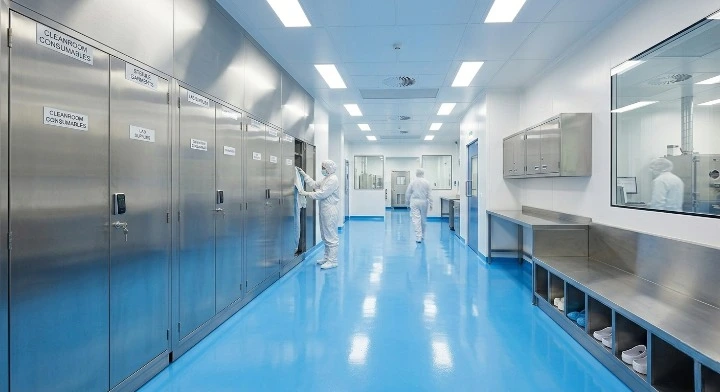
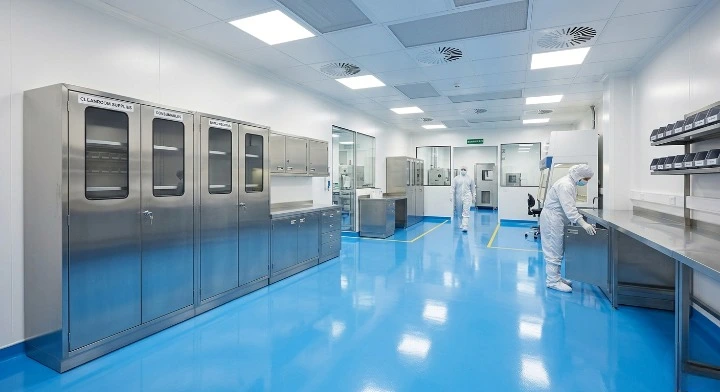
Storage in a controlled environment is not merely a shelf — it is a contamination-proof vault. Every cabinet in a GMP cleanroom is simultaneously a storage solution and a contamination control element: its construction determines whether stored materials remain sterile, whether airborne particles accumulate in dead zones inside, and whether decontamination is possible without dismantling. Metrolabs cleanroom SS storage cabinets are engineered as a natural extension of your sterile infrastructure.
Why a Cleanroom Cabinet Is a Contamination Control Component — Not Just Storage
Standard industrial lockers and cabinets introduce contamination risk — from shedding materials, right-angle corners that can never be fully cleaned, and horizontal tops that accumulate particles. Every Metrolabs cabinet is built to the Zero-Ledge philosophy that governs the entire cleanroom shell.
30° Sloped Top — The Most Important GMP Compliance Feature
The horizontal top surface of a standard cleanroom storage cabinet is a particle accumulation site and an illegal storage surface — GMP regulations prohibit storage of items on top of cleanroom furniture outside the defined laminar flow zone, but in practice, operators routinely place items on convenient flat surfaces unless the surface design physically prevents it. A 30° slope prevents objects from resting on the top surface — anything placed there slides off — while also eliminating the horizontal dust accumulation zone that a flat top creates. The sloped top is also a GMP inspection benefit: an inspector can verify the no-above-storage compliance simply by observing the cabinet form, without needing to review SOPs or operator training records.
Fully Coved Interior — R10mm at Every Corner
A right-angle corner inside a closed storage cabinet is the highest-risk particle accumulation and microbial growth site in the cabinet — it is invisible, inaccessible for wiping with a standard cleaning cloth, and provides physical anchorage for dust, moisture, and bio-burden that cannot be removed without dismantling the cabinet. Metrolabs cabinets have no right-angle interior corners — every internal corner — floor-to-side, side-to-back, floor-to-back, and shelf-to-side — is formed with a continuous R10mm radius that a cleaning cloth can wipe through in a single pass. The coved radius is fabricated as an integral part of the formed SS shell — not applied as a separate corner insert that can delaminate or gap — maintaining the continuous, smooth surface standard across the entire cabinet interior.
Medical-Grade Silicone Gasket — Hermetic Micro-Environment
The continuous silicone door gasket creates a sealed micro-environment inside the closed cabinet — maintaining the stored materials in the same air quality as the surrounding cleanroom while the door is open, and providing a hermetic barrier when the door is closed that prevents particle ingress from cleaning operations (particularly spray disinfection and VHP cycles where aerosol penetration into an open cabinet could contaminate stored sterile materials). The gasket material is pharmaceutical-grade closed-cell silicone — non-outgassing, VHP-resistant, and autoclavable for the highest-grade pharmaceutical and BSL applications. The gasket is continuous around the full door perimeter with no joints — a butt-joined gasket creates a potential leak point at the join that the continuous moulded gasket eliminates.
Perforated Shelving — Vertical Airflow Through Every Tier
A solid shelf inside a cabinet creates a stagnant air zone below the shelf where particles settle on stored materials rather than being swept by the cabinet’s internal air circulation. Perforated SS shelves — the same ∅25mm / 45mm pitch perforation pattern as the cleanroom worksurfaces — allow vertical air movement through all shelf tiers simultaneously, preventing the dead-air zones that solid shelving creates and maintaining particle counts within the cabinet at the same level as the surrounding cleanroom. Adjustable and removable perforated shelves allow the internal storage configuration to be modified for different item sizes without requiring cabinet replacement, and the removable shelves can be extracted for thorough cleaning or autoclaving in pharmaceutical applications.
Four Specialised Storage Solutions — Each for a Specific Cleanroom Need
Metrolabs designs storage cabinets for the specific material, access, and environmental requirements of high-stakes sectors — four specialised configurations beyond the standard cabinet:
Garment Storage Cabinets — HEPA-Filtered Sterile Gowning
Dedicated cabinets for cleanroom garments — coveralls, hoods, boot covers, gloves, and face masks — that must remain sterile and particle-free between uses. Standard storage cabinets are not suitable for garment storage because the air inside a closed cabinet with no air circulation becomes stagnant and particle-laden after each gowning event. Metrolabs garment cabinets include an integrated HEPA fan filter unit (FFU) mounted in the cabinet ceiling — a small centrifugal fan drawing air through an H14 HEPA filter and supplying a continuous downward flow of Grade A filtered air within the closed cabinet. This positive-pressure filtered air environment keeps garments suspended in their hanging positions in the cleanest possible air while the cabinet is closed. Hanging rods are SS 304 with smooth cylindrical profile — no exposed end-cap screws or bracket crevices where garment fibres can snag and shed. Available with UV-C germicidal lamp option for additional surface decontamination of stored garments.
Desiccator Cabinets — Nitrogen Purge / Silica-Gel Humidity Control
For moisture-sensitive electronic components, reference standard hygroscopic materials, lyophilised biological products, and chemical compounds that require controlled low-humidity storage conditions, Metrolabs desiccator cabinets provide an engineered low-RH micro-environment within the cleanroom. Two humidity control methods are available: nitrogen purge desiccator — the cabinet interior is continuously or periodically purged with dry nitrogen gas to maintain RH below 10%, with an inert gas atmosphere that also prevents oxidation of sensitive components; silica-gel tray desiccator — multiple regenerable silica-gel trays in the base of the cabinet absorb moisture passively, maintaining RH below 30–40% with indicator windows showing the saturation state of each tray. Both configurations use the same SS 316L coved interior and hermetic silicone gasket door as the standard cabinet, with the addition of a humidity indicator window in the door for monitoring without opening. Nitrogen inlet and outlet ports are factory-installed in the cabinet rear panel with SS compression fittings.
Chemical Storage Cabinets — Sump, Ventilation & COSHH Compliant
Purpose-engineered for storage of volatile, flammable, or corrosive reagents within the cleanroom or adjacent controlled areas — providing the chemical containment and ventilation requirements of COSHH and OSHA flammable storage regulations in a construction that does not introduce particle-shedding materials or plastic components into the controlled environment. The cabinet body is SS 316L throughout — the most corrosion-resistant standard for exposure to aggressive chemical vapours and accidental liquid spills. An integrated full-perimeter liquid-tight sump tray at the base (minimum 20% of total shelf capacity) contains any liquid spill from a failed container without allowing contamination of the cleanroom floor drain system. Ventilation ports (factory-installed at high and low levels in the cabinet rear panel) connect to the room’s dedicated solvent extraction system via SS 316L flexible bellows — preventing flammable vapour build-up inside the cabinet. Integral flame arrestor screens at both ventilation ports prevent external ignition sources from igniting vapour inside the cabinet. Self-closing door mechanism ensures the cabinet re-seals automatically if the door is released — meeting BS EN 14470-1 chemical storage cabinet requirements.
Pass-Through Cabinets — Material Transfer Without Airlock Breach
Integrated into the cleanroom wall panel system — a double-door cabinet recessed into the partition wall with one door opening into the cleanroom and the other opening into the adjacent area (corridor, support room, or lower-grade cleanroom) — allowing materials to be transferred between areas without breaching the cleanroom airlock or requiring personnel to exit and re-enter. The pass-through cabinet is designed as a pressure vessel with an internal pressure between the two rooms — the door seals and frame airtight seal ensure that no air bypasses the cabinet when both doors are closed, maintaining the pressure differential between the two rooms. Mechanical or electronic door interlock prevents both doors from being simultaneously open — ensuring the cleanroom pressure cascade is never directly breached during material transfer. The cabinet interior has the same coved construction, perforated shelves, and SS 316L specification as the standard cabinet, with UV-C germicidal lamp option for surface decontamination of items before entry to the higher-grade zone.
Three Door Types — Matched to Space and Access Requirements
The cabinet door configuration is selected based on the room space available, the access frequency, and whether visual inventory confirmation is required without opening:
Swing Door — Full Gasket Seal
The standard pharmaceutical cleanroom cabinet door — a full-face SS 316L swing door with a continuous medical-grade silicone perimeter gasket providing a hermetic seal when closed. The door swings on two concealed internal hinges (no exposed pin on the external cabinet face — concealed within the door frame thickness) and closes via an internal magnetic catch or cam-lock mechanism that compresses the silicone gasket uniformly around the full door perimeter. Flush-recessed SS 316L handle with no projecting surface — the handle recess is formed into the door face with a smooth radius at the recess perimeter. Available in single-door (standard widths up to 600mm) and double-door (widths above 600mm) configurations. Anti-fingerprint brushed finish maintains visual cleanliness between cleaning cycles. Full door opening to 180° via concealed hinge design — maximum interior access for loading and unloading.
Sliding Door — Space-Saving Cleanroom Access
For narrow cleanroom bays or cabinet positions where a swing door would obstruct personnel movement or conflict with adjacent equipment — the sliding door configuration provides full cabinet access without requiring any door clearance zone in front of the cabinet. The sliding door runs on a precision SS 304 track system mounted at the top of the cabinet — a bottom-free design that eliminates the floor track that would create a particle trap and cleaning obstacle. The door slides along the cabinet face — parked to one side when open — providing access to the full cabinet width without any door projection into the room. The sliding door includes a compression gasket that is activated by a closing handle mechanism — as the handle is turned to the closed position, cam actuators press the door face against the cabinet frame, compressing the perimeter gasket to achieve the hermetic seal. Designed for single-pull smooth operation even with cleanroom gloves. Available in single and double-panel sliding configurations.
Double-Glazed Vision Door — Contents Visible Without Opening
For storage of frequently referenced materials — reference standards, calibration weights, reagent bottles, analytical column inventory — where personnel must visually confirm contents identity and stock level without opening the cabinet door and disturbing the internal micro-environment. The vision door features a double-glazed borosilicate glass panel set into a stainless steel door frame — the double-glazing prevents condensation on the inner glass face that would obscure the contents view in cold or humid cleanrooms. The perimeter silicone gasket and magnetic closure maintain the same hermetic seal as the solid swing door — the glass panel is structural within the SS door frame and does not reduce the seal performance. The borosilicate glass panel is fully compatible with IPA wipe-down and VHP sterilisation cycles without crazing or delamination. Available with an integrated document holder on the door exterior (label-free, smooth SS pocket — no adhesive labels that shed particles) for cabinet identification and SOP number display.
Six Precision Engineering Features of Every Metrolabs Storage Cabinet
Every Metrolabs cleanroom storage cabinet is built to these standards — features that distinguish a purpose-designed cleanroom storage system from an adapted industrial locker:
SS 304 & SS 316L — No Non-Stainless Components
The entire cabinet — body, door, shelves, hinge assemblies, handle hardware, shelf support pegs, and any internal fittings — is fabricated in the same SS 304 or SS 316L specification. No plastic components (shelf supports, hinges, door bumpers, handle inserts), no rubber parts except the silicone door gasket, and no exposed lubricant on any moving part. Plastic components in cleanroom cabinets outgas volatile organic compounds, shed particles from UV degradation, and discolour under VHP exposure. SS throughout eliminates all three risks. For pharmaceutical Grade A/B cabinets, SS 316L is standard — post-fabrication degreased with IPA and citric acid passivated (ASTM A967) with certificate supplied.
Locking — Electronic & Manual Cam-Lock Options
Cabinet locking for controlled substances, reference standards, calibration equipment, or high-value reagents requires a mechanism that is both GMP-compliant (tamper-evident, access-auditable) and cleanroom-compatible (no exposed mechanism surfaces that shed particles). Metrolabs supplies two locking options: manual cam-lock — a smooth-bore SS 316L cylinder lock with a flush face plate (no projecting keyhole surround), opened with a stainless key, providing a simple mechanical audit trail through the use of the key; electronic keypad cam-lock — a flush-mounted SS 316L keypad or card reader that activates a motor-driven cam-lock mechanism, with electronic access logging of each opening event (date, time, user ID) downloadable to the facility’s quality management system. The electronic lock face is sealed IP54 — resistant to spray disinfection and VHP exposure.
Mounting Options — Floor, Wall-Integrated, or Wall-Hung
Metrolabs storage cabinets are available in three mounting configurations matched to the cleanroom layout and ISO class. Floor-mounted: the cabinet stands on adjustable SS bullet feet at a standard height, with the base of the cabinet sealed to the cleanroom floor at the perimeter to prevent under-cabinet dead zones. Wall-integrated: the cabinet is recessed into the modular cleanroom sandwich panel system, with the cabinet face flush with the room wall surface — eliminating the footprint entirely and simplifying the floor cleaning protocol. Wall-hung: the cabinet is mounted on SS 316L wall brackets with the base clear of the floor by a minimum 150mm — allowing full floor cleaning access below the cabinet and eliminating the floor-to-cabinet perimeter seal joint that a floor-mounted cabinet requires.
Adjustable & Removable Perforated Shelves
All Metrolabs cabinet shelves are adjustable on a 25mm pitch SS 316L shelf peg system — the shelf height can be reconfigured for different item sizes without tools or modification of the cabinet structure. Shelf pegs are smooth-bore SS 316L cylindrical pin type — no clip or snap fit that could fracture and shed metallic particles. Shelves are fully removable — pulled straight forward out of the cabinet for thorough cleaning, inspection, or autoclaving in pharmaceutical and BSL applications. The shelf support peg holes in the cabinet side walls are countersunk and smooth — no sharp holes edges that could catch on gloves or cut cleanroom garments. Each shelf is perforated to the ∅25mm / 45mm pitch standard — all perforations laser-cut with deburred smooth edges, electropolished to Ra <0.5μm on Grade A/B cabinet specifications.
VHP Compatible — Full Cabinet & Gasket Rated
Every component of the Metrolabs cabinet — including the door gasket, the shelf peg material, the lock mechanism housing, and any optional fittings — is specified for compatibility with VHP sterilisation at concentrations up to 1000 ppm for a minimum 30-minute exposure cycle. SS 316L body and shelves: tested to 500+ VHP cycles with no surface pitting, discolouration, or corrosion. Silicone door gasket: pharmaceutical-grade platinum-cured silicone is VHP-resistant and maintains its sealing properties and dimensional stability after repeated VHP exposure. Electronic lock housing: IP54 SS 316L face — the electronic components are protected from VHP penetration by the IP54 sealing. Any vision panel glass: borosilicate glass is VHP-compatible, with no crazing or delamination from VHP concentration or temperature variation during the sterilisation cycle.
Anti-Vibration Reinforced Base — Instrument Protection
For cabinets housing high-accuracy calibration equipment — reference weights, calibration standards, master gauges, precision instruments — that must remain within their specified tolerance range during storage, Metrolabs specifies a reinforced base plate and optional anti-vibration isolation feet. The reinforced base plate (3mm SS 316L vs standard 1.5mm shell thickness) distributes instrument point loads evenly across the floor contact area, preventing the base deformation that causes calibrated instruments to shift position. Anti-vibration isolator feet (neoprene or natural rubber compression mounts, one per levelling foot) decouple the cabinet from floor vibration from HVAC equipment, passing traffic, and adjacent machinery — maintaining stored calibration weights and reference standards within their specified calibration uncertainty throughout the storage period.
Metrolabs SS Storage Cabinet — Technical Standards
Every Metrolabs cleanroom storage cabinet is fabricated, finished, and documented to the following technical parameters:
| Feature | Metrolabs Standard | GMP Benefit |
|---|---|---|
| Grade A/B Material | SS 316L — electropolished or mirror | Max corrosion resist. — VHP & chloride rated |
| Grade C/D Material✓ Std | SS 304 passivated — hairline or dull | IPA / QAC / PAA compatible |
| Interior Corners | Coved — R10mm all corners | No microbial traps — fully wipeable |
| Top Design | 30° slope — GMP enforced | No above-cabinet storage — no dust accumulation |
| Door Seal | Continuous silicone gasket — no joints | Hermetic micro-environment — VHP resistant |
| Shelving | Perforated ∅25mm — adjustable & removable | No dead air — tool-free removal for cleaning |
| Locking | Manual cam-lock / electronic keypad | Access audit trail — controlled substance secure |
| Mounting | Floor / wall-integrated / wall-hung | Zero footprint option — floor cleaning access |
SS Storage Cabinets Across Every Regulated Cleanroom Sector
Sterile, secure, and non-shedding storage for every cleanroom where material integrity and GMP compliance are non-negotiable:
Pharmaceutical GMP
SS 316L storage cabinets for reference standards, calibration weights, sterile garments, and reagents in Grade A–D pharmaceutical suites. Wall-integrated option eliminates floor footprint in filling rooms.
Aseptic & Sterile
HEPA-filtered garment cabinets for aseptic suite gowning rooms. Pass-through cabinets in aseptic filling line airlocks — material entry without cleanroom breach.
Biotech & Cell Therapy
Desiccator cabinets for hygroscopic media and lyophilised biologicals in ATMP suites. Chemical storage for reagents in BSL-2/3 containment. VHP-rated for room-wide decontamination.
Hospital & Healthcare
SS 316L storage cabinets for hospital pharmacy cleanrooms, CSSD sterile supply stores, and OT scrub room PPE storage. Electronic lock with access log for controlled medication storage.
Quality Control Labs
Vision door cabinets for reagent and reference standard storage — contents visible without opening. Electronic cam-lock with access log for audit-ready reference standard custody record.
Electronics Cleanrooms
Desiccator cabinets for moisture-sensitive electronic components in semiconductor cleanrooms. Anti-vibration base for calibration standard storage. ESD-safe internal fitting options.
Food & Beverage
SS 316L chemical storage for FSSAI high-care food cleanrooms — COSHH-compliant sump and ventilation. Garment cabinets for PPE storage in food processing ante-rooms.
BSL Containment
Pass-through and chemical storage cabinets for BSL-2 and BSL-3 containment labs — SS 316L throughout, autoclave-compatible shelves, UV-C option for decontamination of transferred materials.
High-Accuracy Fabrication — A Structural Component of Your Sterile Infrastructure
Metrolabs cabinets are designed to withstand the rigours of pharmaceutical and research facility life — not standard office or commercial storage adapted for a cleanroom:
Custom Dimensions — Wall Alcove or Floor Space Specific
Metrolabs builds storage cabinets to fit any wall alcove, recessed niche, or floor space requirement — standard catalogue dimensions rarely match the available space in a custom cleanroom layout. Custom-dimensioned cabinets eliminate the gaps and loose fittings that standard-size cabinets leave when placed in non-standard spaces — each gap being a particle accumulation and cleaning access problem.
Material Test Certificates — Every Cabinet
Every Metrolabs storage cabinet is supplied with a mill test certificate (MTC) confirming the SS 304 or SS 316L grade, chemical composition, and mechanical properties of the material used in fabrication. The MTC and ASTM A967 passivation certificate are the primary documentary evidence for GMP equipment qualification and are included in the standard delivery package without additional charge.
VHP-Compatible Throughout — Including Gasket & Lock
The most common failure point in cleanroom storage cabinet VHP compatibility is the door gasket — many cabinets use neoprene or EPDM gaskets that degrade under VHP exposure, losing their sealing properties within 50–100 VHP cycles. Metrolabs pharmaceutical-grade platinum-cured silicone gaskets maintain dimensional stability and sealing performance through 500+ VHP cycles — matching the service life of the SS 316L cabinet body.
Non-Shedding Components — Degreased & Passivated at Dispatch
Every Metrolabs cabinet is degreased with IPA and citric acid passivated before packaging and dispatch — ready for immediate installation in an ISO-classified zone without further cleaning. Non-shedding quality means no plastic parts, no exposed lubricants, no adhesive labels on the internal or external surface — all identification is engraved or laser-etched into the SS surface.
Cleanroom Cabinet vs Standard Industrial Cabinet
From Space Survey to Installed & Documented Storage Cabinet
Metrolabs manages the complete supply and installation process — from initial space survey through delivery, installation, and IQ documentation:
Space Survey & Configuration
Wall alcove or floor position measured precisely. Mounting type (floor/wall-integrated/wall-hung) confirmed. Cabinet type, door type, lock type, shelving configuration, and any special features (HEPA, desiccator, chemical sump) specified. Custom dimensions drawn and signed off by customer.
Fabrication & Quality Inspection
Cabinet body TIG welded. Interior corners coved and ground to R10. Door fabricated with gasket housing and hinge recesses. Shelves laser-cut and deburred. Electropolishing / passivation performed. Door gasket fitted and seal test conducted. Lock mechanism fitted and tested. MTCs and passivation certs issued.
Installation & Integration
Cabinet positioned and secured — wall-integrated units recessed into panel system with flush face confirmed. Levelling feet adjusted. Floor-to-cabinet sealant applied. Electrical connections made for electronic locks and HEPA FFUs. Shelf positions set per configuration plan. All functions tested.
Documentation & IQ Issue
Cabinet dimensions, material certs, passivation certs, seal test record, lock function test record, HEPA cert (garment cabinets), and installation photographs compiled as cleanroom furniture IQ package for GMP facility validation submission.
SS Storage Cabinets Compliant with Every Major Cleanroom Standard
WHO & EU GMP
WHO GMP and EU Annex 1 require cleanroom storage to be constructed from smooth, non-porous, impervious materials with no crevices. The coved interior, silicone gasket, sloped top, and perforated shelves of Metrolabs cabinets satisfy all requirements. Material and passivation documentation supplied for GMP qualification.
WHO GMP · EU Annex 1ISO 14644-4
ISO 14644-4 requires cleanroom storage to be compatible with cleaning and decontamination methods. SS 304/316L, full TIG construction, ASTM A967 passivation, and VHP-rated silicone gasket satisfy ISO 14644-4 storage equipment requirements across all ISO Class 3–8 applications.
ISO 14644-4BS EN 14470-1 — COSHH
Chemical storage cabinet configurations comply with BS EN 14470-1 fire-resistant laboratory furniture and COSHH flammable reagent storage regulations — including the integrated sump tray (20% minimum capacity), flame arrestor ventilation ports, and self-closing door mechanism required by both standards.
BS EN 14470-1 · COSHHASTM A967 & 21 CFR
ASTM A967 passivation and SS mill test certificates satisfy US-FDA 21 CFR pharmaceutical equipment construction documentation. The cabinet IQ package is structured for direct inclusion in FDA equipment qualification submissions. Electronic lock access logs support 21 CFR Part 11 electronic record requirements for controlled substance storage.
ASTM A967 · 21 CFR Pt 11Ready to Install Precision-Built SS Storage in Your Cleanroom?
Contact Metrolabs for a free consultation. Our cleanroom furniture specialists will assess your storage requirements, space constraints, ISO class, GMP grade, and security needs — then fabricate, supply, install, and document your storage cabinets with full IQ documentation at delivery.
🔒 Request a Free Storage Cabinet Quote
Quote Request Received!
Our cleanroom furniture team will contact you within 24 working hours.
Immediate: 9840931231