
Wall-Side Cleanroom Work Tables
In a controlled environment, every surface is a contamination risk or a contamination control measure — there is no neutral ground. Metrolabs wall-side cleanroom work tables are precision-fabricated from SS 304 and SS 316L with a Zero-Ledge philosophy: no crevices, no particle traps, no horizontal ledges — a workspace that is as integral to your contamination control strategy as the HEPA filter above it.
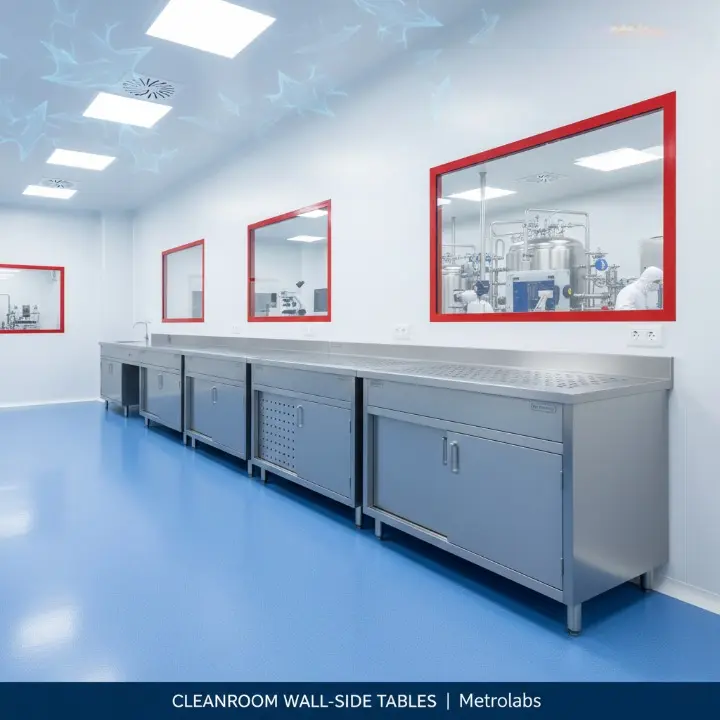
Precision-Fabricated for Real Pharmaceutical & Research Cleanrooms
Every Metrolabs wall-side cleanroom work table is custom-fabricated to your exact wall dimensions, ISO class, and GMP grade — built from SS 304 or SS 316L with full TIG welds, integrated coved backsplash, and electropolished surfaces:
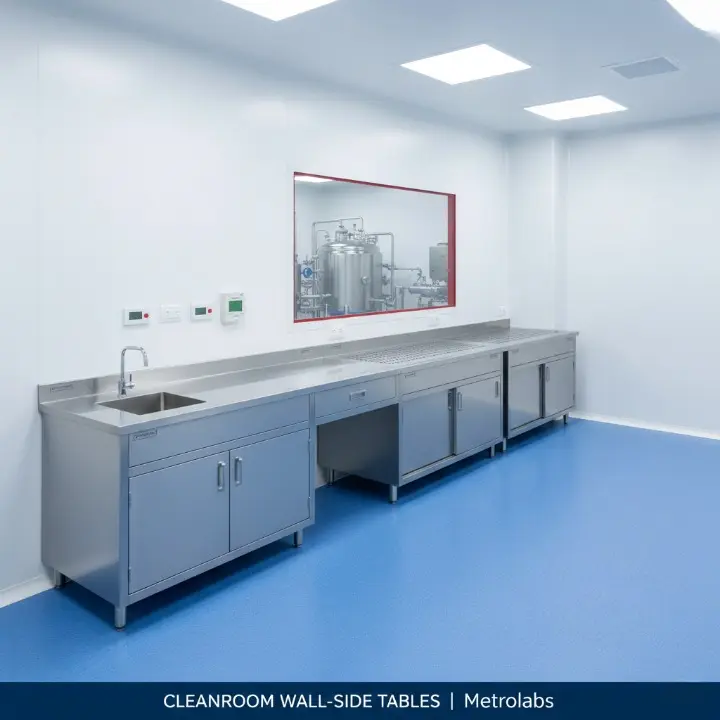
Two Worksurface Options — Matched to Your ISO Class & Airflow Regime
The choice of worksurface is determined by the ISO class of the room and whether the table is positioned within a vertical laminar airflow zone. Both options are available in SS 304 and SS 316L, in all standard finishes:
Solid Top — Mirror / Hairline / Electropolished
The standard worksurface for pharmaceutical Grade C/D rooms, ISO Class 7–8 controlled environments, and any application where the primary requirement is a flat, uninterrupted, chemically inert platform for sample preparation, instrument housing, or documentation. The solid top is a single-piece pressed or welded SS 304/316L sheet — no seams, no joints, no particle-trapping recesses in the worksurface. Available in three surface finishes: Mirror (Ra <0.4μm electropolished — for Grade B/C aseptic and pharmaceutical cleanrooms requiring the highest hygienic surface standard), Hairline (Ra ~0.8μm — for Grade C/D and general cleanroom applications), and Dull Matte (Ra ~1.6μm — for ISO 7–8 and controlled storage areas). All solid top configurations have a continuous 50–100mm integrated coved backsplash that seals against the wall panel — preventing liquids or particles from migrating behind the table into the gap between the table and the wall panel system.
Perforated Top — Laser-Cut ∅25mm on 45mm Pitch
The Grade A and B cleanroom standard — a precision laser-cut perforated SS 304/316L worksurface designed to allow vertical laminar airflow from the ceiling HEPA filter to pass through the work plane unimpeded, maintaining the unidirectional piston effect through the table area. In a Grade A laminar flow zone, a solid worksurface creates a “dead air” pocket directly above the table surface where particles generated by the critical operation accumulate rather than being swept downward to the floor-level return air risers. The perforated surface eliminates this dead zone — the laminar piston continues through the table surface, ensuring that the air quality immediately above the sample or product maintains Grade A (ISO Class 5) compliance throughout the operation. The perforation pattern is laser-cut to ∅25mm holes on a 45mm pitch — providing approximately 30% open area, optimised to allow sufficient airflow through the work plane without compromising structural rigidity or worksurface usability. The perforated top is available electropolished (Ra <0.5μm) for Grade A/B aseptic pharmaceutical applications.
Why a Wall-Side Table Must Be Designed for the Cleanroom — Not Adapted for It
Standard laboratory benches adapted for cleanroom use create contamination risks by introducing design features incompatible with GMP requirements. Metrolabs wall-side tables are designed from the ground up for cleanroom installation.
Zero-Ledge Philosophy — No Particle Accumulation Anywhere
Every horizontal surface on a cleanroom work table that is not the active worksurface is a potential particle accumulation site — and particles that accumulate on surfaces are re-entrained into the room air by vibration, personnel movement, and cleaning. Metrolabs wall-side tables have no horizontal ledges on the frame structure, no exposed bolt heads or bracket lips, no gaps between table and wall. The Zero-Ledge philosophy extends to the frame legs (tubular, no flat bar ledges), the backsplash (coved radiused join to the worksurface), and the floor levellers (encapsulated housing with no exposed thread surfaces).
Fully TIG Welded — No Bolt-and-Bracket Assembly
Bolt-and-bracket assembly — the standard construction method for adjustable-height laboratory benches — creates multiple contamination pathways: the bolt thread space accumulates particles and is impossible to sterilise; the bracket face-to-frame interface creates an inaccessible crevice; and metallic particles can be shed from thread engagement surfaces through vibration. Metrolabs wall-side tables are fully TIG welded — a single continuous weld at every frame junction — eliminating all three contamination pathways. The weld profile is fully dressed to be flush with the surrounding metal, maintaining the smooth, wipeable surface standard across the entire table structure.
Flush Panel Sealing — The Table as Part of the Clean Shell
The wall-side table is the component where the contamination control requirements of the furniture and the cleanroom wall panel system most directly interact. Metrolabs wall-side tables include an integrated continuous backing plate that seals against the modular cleanroom panel wall face — with a perimeter bead of pharmaceutical-grade silicone sealant applied at installation to create a fully sealed, impervious table-to-wall junction. The result is that the wall-side table becomes a structural extension of the cleanroom shell rather than a separate piece of furniture with a gap behind it — and the back of the table and the adjacent wall panel section can both be wiped down as a single continuous surface.
Airtight Cable Grommets — Utility Lines Without Dust Traps
Equipment power cords, data cables, gas supply lines, and vacuum connections must pass through the table surface to reach instruments sitting on it — and the hole through which they pass is a particle trap if not properly sealed. Metrolabs wall-side tables include optional precision-machined airtight SS 304 cable grommets in the worksurface — each grommet has a split silicone plug that grips the cable and seals around it, preventing particle migration through the cable hole while maintaining the airtight integrity of the worksurface. Unused grommets are sealed with flush SS blanking plugs.
Six Precision Engineering Features
Every Metrolabs wall-side cleanroom work table is built to the following precision engineering standards — features that distinguish a purpose-designed cleanroom workstation from a standard lab bench:
SS 304 & SS 316L Construction — Surgical Grade Material
The entire table — worksurface, frame, legs, backsplash, and levellers — is fabricated from the same material specification: SS 304 for Grade C/D and general cleanrooms, SS 316L (2.1–2.8% molybdenum addition) for Grade A/B pharmaceutical, BSL-2/3, and high-humidity wash-down environments. SS 316L provides dramatically improved resistance to pitting corrosion from chloride-based sanitisers (the primary failure mode of SS 304 in pharmaceutical cleanrooms) and full compatibility with VHP sterilisation at concentrations up to 1000 ppm. Post-fabrication, all tables are degreased with isopropyl alcohol and citric acid passivated (ASTM A967) — removing free iron and weld discolouration to restore the full corrosion resistance of the passive chromium oxide surface layer.
Electropolished Surface — Ra <0.5μm Biofilm Inhibition
Electropolishing removes the microscopic surface asperities (peaks and valleys at the micron scale) that provide physical anchorage for bacterial biofilm formation — without these anchorage points, bacterial adhesion is dramatically reduced, cleaning agents remove contamination in a single wipe, and cleaning validation is simplified. At Ra <0.5μm, the electropolished surface meets the EU Annex 1 and WHO GMP requirement for pharmaceutical cleanroom surfaces in Grade A/B zones. The electropolished finish also improves the reflectivity of the worksurface — making it easier for operators to visually detect residual contamination, spills, or product cross-contamination before they become a problem.
Integrated Coved Backsplash — 50–100mm Wall Seal
The backsplash is a continuous integral upstand at the rear edge of the worksurface, formed in the same material and finish as the worksurface itself — never a separately attached plate that creates a weld line at the base collecting liquid and particles. The junction between the worksurface and the backsplash is coved with a continuous R10 radius (minimum) — no right-angle corner that is impossible to fully wipe clean. The backsplash height (50mm standard, 100mm optional) determines the containment volume for liquid spills on the worksurface — a 100mm backsplash retains approximately 4 litres of spilled liquid without overflow behind the table. The backsplash top edge is sealed to the wall panel surface with pharmaceutical-grade silicone at installation — the only sealant joint in the entire table, and fully inspectable from the front.
Encapsulated SS Leg Levellers — Vibration Dampening
The leg levelling feet are encapsulated stainless steel threaded adjusters housed within a smooth SS cylinder — no exposed thread between the leg tube and the floor, which would create particle accumulation in the thread spiral and make the foot impossible to clean. The levelling foot base disc is a flat, smooth SS 304 disc making full-face contact with the cleanroom floor — the large contact area distributes the table load evenly and prevents the indentation of vinyl cleanroom flooring. Optional anti-vibration mounts — natural rubber or neoprene compression mounts inserted between the foot disc and the leg tube — are available for tables housing high-accuracy analytical balances, microscopes, or vibration-sensitive spectroscopy instruments where floor-borne vibration transmission must be minimised.
Airtight Cable Grommets — Optional Utility Integration
For tables requiring equipment connections — power, data, gas, vacuum, or compressed air — Metrolabs integrates precision-machined SS 304 airtight cable grommets in the worksurface at the positions agreed during the furniture design phase. Each grommet has a split silicone plug that seals around the cable and maintains worksurface airtight integrity while the cable is in place. Unused grommet positions are fitted with flush SS blanking plugs. Gas service fittings (bayonet or compression type) can be factory-installed in the backsplash rather than the worksurface — providing horizontal gas connections that do not require holes in the worksurface plane and do not interrupt the laminar flow through a perforated top.
High Ground Clearance — Floor Cleaning & Riser Access
The table leg design provides a minimum 150mm clearance between the floor and the lowest horizontal structural element — sufficient for standard floor mop and scrubber-dryer equipment to pass under the table during floor cleaning without requiring table movement. This floor clearance also ensures that the return air riser grilles fitted at floor level in the wall behind the table are not obstructed by the table structure — maintaining the full extract airflow through the risers that is essential for the low-level return air sweep in Grade A/B laminar flow zones. The open underside also makes spill detection and cleaning under the table straightforward — a critical GMP requirement for pharmaceutical manufacturing areas where undetected spills under equipment create microbial growth and product cross-contamination risks.
Metrolabs Wall-Side Table — Technical Standards
Every Metrolabs wall-side cleanroom work table is fabricated, finished, and commissioned to the following technical parameters:
| Feature | Metrolabs Standard | Cleanroom Benefit |
|---|---|---|
| Grade A/B Material | SS 316L electropolished | Max corrosion resistance — VHP & chloride rated |
| Grade C/D Material✓ Std | SS 304 passivated | IPA / QAC / PAA compatible — cost-effective |
| Surface Finish | EP Ra<0.5μm / Mirror / Hairline | Biofilm inhibiting — cleaning validation simplified |
| Welding | Full TIG — no MIG / bolts | No crevices — no particle-shedding joints |
| Backsplash | Integral 50–100mm — R10 coved | Zero wall-table gap — spill containment |
| Perforated Top | ∅25mm / 45mm pitch — ~30% open | Laminar piston through table — Grade A preserved |
| Height Range | 700–900mm adjustable | Ergonomic — accommodates seated / standing work |
| Leg Levellers | Encapsulated SS — anti-vib option | Stable on uneven floors — no exposed thread |
Wall-Side Cleanroom Tables Across Every Regulated Sector
Purpose-built wall-side workstations for every cleanroom class and industry where non-shedding, hygienic lab furniture is a compliance requirement:
Pharmaceutical GMP
SS 316L EP perforated tables for Grade A/B filling and weighing suites. SS 304 solid tables for Grade C/D process rooms. VHP rated and EU Annex 1 compliant.
Aseptic & Sterile
Perforated SS 316L wall-side tables in Grade A aseptic filling lines — laminar piston uninterrupted through worksurface, anti-vibration feet for balance and filling equipment.
Biotech & Cell Culture
SS 316L wall-side workstations in ATMP and cell culture GMP suites — electropolished surfaces, airtight grommets for incubator power, anti-vibration mounts for microscopes.
Hospital & Healthcare
SS 316L wall-side tables for hospital pharmacy cleanrooms, CSSD preparation areas, and OT scrub rooms — NABH-compliant, foot-pedal sink integration available.
Microbiology & BSL
SS 316L wall-side tables for BSL-2 and BSL-3 containment labs — autoclave-rated material, no horizontal ledges that trap biological contamination, chemical-resistant throughout.
Electronics Cleanrooms
ESD-rated SS 304 wall-side tables for semiconductor and electronics cleanrooms — conductive worksurface laminate option, grounding connections in backsplash.
Food & Beverage
SS 316L wall-side tables for FSSAI and HACCP high-care food production — antimicrobial surface treatment option, deep-coved backsplash for liquid containment in wet areas.
NABL Research Labs
SS 304 wall-side tables for NABL-accredited testing labs — material test certificates and passivation documentation for ISO/IEC 17025 facility compliance records.
A Structural Investment — Designed as an Extension of Your Sterile Infrastructure
Metrolabs designs wall-side tables as structural components of the cleanroom — not as furniture placed inside it. Every design decision is evaluated against the room’s contamination control requirements, ISO class, and sterilisation regime:
Custom Dimensions — Exact Wall Length Fit
Metrolabs manufactures wall-side tables to the exact wall lengths and equipment footprints of your cleanroom layout — eliminating the gaps between table ends and wall corners that standard catalogue-size tables leave. A gap of even 25mm between a table end and a wall panel corner creates a dead space where particles accumulate and where floor cleaning is impossible. Custom-dimensioned tables eliminate this gap by design.
Material Test Certificates — Every Unit
Every Metrolabs cleanroom table is supplied with a mill test certificate (MTC) confirming the SS 304 or SS 316L material grade, the heat and lot number, the chemical composition, and the mechanical properties of the specific coil or plate used in fabrication. The MTC is the documentary evidence that the material is what the specification requires — essential for GMP facility qualification and ISO 14644-4 equipment documentation.
Passivation Certificate — ASTM A967 Tested
Post-fabrication citric acid passivation is performed and documented to ASTM A967 — the test involves a 24-hour copper sulphate wipe test that confirms the passive chromium oxide layer is fully restored across all welded and machined surfaces. The passivation certificate is supplied with every table for inclusion in the facility IQ documentation.
VHP Compatibility Testing — All Materials and Welds
For pharmaceutical facilities with room-wide VHP sterilisation programmes, Metrolabs tests all materials and weld configurations for compatibility with VHP at concentrations up to 1000 ppm for a minimum of 30 minutes exposure — the standard pharmaceutical VHP cycle. SS 316L tables with citric acid passivation and electropolished finish maintain their surface specification and corrosion resistance after 500+ test cycles.
Worksurface Comparison by ISO Class
ⓘ Perforated tops require instrument base plates for items that cannot rest over holes. Metrolabs supplies custom SS insert plates that sit in the perforated zone where needed — restoring solid surface for specific instruments while maintaining perforation in the rest of the worksurface.
Built to Your Exact Specifications — Four Key Customisation Areas
Metrolabs manufactures every wall-side table to the specific dimensional, material, and integration requirements of your cleanroom layout:
Custom Dimensions — Any Wall Length or Depth
Tables are manufactured in any length from 600mm to 6000mm — matching your exact wall bay dimensions to eliminate end gaps. Standard depths are 600mm and 750mm, with 900mm available for deep-equipment applications. Height is adjustable 700–900mm at installation. For rooms with non-standard wall configurations, curved plan sections, or corner positions, Metrolabs fabricates the table to the drawn dimensions of the wall layout with angled or curved ends that maintain the flush wall seal at every point.
Service Integration — Gas, Power, Vacuum, Data
Service connections — power sockets (SS 316L flap-cover IP54), gas taps (bayonet or compression, labelled), vacuum fittings, compressed air, and data ports (RJ45 SS protected) — can be factory-integrated into the backsplash at specified positions, minimising cable and supply line lengths and eliminating the cluttered cable runs that floor-level service connections create. Backsplash integration keeps service connections vertical-face mounted — not horizontal, preventing liquid ingress to service ports during surface cleaning. All service penetrations in the backsplash are sealed with pharmaceutical-grade silicone at the backsplash-panel wall interface.
Under-Table Storage Integration — Cupboards & Open Shelves
The under-table space can be used as cleanroom-compliant storage — either enclosed SS cupboards with sloped tops (zero above-cupboard storage surface) and flush-recessed handles, or open-frame undershelf units with perforated SS shelves for airflow preservation. Under-table cupboards are integral to the table structure — not separate freestanding units — maintaining the continuous sealed base that prevents under-table dirt accumulation at the floor-cupboard junction. Optional lockable cupboard variants for controlled substance storage within the cleanroom. All under-table storage units share the same SS specification and finish as the table top.
Anti-Vibration Mounts — Instrument Protection
For wall-side tables housing analytical balances, precision scales, viscometers, spectrophotometers, or any other vibration-sensitive instrument, Metrolabs integrates natural rubber or neoprene anti-vibration compression mounts between the leg tube and the floor levelling disc — decoupling the table from floor-borne vibration transmitted by HVAC equipment, adjacent machinery, or foot traffic. The isolation frequency of the mounts is calculated from the mass of the instrument and its minimum required isolation frequency (typically 1–5 Hz) to ensure effective isolation across the relevant vibration spectrum. Mass-loaded levelling pads are also available for higher-mass instrument tables where static load absorption is the primary requirement.
From Site Survey to Installed & Documented Workstation
Metrolabs manages the complete supply and installation process — from initial site survey through delivery, installation, and documentation:
Site Survey & Design
Metrolabs surveys the cleanroom wall dimensions, panel layout, return air riser positions, and service connection points. Table dimensions, service integration positions, backsplash height, and surface finish specified. Customer review and sign-off on dimensioned drawings before fabrication begins.
Fabrication & QC
Tables fabricated in specified SS 304/316L. All TIG welds completed and dressed flush. Perforations laser-cut. Electropolishing performed where specified. Citric acid passivation completed. Dimensional and surface finish QC inspection. Material test certificates and passivation certificates issued.
Installation & Sealing
Tables delivered in protective packaging. Installed against wall panels — backsplash positioned flush against panel face. Levellers adjusted — worksurface level confirmed with precision spirit level. Pharmaceutical-grade silicone applied at backsplash-to-wall junction. Cable grommets and service connections tested. Under-table clearance confirmed per design.
Documentation & IQ
Table dimensions, material specifications, finish certificates, passivation certificates, and installation photographs compiled. Sealant application recorded. All documentation packaged as the cleanroom furniture IQ (Installation Qualification) record for the facility validation submission.
Wall-Side Tables Specified to Every Major Cleanroom Standard
WHO & EU GMP
WHO GMP and EU Annex 1 require cleanroom surfaces — including furniture — to be smooth, non-porous, impervious, and easy to clean. SS 316L electropolished wall-side tables satisfy all four requirements, with material test certificates and passivation documentation as GMP qualification evidence.
WHO GMP · EU Annex 1ISO 14644-4
ISO 14644-4 (cleanroom design) requires that furniture and equipment surfaces are compatible with the cleaning and decontamination methods used in the cleanroom — specifying smooth, non-porous, non-shedding surfaces. Metrolabs tables satisfy these requirements in both SS 304 (Grade C/D) and SS 316L (Grade A/B) specifications.
ISO 14644-4ASTM A967 Passivation
ASTM A967 is the US standard for passivation of stainless steel parts, specifying the citric acid or nitric acid treatment processes and the copper sulphate test for confirmation of passive layer restoration. Metrolabs passivation certificates issued to ASTM A967 are the standard documentary evidence for GMP and US-FDA equipment qualification submissions.
ASTM A967 · 21 CFRNABL & COSHH
NABL ISO/IEC 17025 accreditation requires documented equipment specifications confirming material and surface properties of laboratory furniture. Metrolabs material test certificates and passivation records directly satisfy this requirement. Chemical storage table variants comply with COSHH and OSHA flammable reagent storage regulations.
NABL · COSHH · OSHAReady to Install Precision-Built Wall-Side Tables in Your Cleanroom?
Contact Metrolabs for a free consultation. Our cleanroom furniture specialists will survey your wall dimensions, specify the correct material, surface finish, worksurface type, and service integration for your ISO class and GMP grade — then fabricate, supply, install, and document your wall-side tables with full IQ documentation at delivery.
🧱 Request a Free Wall-Side Table Quote
Quote Request Received!
Our cleanroom furniture team will contact you within 24 working hours.
Immediate: 9840931231