
Cleanroom SS Trolleys — High-Accuracy Logistics for Sterile Environments
In the movement of critical materials, the trolley is more than a transport tool — it is a mobile extension of your sterile zone. Metrolabs cleanroom SS trolleys are engineered to facilitate the safe and contamination-free transit of reagents, sterile garments, sensitive instruments, and bulk raw materials across ISO-classified zones. Designed with the Zero-Ledge philosophy throughout, our trolleys ensure your logistics chain maintains the same rigorous standards as the stationary cleanroom infrastructure.
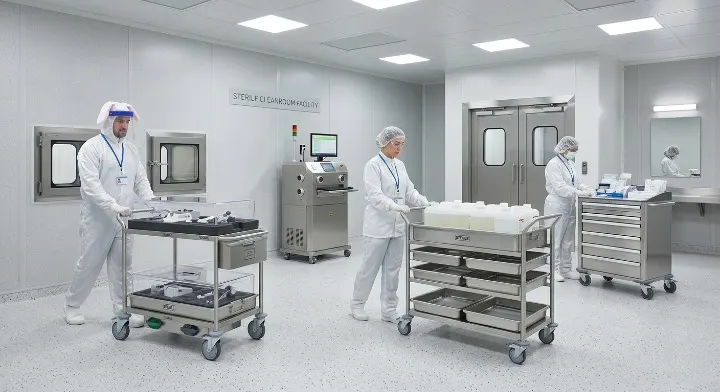
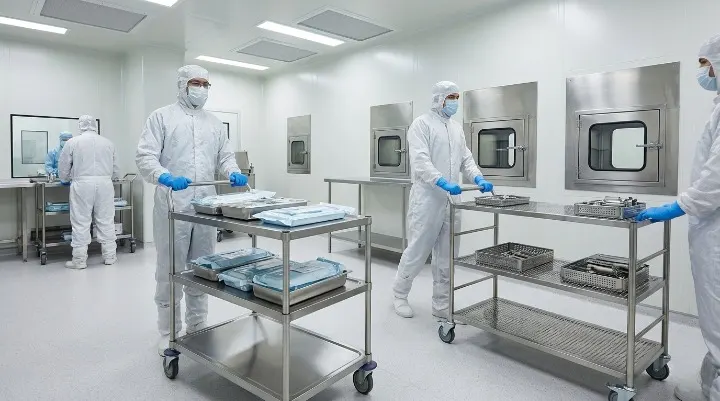
Why a Cleanroom Trolley Is a Mobile Extension of the Sterile Zone — Not Just a Cart
Standard utility carts harbour dust in bolt threads, hollow frame ends, and plastic wheel hubs. Every surface that touches the cleanroom air during transit is a contamination source. Metrolabs designs every trolley detail to prevent this — from the sealed frame ends to the caster material specification.
Perforated Shelves — Preventing Stagnant Air Zones During Transit
As a trolley moves through a laminar flow cleanroom, it displaces air and creates turbulent wake zones behind it. A solid-shelf trolley moving through a Grade B zone creates a moving stagnant air pocket — a region of disrupted laminar flow where the particle count momentarily rises as the shelf blocks the HEPA air piston. The perforated shelf design allows the HEPA air to continue flowing vertically through the trolley structure during transit — the trolley passes through the laminar zone without creating a stagnant envelope. Items stored on the shelves during transit receive the same quality HEPA airflow as they would on a stationary perforated workbench. For Grade A and B zones this is not optional — a solid-shelf trolley moving through a Grade A zone creates a measurable particle count disruption that can be detected by environmental monitoring and constitutes a GMP deviation.
TIG Welded — Eliminating the Crevice Problem in Mobile Equipment
The contamination risk of bolted furniture is amplified in mobile equipment — because a trolley in transit experiences vibration from floor surface irregularities, caster resonance, and the inertia of its load. This vibration progressively loosens bolted connections, generating metallic particles from fretting of the contact surfaces at a rate proportional to the number of transit cycles. A trolley that makes 50 round trips per day between production and storage creates 50 vibration events per day at each of its bolt-in-slot connections — cumulative metallic particle generation that is invisible but measurable in the room particle count. Metrolabs cleanroom trolleys are fully TIG welded at every joint — the vibration from transit has no bolt threads to loosen and no fretting surfaces to generate particles from. The welded structure becomes stronger under load cycling, not weaker.
Total-Lock Foot Pedal — True Stability During Loading and Unloading
The most common trolley-related GMP incident in a pharmaceutical cleanroom is a partially loaded trolley that moves unexpectedly during the loading operation — causing an item to be dropped, spilled, or contaminated by contact with a non-sterile surface as the operator reaches to prevent the trolley from rolling away. Individual caster brakes require the operator to bend down and engage each of the four brakes separately — a sequence that takes 10–15 seconds and requires four separate actions that can be skipped or partially completed under time pressure. The Metrolabs total-lock foot pedal engages all four casters simultaneously through a single foot action — pressing the pedal locks the trolley in position in the time it takes to place one foot on a floor-level lever. The trolley cannot move until the operator deliberately releases all four brakes with the opposing face of the same pedal.
Ergonomic Push-Bar — Preventing Garment Damage and Contamination
The push-bar on a cleanroom trolley is the most frequently touched component of the unit — every operator who moves the trolley contacts the push-bar directly through their cleanroom gloves. A push-bar with exposed bolt heads, thread ends, or bracket joins is a garment damage risk — the sharp edges of exposed fasteners tear cleanroom suit fabric, creating a contamination pathway through the suit. Metrolabs integrates a full-width ergonomic push-bar tube directly into the trolley frame by TIG welding — a smooth, continuous tube with no fasteners, no exposed ends, and a weld-filled junction to the upright frame member ground flush. The 32mm outer diameter provides a comfortable grip through three layers of cleanroom gloving, and the bar height is positioned at the ergonomic push height for the loaded trolley weight on flat floor surfaces.
Four Specialised Trolley Configurations — Workflow-Specific Cleanroom Logistics
Metrolabs customises trolleys for the specific transit, storage, and handling requirements of high-stakes cleanroom sectors — four configurations for defined material movement workflows:
Garment Trolleys — Hanging Rails & Compartments for Sterile Suit Transport
Dedicated trolleys for the transport of sterile cleanroom garments — coveralls, hoods, boot covers, gloves, and face masks — from the cleanroom laundry or storage area to the gowning room. Standard open-frame trolleys create garment contamination risks during transit — folded garments on a shelf contact the shelf surface and absorb particles from any contamination on the shelf, and garments stacked on top of each other create contamination transfer between adjacent items. Metrolabs garment trolleys are configured with a top-tier integrated SS 316L hanging rail — full-length, smooth cylindrical profile with coved end welds — that allows coveralls and gowns to hang freely in their natural orientation, separated by individual garment dividers — rigid SS 316L fins spaced at 50mm intervals — that prevent garment-to-garment contact and maintain airflow around each hanging garment during transit. Individual lower compartments (three or four per tier, separated by SS 316L perforated dividers) store folded PPE items in the gowning sequence order — hoods, overshoes, gloves, and face masks — with the outermost-worn items in the bottom compartment and innermost-worn items at the top. A fully enclosing dust cover — a lightweight polyester or SS mesh enclosure clipped to the trolley frame — protects all garments during transit through lower-grade corridors.
Autoclavable Trolleys — Full-Cycle 134°C Sterilisation Ready
Cleanroom trolleys for Grade A and B pharmaceutical aseptic manufacturing — where the trolley must be sterile before it enters the aseptic zone, not merely clean. Standard trolleys cannot be autoclaved because their caster bearings (standard steel ball bearings) corrode and fail at 134°C, and their rubber anti-vibration mounts or seals swell and degrade, releasing particles and losing dimensional stability after the first autoclave cycle. Metrolabs autoclavable trolleys are fully engineered for 134°C / 3 bar autoclave cycles with no component degradation. Caster wheels: medical-grade PEEK-cage ball bearings rated to 150°C — the PEEK polymer cage maintains its dimensional stability and bearing separation function through repeated autoclave cycles without swelling, outgassing, or metal-to-metal contact. Caster axles and housings: SS 316L — no component degradation at autoclave temperature. Frame seals (where used): PTFE-coated seals rated to 150°C. The autoclavable trolley is supplied with a first autoclave cycle certification record at handover, and is rated for 50 autoclave cycles before first bearing inspection. Custom packing-list hooks and SS 316L load restraint bars are available for securing items during autoclave loading.
Instrument Trolleys — Reinforced Anti-Vibration for Analytical Equipment
Heavy-duty trolleys designed for the safe transit of high-accuracy analytical instruments — precision balances, portable spectrophotometers, viscosity meters, portable particle counters, and calibration standards — between laboratory modules and to-and-from the calibration area. The instrument trolley addresses the specific vulnerability of analytical instruments to shock and vibration during transit — a balance or spectrophotometer knocked against a door frame or jolted over a floor expansion joint can suffer beam deflection, optical misalignment, or sensor damage that requires recalibration or repair. The instrument trolley uses a reinforced SS 316L frame (50×50×3mm section vs standard 2mm) for higher stiffness under point loads, a marine-edge solid worksurface to prevent instrument movement, and neoprene anti-vibration mounts between the worksurface and the frame — providing mechanical isolation from the vibration transmitted through the frame during transit. Lateral SS restraint bars with quick-release SS latches provide physical containment of the instrument during transit, preventing tipping even in the event of sudden deceleration or an uneven floor surface. The total-lock pedal is automatically engaged when the trolley is stopped — the locking mechanism cannot be inadvertently released during the loading and unloading of a heavy instrument.
Multi-Tier Stock Trolleys — Adjustable Shelving for Bulk Material Transit
High-capacity multi-tier trolleys designed for the efficient transit of bulk raw materials, reagent bottles, packaging components, and consumables between the material receipt and quarantine areas, the storage zone, and the cleanroom production suites — the material logistics backbone of pharmaceutical and biotech manufacturing facilities. The multi-tier stock trolley accommodates a wide range of container sizes through a fully adjustable shelf system — three or four tiers on a 25mm pitch peg system allowing any combination of tier heights from 100mm to 600mm clear height per tier. This allows the same trolley to carry 1-litre reagent bottles (requiring approximately 200mm clear height) on one trip and 25-litre carboys (requiring approximately 450mm clear height) on the next without any reconfiguration other than repositioning the shelf pegs. Load-rated perforated shelves (150kg UDL per shelf for standard specification, 200kg UDL for heavy-duty specification) accommodate the weight of dense reagent containers without shelf deflection or frame distortion. Corner bumpers — SS 316L dome-head protectors at each frame corner — prevent damage to the cleanroom panel walls during corridor manoeuvring.
Six Precision Engineering Features of Every Metrolabs Cleanroom Trolley
Every Metrolabs cleanroom SS trolley is built to these standards — making it a cleanroom-compatible mobile infrastructure component rather than an industrial cart placed inside a sterile zone:
SS 304 & SS 316L — Electropolished, Passivated, Zero Particulate
Every component of the Metrolabs cleanroom trolley — frame uprights, cross-bracing, shelf panels, push-bar, caster mounting plates, brake pedal linkage, and shelf support pegs — is SS 304 or SS 316L throughout. No plastic components in the frame or shelf structure, no painted surfaces, no chrome-plated fittings, and no zinc-plated hardware anywhere on the unit. SS 316L is specified for Grade A/B pharmaceutical applications and for trolleys in rooms with VHP decontamination programmes — the passivated SS 316L surface withstands VHP at 1000 ppm concentration through 500+ cycles. The electropolished frame surface (Ra <0.5μm for Grade A/B specification) has the same biofilm-inhibiting micro-smoothness as the fixed workstation surfaces — the trolley does not degrade the environmental standard of the zones it visits. Post-fabrication: IPA degreased and ASTM A967 citric acid passivated. MTC and passivation certificate supplied.
Perforated & Marine-Edge Shelves — Application-Matched
Metrolabs offers two shelf specifications for cleanroom trolleys. Perforated shelves — ∅25mm / 45mm pitch laser-cut SS 316L with deburred, smooth perforation edges — providing approximately 30% open area for laminar flow continuity during both transit and stationary periods. All perforation edges are electropolished to prevent any sharp edge from catching a glove during loading and unloading. Marine-edge shelves — a continuous SS 316L shelf with an integral 8mm raised perimeter bead, available with or without a floor drain port — contain liquid spills from damaged containers during transit and prevent small vials and components from sliding off the shelf during corridor manoeuvring. Both shelf types are available at 150kg and 200kg UDL load ratings and can be mixed within the same trolley — e.g., marine-edge on the top tier for liquid containers and perforated on lower tiers for solid items.
Total-Lock Foot Pedal — All-Four Casters Locked in One Action
The Metrolabs total-lock brake system uses a linked SS 316L rod-and-cam mechanism that connects all four caster brake assemblies to a single floor-level pedal. When the pedal is pressed, the cam rotates simultaneously at all four caster positions, engaging a friction pad against each caster wheel and locking both the wheel rotation and the swivel mechanism — preventing the trolley from moving in any direction, not just from rolling. The total-lock mechanism is the most critical safety feature of a loaded cleanroom trolley — a trolley carrying vials, reagent bottles, or an analytical instrument that moves unexpectedly during loading or unloading is a serious GMP and safety incident. The linked mechanism requires one foot placement to lock all four — and one foot placement to release. All linkage components are SS 316L — no plastic rods, no rubber cable pulls, no corroding galvanised steel components.
Medical-Grade Non-Marking SS Casters — Silent & Autoclavable
Metrolabs cleanroom trolleys use 125mm or 150mm diameter medical-grade SS casters — a precision-built swivel caster with a polyurethane (PU) or high-grade thermoplastic (TPU) wheel compound, a SS 316L wheel hub and axle, and a PEEK or SS ball-bearing swivel mechanism. The PU/TPU compound is white or grey — not black rubber — so it leaves no black marks on cleanroom vinyl, epoxy, or polished concrete flooring. The ball-bearing swivel mechanism is lubricated with a food-grade or pharmaceutical-grade grease — no conventional grease that could migrate to the wheel surface and transfer to the floor. The caster assembly is completely autoclavable at 134°C for the autoclavable trolley specification — no component in the caster assembly degrades, swells, or loses dimensional stability at autoclave temperature. Noise: at 1m/s transit speed, the caster generates less than 45 dB(A) — substantially quieter than standard industrial casters — contributing to the quiet laboratory environment required for concentrated analytical work.
Non-Shedding Shelf Damping — Vibration & Noise Reduction
Metal-to-metal contact between stored items and SS shelves generates both vibration during transit and metallic impact noise when items are placed on or removed from the shelf. In a pharmaceutical cleanroom, metallic impact noise from trolley operations is a source of personnel distraction during analytical operations and can be misinterpreted as equipment malfunction alerts. Metrolabs treats the top surface of each SS shelf with a non-shedding, non-outgassing silicone or PTFE-coated silicone damping mat — bonded to the shelf without adhesive (mechanical-crimp or heat-bond to the perforations — no adhesive contact with the cleanroom environment). The damping material reduces vibration transmission from the casters to the shelf surface (protecting sensitive instruments on the shelf) and reduces the metallic impact noise of items placed on the shelf by a minimum 15 dB. The damping mat is SS 316L/silicone throughout — IPA wipe-compatible, VHP compatible, and fully removable for cleaning or replacement without tools.
Sealed Frame Ends — No Hollow Tube Dead Zones
Standard trolleys are built from open-end tube sections — the top and bottom of each upright tube is open, creating hollow dead zones that accumulate particles, moisture, and microbial contamination that cannot be cleaned without physical access to the tube interior. Metrolabs cleanroom trolleys use frame tube sections with all open ends TIG-welded shut with a smooth SS cap weld — ground flush with the tube end face and polished to the same surface finish as the tube body. The cap weld at each tube end eliminates the hollow interior as a contamination site. For tube sections that are part of the push-bar assembly, the push-bar tube ends are sealed with the same cap weld — no open tube ends anywhere on the trolley exterior. Floor-level tube ends are sealed with a flat SS disc weld that protects the tube end from floor-cleaning chemical contact and prevents moisture ingress into the frame during floor washing operations.
Metrolabs Cleanroom SS Trolley — Technical Standards
Every Metrolabs cleanroom SS trolley is fabricated, finished, and documented to these technical parameters:
| Feature | Metrolabs Standard | Cleanroom / GMP Benefit |
|---|---|---|
| Grade A/B Material | SS 316L — ASTM A967 passivated | VHP + autoclave compatible |
| Grade C/D Material✓ Std | SS 304 passivated — IPA rated | Cost-effective — full disinfectant compatible |
| Shelf Types | Perforated ∅25mm or marine-edge 8mm | Airflow continuity or spill containment |
| Shelf Load | 150kg UDL (std) / 200kg (heavy-duty) | Bulk reagent and carboy-safe |
| Frame Welding | Full TIG — cap-welded tube ends | No crevices — no hollow dead zones |
| Casters | Medical-grade PU/TPU — 125/150mm | Non-marking — autoclavable — silent |
| Brake System | Total-lock — all-4 linked — SS rod-cam | Complete immobilisation — single foot action |
| Push-Bar | Ergonomic SS 32mm — TIG welded seamless | No garment snag — no bolt heads or caps |
Cleanroom SS Trolleys Across Every Regulated Mobile Logistics Application
Zero-crevice, audit-ready, and laminar-flow-compatible trolleys for every cleanroom where contamination-free material transit is a GMP requirement:
Pharmaceutical GMP
SS 316L perforated-shelf trolleys for raw material transit, in-process sample logistics, and reagent distribution in Grade B/C suites. Autoclavable configuration for Grade A/B zone entry. VHP compatible throughout.
Aseptic Manufacturing
Fully autoclavable SS 316L trolleys for vial and component transit into aseptic filling suites. Perforated shelves for Grade A laminar flow continuity. Total-lock brake for stability during vial tray loading.
Hospital & CSSD
Autoclavable garment and instrument trolleys for hospital CSSD and OT logistics. Total-lock casters for stability during sterile tray loading. NABH compliant construction and documentation.
Biotech & ATMP
SS 316L trolleys in ATMP and gene therapy GMP suites — media and reagent transit, instrument trolleys for bioreactor accessories, and autoclavable configurations for sterile zone material entry.
Electronics Cleanrooms
SS 304 or SS 316L trolleys for wafer carrier transit, component tray logistics, and tool transport in semiconductor and electronics cleanrooms. Non-magnetic frame option for ESD-sensitive material zones.
NABL Research Labs
SS 304 multi-tier stock trolleys for reagent and consumable logistics in NABL-accredited testing labs. Instrument trolleys with anti-vibration for analytical equipment transit. Passivation certification supplied.
Food & Beverage
SS 316L marine-edge trolleys for FSSAI high-care food production ingredient transit and finished product logistics. Autoclavable for high-care zone entry. Non-marking casters for specialised food production flooring.
BSL Containment
SS 316L trolleys in BSL-2 and BSL-3 containment labs — autoclavable for decontamination chamber entry, marine-edge shelves for biological spill containment, and sealed-end frame tubes throughout.
Custom Load Ratings, Floor Protection & Audit-Ready Documentation
Metrolabs focuses on high-accuracy fabrication and custom configuration to ensure your cleanroom logistics chain maintains the same compliance standard as your fixed cleanroom infrastructure:
Custom Load Ratings — Engineered Substructure for Your Specific Weight
Metrolabs engineers the trolley substructure to meet specific weight requirements — standard 150kg UDL per shelf, heavy-duty 200kg UDL, or custom ratings for carboy-level loads (25-litre containers at 25kg each — requiring 75kg point load capacity for three containers per shelf). The frame section, shelf thickness, cross-bracing geometry, and weld specification are all calculated from the actual load requirement rather than a generic catalogue specification.
Floor Protection — Caster Compatibility with Specialised Coatings
Metrolabs selects caster compounds specifically compatible with the installed cleanroom flooring — confirming the floor coating material (vinyl, epoxy, ESD-dissipative epoxy, polished concrete, or Altro Mondoplex) and selecting a caster PU or TPU compound that is non-marking and chemically compatible with the specific floor coating. A caster compound that marks or chemically attacks the floor coating is a GMP inspection finding — black marks on white cleanroom flooring and chemically etched floor zones are documented deviations.
Material Test Certificates at Delivery
Every Metrolabs cleanroom SS trolley is supplied with an SS MTC and ASTM A967 passivation certificate at delivery — for inclusion in the facility IQ documentation. Autoclavable trolleys include the first-cycle autoclave certification record. Instrument trolleys include the anti-vibration mount isolation frequency specification certificate.
Noise Reduction — Non-Shedding Damping Materials
Every shelf is treated with non-shedding dampening materials to minimise vibration and metallic noise, contributing to a focused laboratory environment. Caster noise is limited to below 45 dB(A) at standard transit speed. The push-bar ergonomic grip allows smooth, controlled movement without the rattling and metallic impact noise of poorly designed trolleys on epoxy floor expansion joints.
Cleanroom SS Trolley vs Standard Utility Cart
From Load Assessment to Commissioned & IQ-Documented SS Trolley
Metrolabs manages the complete trolley supply process — from load assessment through custom fabrication, commissioning, and IQ documentation:
Load & Zone Assessment
Materials to be transported, container types and weights, number of tiers, ISO class of zones transited, floor coating type, and special requirements (autoclavable, garment rails, anti-vibration, corner bumpers) confirmed. Custom dimensioned drawing produced and signed off before fabrication.
Precision Fabrication
Frame TIG welded. Tube ends cap-welded. Shelves laser-cut (perforated) or pressed (marine-edge). Push-bar TIG welded seamlessly. Caster brackets welded. Brake linkage assembled and tested. Shelf damping applied. EP / ASTM A967 passivation performed. Load test and brake test documented. MTCs issued.
Commissioning & Verification
Trolley delivered degreased and passivated — ready for cleanroom entry. Caster total-lock function tested. Shelf load test verified. Push-bar height ergonomics confirmed. For autoclavable trolleys: first autoclave cycle certificate issued. Floor marking test on specified flooring type confirmed.
Documentation & IQ
Dimensions, material certs, passivation cert, load test record, brake test record, caster floor-compatibility confirmation, shelf damping specification, autoclave cert (if applicable), and delivery photos compiled as trolley IQ documentation package for GMP facility validation.
Cleanroom SS Trolleys Compliant with Every Major GMP & ISO Standard
WHO & EU GMP
WHO GMP and EU Annex 1 require all cleanroom equipment including mobile equipment to be smooth, non-porous, non-shedding, and compatible with decontamination methods. TIG-welded SS 316L trolleys with perforated shelves, non-marking casters, cap-welded frame ends, and VHP-compatible construction satisfy all WHO GMP and EU Annex 1 mobile equipment requirements for pharmaceutical grades A through D.
WHO GMP · EU Annex 1ISO 14644-4
ISO 14644-4 requires cleanroom equipment to be compatible with cleaning and decontamination and not to generate particles during normal use. Metrolabs TIG-welded, no-bolt, cap-welded-end, passivated trolleys satisfy ISO 14644-4 mobile equipment requirements. Perforated-shelf trolleys specifically support ISO 14644-4 airflow design requirements by not disrupting the laminar piston in vertical unidirectional flow cleanrooms during transit.
ISO 14644-4ASTM A967 & 21 CFR
ASTM A967 passivation and SS mill test certificates supplied with every trolley satisfy US-FDA 21 CFR pharmaceutical equipment construction documentation. The trolley IQ documentation package is structured for direct inclusion in FDA equipment qualification submissions. Autoclavable trolleys include the autoclave cycle certification required for sterile mobile equipment in 21 CFR aseptic processing facilities.
ASTM A967 · 21 CFRNABH & NABL
NABH hospital accreditation requires mobile equipment in OT and pharmacy to be smooth, non-porous, and compatible with hospital-grade disinfection. Metrolabs SS 316L trolleys with autoclavable casters and total-lock brakes satisfy all NABH mobile equipment requirements. NABL ISO/IEC 17025 material documentation requirements satisfied by ASTM A967 passivation and MTC certificates.
NABH · NABL · ISO 17025Factory & Office
4, SIDCO-MICRO, Thirumudivakkam,
Chennai – 600 132, Tamil Nadu
🗺 Open in Google Maps ↗
Phone
Website & GSTN
www.metrolabs.biz
www.schoollabfurniture.com
GSTN: 33AASFM3382K1ZT
Ready to Equip Your Cleanroom with Zero-Ledge SS Trolleys?
Contact Metrolabs for a free consultation. Our specialists will assess your material transit requirements, load ratings, ISO class, GMP grade, and flooring type — then fabricate, supply, and document your SS trolleys with full IQ documentation at delivery.
🚥 Request a Free SS Trolley Quote
Quote Request Received!
Our cleanroom furniture team will contact you within 24 working hours.
Immediate: 9840931231