
Cleanroom Sanitation Wash Stations — The All-in-One Decontamination Hub
In the lifecycle of a sterile environment, the transition from dirty to clean is the most critical stage. Metrolabs cleanroom sanitation wash stations are engineered to serve as a comprehensive, modular decontamination hub for personnel and small equipment — integrating multiple cleaning steps into a single, seamless structural unit that maintains the Zero-Ledge philosophy throughout every surface and every component. One station. Complete decontamination. No compromises.
Why a Single Integrated Station Outperforms Multiple Separate Fixtures in a Cleanroom Airlock
Standard gowning rooms place sinks, soap dispensers, ABHR dispensers, hand dryers, and glove dispensers as separate items on separate walls — each requiring the partially-decontaminated person to move between stations, touching surfaces at each transition. Metrolabs integrates all these functions into a single, flush-mounted SS unit where no surface contact is required at any stage of the decontamination sequence.
The Decontamination Chain — How a Single Broken Link Invalidates the Entire Protocol
A personnel decontamination protocol is only as effective as its weakest step. Consider the standard gowning room workflow: handwash at the sink — reach across to press a wall-mounted soap dispenser (touching the dispenser with freshly washed wet hands — contamination transfer); walk to the ABHR dispenser on the opposite wall (contamination from floor if overshoes not yet on); operate the ABHR with hands that touched the soap dispenser; walk to the hand dryer and press the button with hands that just touched the ABHR dispenser; reach to the glove box on the far shelf, touching the shelf edge. The Metrolabs integrated station places soap dispenser, faucet, ABHR dispenser, HEPA dryer, and glove dispenser in a single vertical array, all operated by infrared sensors or a single foot pedal — no hand-to-surface contact at any step, and no movement required between steps.
HEPA-Filtered Hand Drying — Why Paper Towels and Standard Dryers Are Contamination Events
Paper towel hand drying in a cleanroom gowning area is a particle generation event — the friction of wiping generates cellulose fibres from the towel, and the used towel itself becomes a contaminated waste item requiring disposal in a way that does not generate a particle cloud when the bin is opened. Standard air dryers (commercial hot-air dryers) draw in unfiltered ambient air and blow it at high velocity onto wet hands — in a gowning room, this ambient air contains the particles shed by arriving personnel (street-clothes fibres, hair, skin cells) that have not yet been captured by the room’s HVAC. The Metrolabs HEPA-filtered hand dryer draws air through an H14 HEPA filter before delivery to the hands — the air reaching the hands is at the same particle count as the cleanroom supply air, not the unfiltered gowning room air.
Sterile Glove Dispenser — Completing the Clean Chain
The final step in a personnel decontamination protocol — gloving — is the step most frequently compromised by the station layout. If the glove dispenser is located on a different surface from the handwash station, the operator must reach across and touch the dispenser surface with freshly washed and dried hands — transferring whatever contamination is on the dispenser exterior to the hands immediately before gloving. Metrolabs integrates the sterile glove dispenser directly into the sanitation station panel — the glove extraction slot is positioned at the correct ergonomic height immediately adjacent to the hand dryer outlet, allowing the gloves to be extracted by a pull action that requires only one hand and no contact with the dispenser body. The dispenser compartment is a sealed SS 316L box loaded from the rear — the front face remains clean and non-porous.
Multi-Fluid Delivery — One Protocol, One Station, No Compromises
A complete surgical hand decontamination protocol requires three fluid application steps in sequence — initial wet application with water, surgical-grade soap scrub with thorough friction (minimum 60 seconds), water rinse, and alcohol-based hand rub (ABHR) application on dry hands. Standard gowning rooms provide these fluids at different dispenser locations, requiring the operator to interrupt the scrubbing friction at each fluid transition to move to the next dispenser. Metrolabs sanitation stations provide all three fluids — sterile water (infrared faucet), surgical-grade soap (elbow or infrared dispenser), and ABHR (infrared dispenser) — in a single vertical array within arm’s reach of the handwash basin, allowing the complete protocol to be performed without breaking the scrubbing sequence or changing position.
Four Specialised Station Configurations — Matched to Your SOP and ISO Class
Metrolabs customises every sanitation station to match your facility’s specific SOPs — four configurations designed for defined cleanroom decontamination workflows:
Multi-Bay Scrub Stations — High-Throughput Gowning Entry
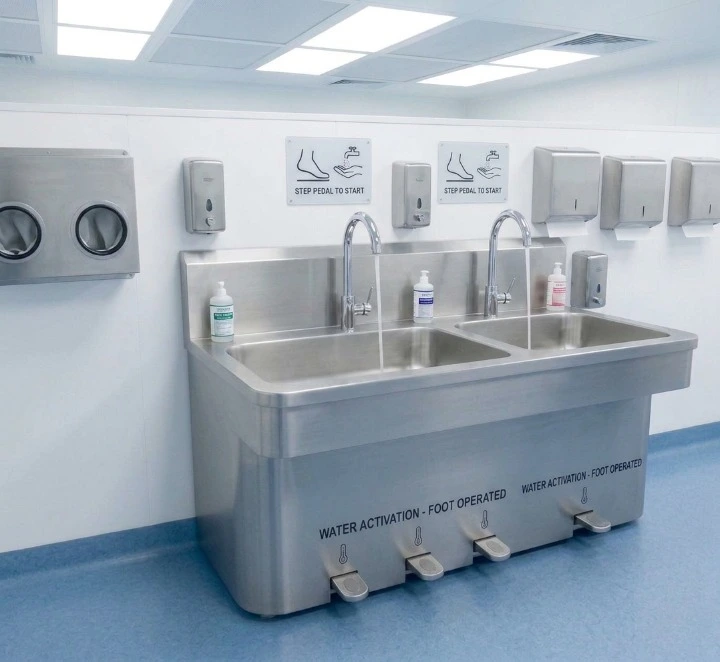
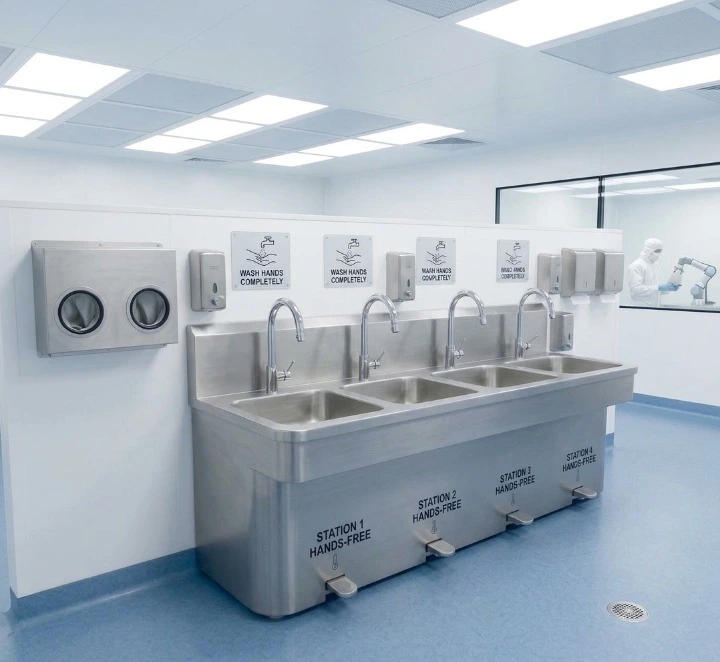
Extended multi-bay sanitation stations providing simultaneous decontamination capacity for multiple personnel during shift-change gowning events — the most common throughput constraint in pharmaceutical manufacturing cleanrooms where 20–40 personnel must complete the full decontamination protocol within a 15-minute shift-change window. The multi-bay scrub station is a single continuous SS 316L structural unit with typically two to four individual scrub bays — each bay comprising its own deep-drawn coved basin, infrared faucet, soap and ABHR dispensers, and glove dispenser — sharing a single HEPA hand-dryer zone and a single concealed plumbing manifold. Individual full-height splash guards between bays prevent cross-contamination from adjacent scrubbing personnel — water droplets, soap spray, and ABHR mist from each bay are contained within the vertical shield boundary of that bay. The shared HEPA dryer zone is positioned at the end of the station — personnel complete the scrub at their bay and step sideways to the dryer before gloving at the shared glove dispenser, maintaining the protocol sequence efficiently at maximum throughput. Available in 2, 3, and 4-bay configurations with custom inter-bay spacing matched to ergonomic elbow clearance requirements.
Equipment Decontamination Stations — Heavy-Duty Spray Wands & Large Basins
Specialist sanitation stations designed for the pre-cleaning and decontamination of laboratory glassware, small instruments, stainless trays, and small machinery components before they enter the cleanroom through the material airlock — a distinct function from personnel handwash stations that requires a fundamentally different specification: a larger, deeper basin (typically 600–900mm width, 300mm depth) to accommodate instrument trays and flask collections; a heavy-duty retractable spray wand — a flexible SS 316L hose on a spring-retract reel with a trigger-operated adjustable spray/jet head providing both a gentle spray mode (for rinsing sensitive glassware without impact breakage) and a focused jet mode (for mechanically dislodging contamination from instrument crevices); an integrated drainboard on one or both sides of the basin (sloped, marine-edge contained, SS 316L) for staging washed items; and an optional purified water (PW) or water-for-injection (WFI) supply for a final purified rinse. The equipment decontamination station is designed for IPA spray-down of the external surfaces of large items — a stainless steel back panel with drain channel captures IPA run-off from the vertical item surface and channels it to the basin, preventing floor contamination during IPA surface wipe operations.
Recessed Wall Stations — Flush-Mounted, Zero Floor Footprint
For gowning rooms where floor space is at a premium — and in Grade B anteroom spaces where every square metre of floor area must be available for personnel movement during the gowning sequence — Metrolabs designs sanitation stations that are recessed fully into the modular cleanroom panel system, with the station face flush with the wall surface and no projection into the room. The recessed station is fabricated as a complete pre-assembled unit — basin, dispensers, dryer, plumbing, and waste bin — that fits into a pre-formed aperture in the cleanroom panel wall during the panel installation phase. The station face plate is the same surface as the surrounding panel — flush, smooth, and wipeable across the complete wall face without any protrusion or recess that would create a particle trap or cleaning obstacle. The plumbing connections route through the panel thickness to the service corridor on the panel back face — entirely concealed from the cleanroom interior. This configuration eliminates all floor-to-unit perimeter joints, all lateral wall-to-unit sealant lines, and all under-unit dead zones that a freestanding unit creates.
Automated Boot Washers — Footwear Decontamination
Personnel entering cleanrooms through gowning areas bring on their footwear the highest particle and contamination load of any part of the body — the floor contact surface of standard footwear accumulates particles, biological material, and chemical residues from every surface they have contacted. Even with cleanroom overboots, the external surface of the overboot applies to the cleanroom floor any contamination it contacted in the lower-grade ante-room. Metrolabs automated boot washers are lower-level sanitation stations — step-in bays at floor level with stainless brush platforms, chemical spray mechanisms, and water rinse capability — that provide mechanised cleaning of boot soles before cleanroom entry. The operator steps onto the active brush platform (activated by weight or foot-switch), the rotating stainless brushes scrub the boot sole while a metered sanitiser solution is spray-applied, followed by a water rinse and air-blow dry cycle. Boot washers are available as a standalone floor-level station or integrated as a lower-bay addition to the standard sanitation wash station — the operator completes the handwash and gloving sequence at the upper station while simultaneously standing in the boot washer bay for automatic foot decontamination.
Six Engineering Features That Make Every Metrolabs Station a Contamination Control Component
Every Metrolabs cleanroom sanitation wash station is built to these standards — making it an active participant in your contamination control system rather than a passive fixture in the gowning room:
SS 304 & SS 316L — No Non-Stainless Components in Contact Zones
The entire wet-contact zone of the Metrolabs sanitation station — basin, counter, splash guards, faucet body, dispenser housings, dryer intake and exhaust faces, waste bin lid, and all visible surfaces — is SS 304 or SS 316L. No plastic in the basin or dispenser bodies, no chrome fittings in the wash area, and no rubber or foam seals exposed to the cleanroom environment. SS 316L is specified for Grade A/B pharmaceutical applications and for stations in rooms with VHP decontamination programmes — the passivated SS 316L surfaces withstand VHP at 1000 ppm concentration through 500+ cycles. All contact-zone surfaces are electropolished or mirror-finished to Ra <0.5μm — a surface roughness that inhibits biofilm adhesion by eliminating the micro-scale surface features that micro-organisms anchor to. Post-fabrication ASTM A967 passivation certification supplied.
Full-Height Integrated Splash Guards — Bay-to-Bay Contamination Prevention
Multi-bay sanitation stations require a physical barrier between adjacent scrubbing personnel to prevent cross-contamination from water droplet spray, soap aerosol, and ABHR mist generated during the vigorous scrubbing motion. Metrolabs integrates full-height SS 316L splash shields between adjacent bays — extending from the counter surface to the ceiling or to the HEPA dryer soffit height — that physically intercept any lateral spray or droplet projection and channel it back toward the originating bay’s basin. The shields are designed with a continuous radiused return edge at the basin side — the shield does not create a right-angle pocket at the basin perimeter that would accumulate soap and water residue. The shield surface is smooth, vertical, and fully wipeable in a single downward pass. A continuous silicone bead at the counter junction seals the shield-to-counter interface without creating a crevice, and the shield is removable for periodic deep cleaning by releasing a quarter-turn cam mechanism at the top and bottom mounting points.
HEPA H14 Filtered Hand Dryer — Sterile Air to Dried Hands
The HEPA hand dryer integrated into the Metrolabs sanitation station is a custom high-velocity dryer unit with an H14 HEPA filter in the air intake duct — delivering air to the drying zone at the same cleanliness standard as the cleanroom supply air rather than the unfiltered gowning room air. The motor and fan assembly are mounted behind the cleanroom panel wall (in the service corridor) with only the stainless outlet nozzle visible on the station face — eliminating the motor noise and vibration from the cleanroom-side environment. The air outlet nozzle is SS 316L, smooth-bore, with no protruding louvres or grilles that accumulate dust and moisture. The air velocity is adjustable between 20–80 m/s — a lower velocity for gentle drying of sensitive skin conditions, a higher velocity for rapid drying within the protocol time allocation. Drying time at 60 m/s is approximately 12 seconds for fully washed hands — matching the throughput requirement of a multi-bay scrub station.
Fully Encapsulated Plumbing — SS Shroud with Service Access
All hot and cold supply pipes, thermostatic mixing valves, isolation valves, soap and ABHR reservoir connections, waste drain and S-trap, and any fluid manifolds are housed within a close-fitting SS 316L plumbing shroud that covers the entire under-basin service space from counter bottom to floor. The shroud exterior is smooth, continuous, and wipeable — no exposed pipe surfaces, no brackets creating particle traps, no valve handles accessible by unauthorised personnel. The shroud incorporates a service panel — a flush-face removable panel secured by quarter-turn cam fasteners — that provides full access to all services within the shroud without tools. Soap and ABHR reservoirs are top-access — the reservoir caps are accessed from the counter surface (not the shroud) allowing refill without opening any panel or disturbing the cleanroom environment. All fluid connections use push-fit fittings — no thread sealant compound exposed in the plumbing system.
Ergonomic Hands-Free Operation — IR Sensors & Foot Pedal
Every fluid delivery function of the Metrolabs sanitation station is operated without hand contact — infrared proximity sensors on the faucet, soap dispenser, and ABHR dispenser detect hand presence and deliver the pre-set dose or water flow without requiring any surface touch. For environments where electronic sensors are restricted or where the station will undergo frequent VHP decontamination (which can shorten sensor service life), a mechanical foot-pedal system provides the alternative — stainless steel foot levers at floor level operate the water supply and soap delivery via a concealed cable-and-pulley mechanism with no electronic components in the cleanroom environment. The ergonomic positioning of all components — faucet spout height, soap dispenser outlet height, ABHR outlet height, dryer nozzle height, and glove dispenser slot height — is optimised for the complete scrubbing protocol sequence without personnel bending, reaching, or changing stance during any step.
Airtight Integrated Waste Bin — Sealed Disposal Without Particle Release
The disposal of used PPE items (paper towels, if used; first pair of gloves removed during protocol; disposable scrub brushes) at a sanitation station requires a waste receptacle that does not itself become a contamination source. A standard open-top bin in a gowning room generates a particle burst on each item deposit — the air displaced by the dropping item carries particles from inside the bin into the room air. Metrolabs integrates a sealed, airtight SS 316L waste bin directly into the station structure — the bin lid is a spring-loaded, SS 316L-faced, foot-operated flap that provides a momentary opening for item deposit without allowing sustained air connection between the bin interior and the cleanroom environment. The bin is sized for a full shift’s protocol waste volume and is extracted from the station side panel for liner replacement — the extraction access does not face the cleanroom interior.
Metrolabs Sanitation Wash Station — Technical Standards
Every Metrolabs sanitation station is fabricated, finished, and documented to these technical parameters:
| Feature | Metrolabs Standard | GMP / Hygiene Benefit |
|---|---|---|
| Material (Grade A/B) | SS 316L — EP Ra <0.5μm | VHP rated — biofilm-inhibiting finish |
| Material (Grade C/D)✓ Std | SS 304 passivated — mirror/dull | IPA, QAC, PAA resistant throughout |
| Basin Construction | Deep-drawn seam-free — R10 coved | No internal joints — no biofilm anchor sites |
| Fluid Dispensers | Soap + ABHR + water — infrared/foot-pedal | Complete protocol in one station — no hand contact |
| Hand Dryer | H14 HEPA filtered — 20–80 m/s | Sterile air drying — no ambient particles |
| Splash Guards | Full-height SS 316L — between bays | No cross-bay spray contamination |
| Plumbing | Fully encapsulated — SS shroud | No exposed pipes — quarter-turn service access |
| Waste Disposal | Airtight SS bin — foot-operated flap | No particle release on deposit — sealed throughout |
Sanitation Wash Stations Across Every Regulated Cleanroom Sector
Integrated, hands-free, and GMP-documented decontamination hubs for every cleanroom where personnel hygiene is the first line of contamination control:
Pharmaceutical GMP
SS 316L multi-bay sanitation stations in Grade B/C gowning anterooms. Infrared or foot-pedal operation. HEPA drying. VHP compatible. Full IQ documentation for GMP equipment qualification at handover.
Aseptic Manufacturing
Flush-mounted recessed sanitation stations in Grade A/B aseptic suite anterooms. Zero floor footprint. HEPA H14 dryer. Sterile glove dispenser in-line. Panel-integrated plumbing concealment.
Hospital & OT
Pre-operative multi-bay scrub stations with surgical-grade soap and ABHR dispensers. Automated boot washers for high-traffic OT corridors. NABH compliant throughout. Eye-wash integration available.
Biotech & ATMP
SS 316L sanitation stations in ATMP and gene therapy GMP suites. Foot-pedal operation for VHP-intense environments. Equipment decontamination stations for biological process vessel pre-clean.
Food & Beverage
SS 316L multi-fluid sanitation stations for FSSAI high-care food production gowning. Automated boot washers at high-care zone entry. Airtight waste bins for hygienic PPE disposal in food areas.
BSL Containment
SS 316L decontamination stations in BSL-2 and BSL-3 gowning. Foot-pedal operation eliminates electronic components exposed to biocide decontamination. Equipment decontamination stations at material airlocks.
Electronics Cleanrooms
SS 304 sanitation stations for semiconductor and electronics cleanrooms — IPA and DI water supply for equipment wipe-down. ESD-safe earthing on station body. HEPA dryer with anti-static air delivery.
NABL Research Labs
SS 304 sanitation stations for NABL-accredited laboratories — single-bay with ABHR, soap, and water. HEPA drying. ASTM A967 passivation certification for equipment qualification records.
High-Accuracy Fabrication Supporting Your Path to ISO & GMP Certification
Metrolabs focuses on high-accuracy fabrication and custom configuration to ensure your sanitation zone actively supports your contamination control strategy and GMP certification path:
Custom SOP Matching — Station Designed Around Your Protocol
Metrolabs designs every sanitation station around the customer’s specific handwash and decontamination SOP — confirming the fluid sequence (water, soap, water, ABHR or water, soap, scrub-brush, water, ABHR), the scrub duration, the water temperature, the glove type and dispenser refill frequency, and the waste disposal items — then configuring the station components, heights, and sequence layout to support that specific protocol without the operator needing to deviate from the protocol steps at any point during the station use.
Material Test Certificates & Passivation Documentation
Every Metrolabs sanitation station is supplied with a complete IQ documentation package — SS mill test certificates (MTCs) for every material used, ASTM A967 citric acid passivation certificate, H14 HEPA filter efficiency certificate (for the hand dryer), IP54 sensor rating certificate, and thermostatic valve compliance certificate — all documents required for pharmaceutical GMP equipment qualification at the time of handover.
Flush-Mounted Integration — No Perimeter Sealant Joints to Degrade
Metrolabs flush-mounted sanitation stations eliminate the adhesive sealant perimeter joints that freestanding stations require at the wall-unit interface — joints that degrade over time and become particle traps and microbial growth sites at the station base and sides. The flush-mounted unit sits within the panel system with a continuous SS-to-SS mechanical join at all four edges — no silicone, no adhesive, no crevice.
VHP Compatibility Throughout — Every Component Rated
Every component of the Metrolabs sanitation station — including the H14 dryer filter housing, the IR sensor electronics (IP54 sealed), the glove dispenser internal compartment, and the waste bin lid mechanism — is specified for VHP compatibility at 1000 ppm for standard pharmaceutical VHP cycle durations. For foot-pedal operated stations, there are no electronic components — inherent VHP compatibility without any special sealing requirement.
Integrated Station vs Separate Fixtures
From SOP Review to Installed & IQ-Documented Sanitation Station
Metrolabs manages the complete station supply and installation process — from SOP review through custom fabrication, installation, and GMP documentation:
SOP Review & Station Design
Handwash and decontamination SOP reviewed. Fluid sequence, temperatures, scrub duration, and waste items confirmed. Bay count, mounting type (floor/wall-flush), IR or foot-pedal, boot washer requirement, and glove type confirmed. Custom dimensioned station drawing produced and signed off before fabrication.
Precision Fabrication
Station body TIG welded. Basin deep-drawn. Splash guards fitted. Dryer housing fabricated with HEPA filter bay and motor mount. Dispenser housings integrated into panel. Glove dispenser compartment fitted. Waste bin integrated. Plumbing shroud fabricated. EP and ASTM A967 passivation performed. All electronics IP54 sealed and tested. MTCs issued.
Installation & Commissioning
Station positioned — flush-mounted units integrated into panel aperture during panel install phase. Hot and cold supplies connected. Soap and ABHR reservoirs filled. HEPA dryer motor connected behind wall. IR sensors calibrated. Foot-pedal mechanism adjusted. Thermostatic valve calibrated. Boot washer brush mechanism commissioned. All functions tested through protocol sequence.
Documentation & IQ
Dimensions, material certs, passivation certs, HEPA filter cert, IR sensor IP54 cert, thermostat calibration record, function test records, installation photos, reservoir fill record, and SOP alignment confirmation compiled as sanitation station IQ documentation for GMP facility validation submission.
Sanitation Stations Compliant with Every Major GMP & ISO Standard
WHO & EU GMP
WHO GMP and EU Annex 1 require cleanroom personnel decontamination facilities to prevent cross-contamination at every step of the handwash sequence. Hands-free operation, HEPA drying, sealed waste disposal, and in-line glove dispensing satisfy all WHO GMP and EU Annex 1 personnel hygiene facility requirements for pharmaceutical manufacturing grades A through D.
WHO GMP · EU Annex 1ISO 14644-4
ISO 14644-4 requires cleanroom utility equipment to be compatible with cleaning and decontamination methods and not to generate particles during normal use. SS 316L construction, HEPA-filtered drying, and sealed waste management satisfy ISO 14644-4 utility equipment requirements for all ISO Class 3–8 applications. Flush wall-mounting eliminates equipment perimeter contamination as a GMP inspection point.
ISO 14644-4NABH & NABL
NABH hospital accreditation requires pre-operative gowning facilities to include hands-free dispensing, effective drying, and hygienic waste disposal. Metrolabs multi-bay scrub stations with HEPA drying and sealed waste bins satisfy all NABH gowning facility requirements. NABL ISO/IEC 17025 material documentation requirements satisfied by ASTM A967 passivation and MTC certificates.
NABH · NABL · ISO 17025ASTM A967 & 21 CFR
ASTM A967 passivation and SS mill test certificates supplied with every station satisfy US-FDA 21 CFR pharmaceutical equipment construction documentation requirements. The IQ documentation package is structured for direct inclusion in FDA equipment qualification submissions. Flush-mounted panel integration supports 21 CFR cleanroom construction documentation requirements for utility equipment integration.
ASTM A967 · 21 CFRFactory & Office
4, SIDCO-MICRO, Thirumudivakkam,
Chennai – 600 132, Tamil Nadu
🗺 Open in Google Maps ↗
Phone
Website & GSTN
www.metrolabs.biz
www.schoollabfurniture.com
GSTN: 33AASFM3382K1ZT
Ready to Install Integrated Sanitation Stations in Your Cleanroom?
Contact Metrolabs for a free consultation. Our specialists will review your decontamination SOP, facility layout, ISO class, GMP grade, and personnel throughput requirement — then fabricate, supply, install, and document your sanitation wash stations with full IQ documentation at delivery.
🚫 Request a Free Sanitation Station Quote
Quote Request Received!
Our cleanroom utility team will contact you within 24 working hours.
Immediate: 9840931231