
Cleanroom Sanitation & Hygiene Systems — High-Accuracy Contamination Control at Every Entry Point
In the architectural design of a sterile facility, the transition from the gowning area to the production suite is the most critical checkpoint. Metrolabs provides high-accuracy Sanitation and Hygiene Systems specifically engineered to eliminate surface contact and ensure that personnel maintain surgical-level cleanliness. Our systems are designed with a Zero-Ledge philosophy — ensuring that the hygiene station itself remains an aseptic structural component within your facility, not merely a fixture placed inside it.
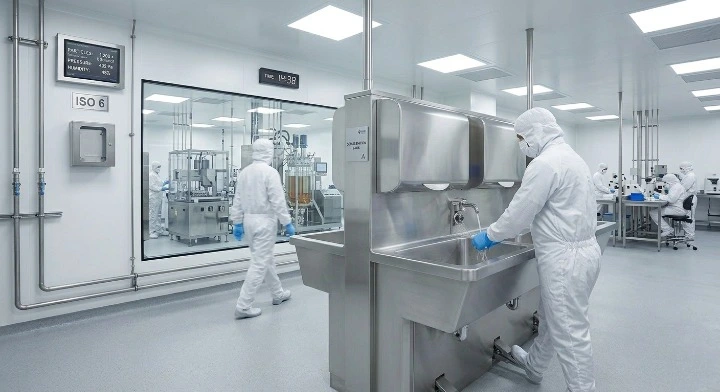
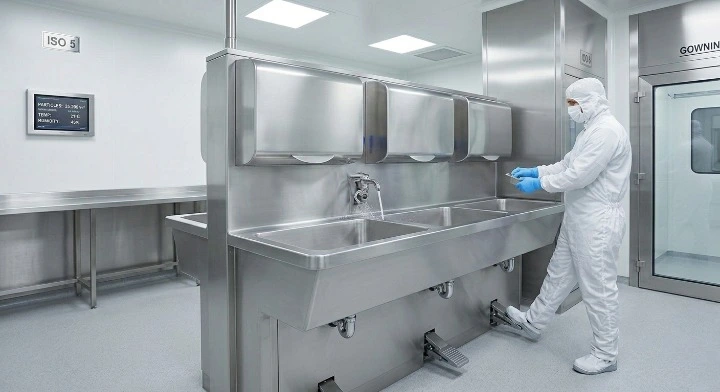
Why the Sanitation Station Is the Most Critical Checkpoint in a Sterile Facility
The gowning-to-production transition is where most contamination events originate. Metrolabs sanitation and hygiene systems are engineered to eliminate every contamination mechanism at this critical checkpoint — from faucet handle re-contamination to moisture penetration behind the basin unit.
Mechanical Hands-Free Actuation — The Failure-Proof Clean Chain
The fundamental contradiction of a standard cleanroom handwash station is that turning off the faucet after washing re-contaminates the just-cleaned hands — the faucet handle is one of the most heavily contaminated surfaces in the gowning room, touched by every person before and after washing. Electronic infrared sensors resolve this but introduce a new risk: sensor failure from power fluctuations, lighting interference from gowning room fluorescent fittings, or sensor fouling from soap film on the sensor window. Metrolabs foot-pedal and knee-operated systems use heavy-duty spring-loaded mechanical actuators that have no electronic components in the cleanroom environment — the water flow is initiated by pressing a stainless steel pedal or knee panel connected to the water valve by a concealed cable-and-pulley or hydraulic mechanism. Mechanical actuation is 100% reliable regardless of power supply status, ambient light conditions, or sensor contamination, and the mechanical mechanism continues to function correctly through a full VHP decontamination cycle without any electronic component damage.
Deep-Drawn Coved Bowl — Eliminating the Biofilm Anchor Point
A right-angle internal corner in a wash basin is a biofilm incubation site — the combination of constant moisture, organic residues from handwashing soap, and physical protection from the water stream in the corner shadow creates ideal conditions for microbial growth. Once a biofilm establishes in a corner crevice, standard IPA or QAC spray cleaning cannot penetrate to the bottom of the corner effectively — the cleaning agent contacts the biofilm surface but not the protected base. Metrolabs wash basins are deep-drawn from a single piece of SS 316L — pressed to shape in one forming operation that produces a bowl with no internal welds, no visible joints, and no right-angle corners anywhere. All internal corners are a continuous R10 radius that the water stream reaches and the cleaning cloth wipes through without repositioning. The electropolished surface (Ra <0.5μm) further inhibits biofilm by eliminating the microscopic surface features that micro-organisms anchor to.
Anti-Vortex Drainage — Preventing Aerosol Generation and Pressure Disruption
Standard basin drain designs create a vortex as water drains — the spinning water column draws air from below the drain up through the drain opening and into the room. In a positively pressurised cleanroom, this drain air ingress disrupts the pressure differential at the drain point, and the vortex water column generates aerosols at the air-water interface that are projected upward from the drain opening. Metrolabs specifies anti-vortex drain designs — a drain fitting with an internal flow director that breaks the vortex rotation, converting the spinning flow to a straight laminar drain flow. The laminar drain flow does not draw air from below the drain and does not generate aerosols at the drain opening. For cleanrooms with maintained pressure differentials, this is the difference between maintaining the designed pressure cascade at every drain point and experiencing periodic pressure equilibration events each time the basin is used.
Acoustic Dampening — Sound-Deadening Pads for Stable Work Environment
A stainless steel basin without acoustic treatment produces significant impact noise when the water stream or items strike the basin surface — vibration transmitted through the basin structure to the wall panels, creating noise levels that distract personnel during concentrated analytical and precision operations in adjacent cleanroom zones. Metrolabs integrates sound-deadening pads on the underside of every basin — non-shedding closed-cell neoprene or bitumen-free acoustic compound specified to be non-outgassing (no VOC release from the adhesive or compound into the room air), moisture-resistant, and particle-retaining. Acoustic testing confirms a minimum 10 dB reduction in impact noise transmission through the basin and wall junction, maintaining the stable and focused work environment that GMP laboratory operations require.
Four Integrated Sanitation & Hygiene Configurations — Matched to Your Facility Grade
Metrolabs configures sanitation systems for the specific personnel hygiene SOP, ISO class, and cleanroom grade of your facility:
Foot-Pedal Operated Wash Basins — Mechanical Hands-Free at Grade B/C Entry
The primary sanitation fixture for pharmaceutical Grade B and C cleanroom gowning anterooms — a wall-hung SS 316L wash basin actuated by a heavy-duty spring-loaded foot pedal that initiates water flow with a simple foot press and stops it when the foot is released. The foot pedal mechanism is purely mechanical — a stainless steel lever connected to the water supply valve through a cable-and-pulley or hydraulic transmission concealed within the plinth or wall mounting structure. No electronic components exist in the cleanroom environment: the mechanism will function correctly through power outages, VHP decontamination cycles, and after prolonged periods of non-use when electronic sensors are most likely to fail. The pedal spring is rated for 500,000 actuations before spring replacement — approximately 10 years of daily use at 130 actuations per day (representing a three-shift pharmaceutical facility with an average of one handwash per personnel entry). The pedal is positioned at the correct ergonomic height (approximately 100mm above floor level) to be activated while standing in the gowning area without requiring a change of posture or step forward. Both feet can be used — the pedal extends across the full basin width to allow right-foot or left-foot activation. The pedal is SS 316L with a non-slip surface texture — it will not corrode, deform under repeated use, or create particles from surface degradation.
Knee-Operated Wash Basins — Ergonomic Leg-Operated for Intensive Scrub Protocols
Knee-operated wash basins provide a larger-contact, easier-to-reach alternative to foot pedals for intensive scrub protocols — particularly in surgical scrub applications and pharmaceutical aseptic manufacturing anterooms where the scrub cycle is 3–5 minutes long and the operator’s attention and both hands must remain on the scrubbing process throughout without any interruption to adjust the water flow. The knee panel is a large (typically 150×200mm) SS 316L plate mounted at the correct height (approximately 350–450mm above floor level) to be activated by the knee or lower thigh of the scrubbing operator. The panel is slightly convex — the outward curve matches the inward curve of the knee and thigh, providing comfortable contact over the full panel area rather than a point contact at the centre. The knee panel mechanism is a hydraulic transmission — pressing the panel compresses a small hydraulic cylinder that opens the water supply valve, and releasing the panel allows the return spring to close the valve. The hydraulic transmission is smoother in action than a cable-and-pulley — it has no mechanical jerking at the valve opening, which means the water flow starts and stops without pressure surge, reducing the aerosol generation associated with pressure-surge water starts. Available as a combined knee panel (water flow) and foot pedal (soap dispenser pump) configuration for integrated scrub protocol support.
Integrated Hygiene Hub — Soap, Water & Sanitiser in One Wall-Mounted Unit
The integrated hygiene hub combines the wash basin, soap dispenser, sanitiser dispenser, and paper towel or hand dryer provision into a single wall-mounted stainless steel assembly — all functions in one structural unit, all actuation mechanical or infrared, and all surfaces SS 316L with no ledges, horizontal seams, or exposed fasteners. The integrated hub eliminates the most common contamination mechanism in standard gowning rooms — the operator moving between separate basin, soap dispenser, sanitiser dispenser, and drying station, touching a different contaminated surface at each transition. In the integrated hub, the soap dispenser nozzle is positioned 150mm to one side of the basin centreline at the same height as the basin rim — the operator can depress the soap pedal (foot-operated) and apply soap to both hands without removing their hands from the basin area, then resume washing without any intermediate surface contact. The sanitiser dispenser (infrared sensor or foot-pedal) is positioned at the correct height for post-drying application — the complete handwash sequence from water-on to sanitiser-applied can be completed without the hands touching any surface. A recessed soap reservoir (top-access, SS 316L body) is filled from the counter surface without opening any panel. Concealed plumbing services the basin, soap lines, and sanitiser lines within the same SS shroud — a single, clean under-unit appearance regardless of the number of fluid services supplied.
Wall-Hung Zero-Ledge Units — Grade B Airlock & Floor-Clean Strategy
For Grade B airlocks where every square millimetre of floor surface must be cleanable to Grade A equivalent standard — and where the floor cleaning validation requires documentary evidence that no area of floor was inaccessible to the cleaning operative during the cleaning cycle — Metrolabs specifies wall-hung sanitation units with a minimum floor clearance of 300mm, and zero floor-level ledges or plinths. The wall-hung unit is mounted on SS 316L heavy-duty brackets bolted to the cleanroom panel structural frame — the entire floor area below the unit is open and accessible to the standard floor mop or scrubber-dryer in a single pass. The plumbing shroud is mounted to the rear face of the basin (not to the floor), so the floor area directly below the shroud is as accessible as the open floor area elsewhere in the room. The wall-to-basin interface is a continuous pharmaceutical-grade silicone bead — sealed, smooth, and wipeable — at the splashback-to-panel junction. The underside of the counter surface has no horizontal ledges, collection surfaces, or exposed fastener heads — the under-counter face is a smooth, continuous SS surface that the ceiling-to-floor cleaning pass covers without any obstacle. Dead zone elimination: the most common GMP inspection finding on cleanroom sanitation systems is the ‘dead zone’ under the basin — the area between the plinth and the floor wall where cleaning validation cannot confirm 100% coverage. The wall-hung zero-ledge design eliminates this finding entirely.
Six Engineering Features of Every Metrolabs Sanitation & Hygiene System
Every Metrolabs sanitation system is built to these standards — making it an aseptic structural component of your facility rather than a plumbing fixture placed in a controlled environment:
SS 316L Surgical Grade — Maximum Chemical Resistance
The entire sanitation unit — basin, counter, splashback, plumbing shroud, pedal housing, and wall bracket — is SS 316L throughout. No SS 304 in wet contact zones, no chrome-plated fittings, no plastic components in the basin body or any wet-contact area. SS 316L is specified because the combination of chloride-containing disinfectants, organic acid soap residues, and temperature cycling from hot and cold water is aggressively corrosive to SS 304 but within the corrosion resistance envelope of SS 316L. The molybdenum addition in SS 316L provides the pitting corrosion resistance needed for cleanroom sanitation applications that SS 304 cannot match. Post-fabrication: IPA-degreased and ASTM A967 citric acid passivated. Passivation certificate and SS mill test certificate supplied for IQ documentation inclusion.
Integrated Splashbacks — Protecting Your Modular Cleanroom Panels
The basin splashback is a continuous high-riser backplate — typically 150–250mm high above the counter surface — that is fabricated as an integral part of the basin unit, not as a separate tile or panel. The splashback face is a smooth, continuous SS 316L surface that seals directly to the cleanroom panel at the top edge with a continuous pharmaceutical-grade silicone bead. The junction between the splashback and the cleanroom panel is sealed, smooth, and wipeable — there is no gap, no grout line, and no exposed panel face above the splashback that could be wetted by soap spray or water aerosol during the handwash cycle. This protects your modular cleanroom panels from moisture, soap residue, and repeat IPA spray disinfection — exposures that degrade standard decorative panel surfaces over time and create the surface deterioration that is a common GMP inspection finding on gowning room panels adjacent to sanitation fixtures.
Thermostatic Mixing Valve — Consistent Scrub Temperature
The thermostatic mixing valve blends hot and cold water supplies to deliver a specified mixed temperature — typically 38–40°C for pharmaceutical handwashing, 40–42°C for surgical scrub protocols — regardless of variations in the incoming hot and cold supply pressures. This allows the handwash SOP to specify water temperature as a controlled parameter and prevents the thermal shock hazard where a pressure variation in the hot supply momentarily delivers scalding water. The TMV is a pressure-balanced type with an anti-scald failsafe — if cold supply fails, the valve automatically closes rather than allowing scalding water to flow. All thermostatic valves are housed within the concealed plumbing shroud — accessible for maintenance and calibration without exposing the cleanroom environment to plumbing disruption. Calibration record supplied at handover for IQ documentation.
Concealed Plumbing — No Exposed Hardware
All hot and cold supply pipes, the thermostatic mixing valve, drain pipe, S-trap, foot-pedal or knee-panel hydraulic/cable mechanism, soap reservoir lines, and isolation valves are housed within a close-fitting SS 316L plumbing shroud covering the entire under-basin space. The shroud exterior surface is smooth, continuous, and wipeable — no exposed pipes collecting dust and scale, no pipe brackets creating particle traps, no valve handles accessible to unauthorised personnel. The shroud incorporates a service panel — a flush-face removable panel secured by quarter-turn cam fasteners — providing full access to all services without tools, without disturbing the basin unit, and without exposing the cleanroom environment to the under-shroud space during maintenance. Soap and sanitiser reservoirs are top-access — the reservoir caps are reached from the counter surface, allowing refill during a room cleaning period without opening any panel.
Acoustic Dampening — 10 dB Noise Reduction
The underside of every Metrolabs wash basin is treated with non-shedding closed-cell acoustic compound — bitumen-free, non-outgassing, and moisture-resistant — applied to the external basin surface. The compound material is specified to be non-shedding (zero particle contribution to the cleanroom environment through the wall structure), non-outgassing (no VOC release from the adhesive or compound into the room air), and moisture-resistant (maintaining adhesion under the constant humidity of the basin environment). Acoustic testing before and after application confirms a minimum 10 dB reduction in impact noise transmission through the basin and its supporting structure. The result is a quieter gowning area — one that maintains the stable, focused work environment required for the concentrated analytical and precision operations performed in adjacent cleanroom zones.
Ergonomic Design — Full Forearm-to-Fingertip Scrub Reach
Every Metrolabs sanitation basin is optimised for depth and height to ensure that personnel can follow complete forearm-to-fingertip scrubbing protocols comfortably — reaching to the elbow without bending forward to the point of compromising gowning sterility, and accessing the full depth of the basin without contact between the gown sleeves and the basin rim. Basin depth (front-to-back internal dimension) is specified at 350–400mm for forearm-to-fingertip access. Counter height is specified at 850–900mm — the ergonomic height for standing scrub access for personnel of 160–185cm height without bending. The faucet or gooseneck spout is centred over the basin at a height that provides coverage of both hands and forearms simultaneously without the operator repositioning. For surgical scrub basins where both forearms must be wetted and rinsed bilaterally, the basin width is extended to 550–600mm to accommodate both arms simultaneously without lateral contact between the arms and the basin sides.
Metrolabs Sanitation & Hygiene System — Technical Standards
Every Metrolabs sanitation system is fabricated, finished, and documented to these technical parameters:
| Feature | Metrolabs Standard | GMP / Hygiene Benefit |
|---|---|---|
| Material | SS 316L — all wet contact surfaces | Chloride-resistant — biofilm-inhibiting EP |
| Bowl Construction✓ Std | Deep-drawn single-piece — R10 coved | No internal joints — no biofilm anchor points |
| Actuation | Foot pedal or knee push-panel | 100% hands-free — no electronics to fail |
| Drainage | Anti-vortex — S-trap smooth bore | No aerosol — no pressure disruption |
| Temperature | Thermostatic mixing 38–42°C | SOP temp consistent — anti-scald failsafe |
| Splashback | Integral 150–250mm — sealed to panel | Modular panel protected from moisture |
| Plumbing | Fully concealed — SS 316L shroud | No exposed pipes — no dust accumulation |
| Acoustic | Non-shedding closed-cell pads — bowl underside | 10 dB impact noise reduction |
Sanitation & Hygiene Systems Across Every ISO Class and Regulated Sector
Mechanical hands-free, audit-ready, and Zero-Ledge sanitation systems for every cleanroom where personnel hygiene is the first line of contamination control:
Pharmaceutical GMP
SS 316L foot-pedal and knee-operated wash basins for Grade B/C gowning anterooms. Wall-hung zero-ledge for Grade B floor-cleaning validation. VHP compatible. Full GMP IQ documentation at handover.
Aseptic Manufacturing
Integrated hygiene hubs for aseptic suite anterooms — soap, water, and sanitiser in one unit. Mechanical actuation for VHP-intense environments. Zero-ledge wall-hung for Grade A-adjacent floor cleaning.
Hospital & OT
Knee-operated surgical scrub basins for OT gowning and anteroom scrub protocols. High-riser integral splashbacks for theatre panel protection. NABH compliant throughout. Anti-vortex drainage standard.
Biotech & ATMP
SS 316L foot-pedal wash basins for ATMP GMP gowning suites. Integrated hygiene hubs for cell therapy anteroom protocols. Mechanical actuation standard — no electronic failure in high-frequency VHP environments.
Research Laboratories
SS 316L foot-pedal and infrared-combined sanitation systems for NABL-accredited research labs. Wall-hung zero-ledge for floor-cleaning protocol compliance. Thermostatic mixing for consistent handwash temperature.
BSL Containment
SS 316L foot-pedal wash basins for BSL-2 and BSL-3 gowning. Mechanical actuation — no electronics damaged by high-concentration biocide decontamination. Anti-vortex drainage for aerosol prevention.
Food & Beverage
SS 316L foot-pedal sanitation stations for FSSAI high-care food production entry points. Integrated soap and sanitiser dispensers. Acoustic dampening for hygienic production environments. Non-marking floor-clear mounting.
Electronics Cleanrooms
SS 316L sanitation systems for semiconductor and electronics cleanroom gowning. Mechanical actuation — no ESD risk from electronic sensor components. Anti-vortex drainage preventing pressure disruption in critical zones.
High-Accuracy Fabrication Supporting Your ISO & GMP Certification Path
Metrolabs focuses on high-accuracy fabrication and Zero-Ledge design to ensure your sanitation systems actively support your contamination control strategy and GMP certification path:
Custom Dimensions — Matched to Your Gowning Room Layout
Metrolabs fabricates sanitation systems to the exact bay width, mounting height, and plumbing position of the installation — custom basin widths from 350mm to 900mm, counter depths from 350mm to 500mm, and splashback heights matched to the panel dado rail system. Bespoke dimensions ensure the splashback sits exactly flush with the panel surface, the counter aligns with adjacent gowning tables, and the plumbing connections align exactly with the pre-formed penetrations in the panel structure.
VHP Compatibility Throughout — Every Component Rated
Every component of the Metrolabs sanitation system — including the foot pedal mechanism, the knee panel hydraulic transmission, the soap reservoir body, and the acoustic damping compound — is specified for VHP compatibility at 1000 ppm for standard pharmaceutical VHP cycle durations. For foot-pedal and knee-operated systems with no electronic components in the cleanroom environment, VHP compatibility is inherent — the purely mechanical mechanism has no components that can be damaged by VHP exposure at any concentration or cycle frequency.
Material Test Certificates & Passivation Documentation
Every Metrolabs sanitation system is supplied with a complete IQ documentation package — SS mill test certificates (MTCs) for all materials, ASTM A967 citric acid passivation certificate, thermostatic valve compliance certificate and calibration record, acoustic compound non-shedding and non-outgassing specification, installation photos, and sealant application record. This documentation suite is structured for direct inclusion in the facility IQ documentation at handover.
Grade B Airlock Strategy — Wall-Hung Eliminates Dead Zones
For Grade B airlocks, Metrolabs recommends wall-hung foot-operated units with a minimum 300mm floor clearance. By mounting the unit flush to the wall and leaving the floor clear, the cleaning team can maintain a 100% sterile floor surface — the most common GMP inspection finding on gowning room sanitation systems (the ‘dead zone’ under a plinth-mounted basin) is eliminated by design. Floor cleaning validation documentation can confirm 100% floor coverage without exemptions.
Metrolabs vs Standard Sanitation Fixtures
From Gowning SOP Review to Installed & IQ-Documented Hygiene System
Metrolabs manages the complete sanitation system supply and installation process — from SOP review through fabrication, installation, and IQ documentation:
SOP Review & Design
Gowning and handwash SOP reviewed. Actuation type (foot pedal / knee panel), mounting (wall-hung / plinth), basin dimensions, splashback height, thermostatic temperature, soap and sanitiser dispenser positions confirmed. Custom dimensioned drawing produced and signed off before fabrication.
Precision Fabrication
Basin deep-drawn from SS 316L. Splashback integral. Counter and marine edge formed. Plumbing shroud fabricated. Acoustic damping applied. Thermostatic valve installed. Foot pedal / knee panel mechanism assembled. Anti-vortex drain fitted. ASTM A967 passivation performed. EP / mirror finish applied. MTCs issued.
Installation & Commissioning
Unit mounted at specified height. Splashback sealed to panel — pharmaceutical-grade silicone continuous bead. Hot and cold supplies connected. S-trap drain connected. TMV calibrated to specified temperature. Foot pedal and knee panel actuations tested. Soap and sanitiser reservoirs filled. Full protocol tested.
IQ Documentation
Dimensions, MTCs, ASTM A967 passivation cert, TMV calibration record, acoustic compound specification, foot pedal cycle life certification, installation photos, sealant application record, and plumbing test records compiled for GMP facility IQ documentation at handover.
Sanitation Systems Compliant with Every Major GMP & Hygiene Standard
WHO GMP & EU Annex 1
WHO GMP and EU Annex 1 require cleanroom handwash facilities to prevent cross-contamination at every step. Mechanical hands-free actuation, deep-drawn R10 bowls, integral splashbacks, and concealed plumbing satisfy all WHO GMP and EU Annex 1 handwash facility requirements for pharmaceutical grades A through D.
WHO GMP · EU Annex 1ISO 14644-4
ISO 14644-4 requires cleanroom utility equipment to be compatible with cleaning and decontamination methods. SS 316L construction, concealed plumbing, Zero-Ledge wall-hung mounting, and VHP compatibility satisfy ISO 14644-4 utility equipment requirements. Wall-hung 300mm clearance supports ISO 14644-4 floor cleaning access requirements.
ISO 14644‑4NABH & Hospital Standards
NABH hospital accreditation requires pre-operative gowning facilities to include hands-free dispensing, effective scrub access, and hygienic waste drainage. Metrolabs knee-operated surgical scrub basins with anti-vortex drainage and integral splashbacks satisfy all NABH gowning facility requirements.
NABH · OT Scrub GradeASTM A967 & 21 CFR
ASTM A967 passivation and SS mill test certificates supplied with every unit satisfy US-FDA 21 CFR pharmaceutical equipment construction documentation requirements. The IQ documentation package is structured for direct inclusion in FDA equipment qualification submissions. Wall-hung mounting supports 21 CFR cleanroom construction utility equipment documentation.
ASTM A967 · 21 CFRFactory & Office
4, SIDCO-MICRO, Thirumudivakkam,
Chennai – 600 132, Tamil Nadu
🗺 Open in Google Maps ↗
Phone
Website & GSTN
www.metrolabs.biz
www.schoollabfurniture.com
GSTN: 33AASFM3382K1ZT
Ready to Install Zero-Ledge Sanitation Systems in Your Cleanroom?
Contact Metrolabs for a free consultation. Our specialists will review your gowning SOP, facility layout, ISO class, GMP grade, and cleanroom grade — then design, fabricate, install, and document your sanitation and hygiene systems with full IQ documentation at delivery.
🚫 Request a Free Sanitation System Quote
Quote Request Received!
Our cleanroom hygiene systems team will contact you within 24 working hours.
Immediate: 9840931231