
Biosafety Cabinet (BSC Class II)
Simultaneous Protection for Personnel, Product & Environment — In One Ventilated Enclosure
The Metrolabs Class II Biosafety Cabinet is the structural cornerstone of any microbiology room that handles potentially infectious biological agents. Using high-velocity laminar downward airflow and dual HEPA filtration, it creates a ventilated work zone that simultaneously shields the operator from bio-aerosol exposure, protects samples from cross-contamination, and purifies exhaust air before returning it to the laboratory — a three-way containment performance that no other single piece of laboratory equipment provides.
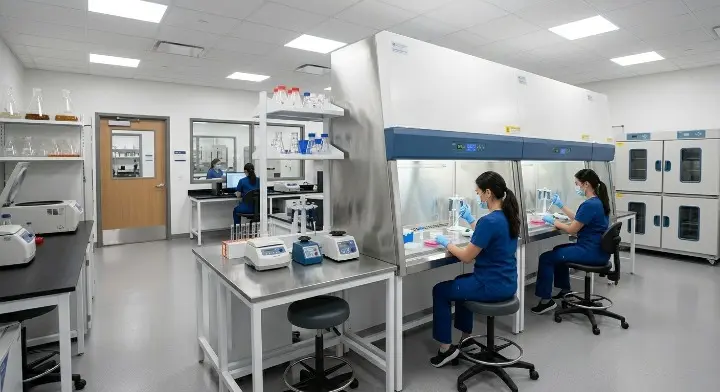
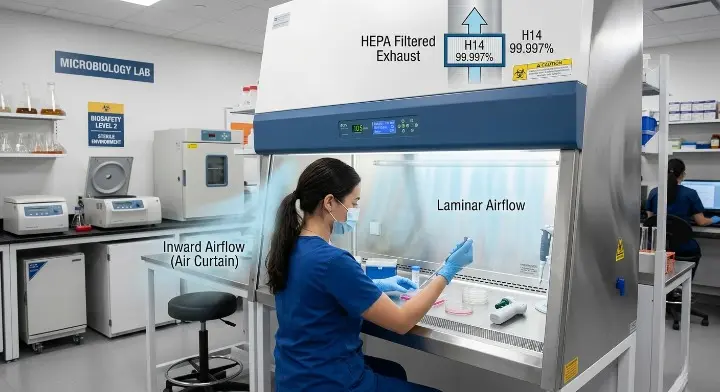
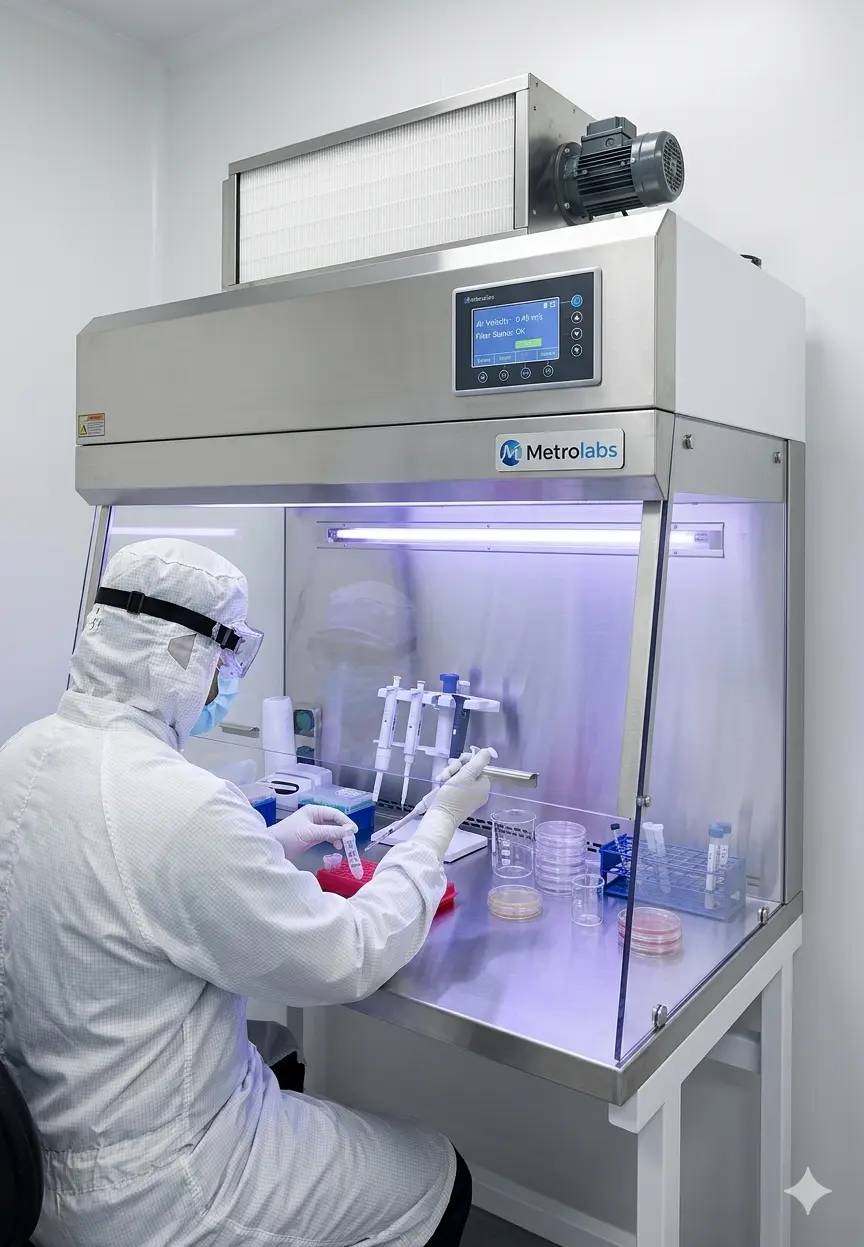
Inward air curtain at ≥0.38 m/s draws room air into the cabinet through the front sash opening — preventing bio-aerosols generated at the work surface from reaching the operator’s face and breathing zone.
HEPA-filtered vertical downflow air (Grade A — ISO Class 5) sweeps the work surface with ultra-clean air — preventing ambient airborne micro-organisms from contaminating cell cultures, media, and sensitive samples.
All exhaust air passes through a HEPA filter before returning to the laboratory — ensuring that biological agents from the work zone never escape to the surrounding room, protecting colleagues and the facility.
How the Metrolabs BSC Class II Protects All Three Parties Simultaneously
The BSC Class II is the only laboratory equipment that simultaneously protects the operator, the sample, and the laboratory environment. Understanding how it achieves all three is essential for correct use and for selecting the right unit for your application.
Room Air Drawn In — Personnel Protection Begins
When the cabinet is operating, a fan mounted at the top of the unit draws air inward through the front aperture (the sash opening where the operator works). This inward airflow — maintained at a minimum of 0.38 m/s (75 fpm) per NSF 49 — creates a persistent air curtain at the sash opening that continuously sweeps any bio-aerosols generated at the work surface away from the operator’s face and breathing zone and into the cabinet interior. As long as this inward air velocity is maintained above the threshold, no bio-aerosol from the work zone can travel outward through the sash opening to the operator.
HEPA Downflow Creates Grade A Work Zone — Product Protection
Simultaneously, the fan draws air from the cabinet plenum through the supply HEPA filter (H14, 99.997% at 0.3 micron MPPS) and delivers it downward across the work surface at 0.25–0.38 m/s in a vertical laminar pattern. This constant supply of HEPA-filtered air maintains the work surface environment at Grade A (ISO Class 5) — fewer than 3,520 particles per cubic metre at 0.5 micron — preventing ambient microorganisms from contaminating cell cultures, media, and samples on the work surface.
Contaminated Air Splits at Front Grille — 70% / 30% Split
The downflow air — which has now swept across the work surface and may carry biological agents from the work in progress — mixes with the inflow air at the front intake grille and is drawn into the recirculation and exhaust plenum below the work surface. Here the contaminated air is split: approximately 70% is directed back to the supply HEPA filter for recirculation, and approximately 30% is directed to the exhaust HEPA filter for purification before discharge back to the laboratory room. This Type A2 split — 70/30 recirculation/exhaust — is the standard for non-volatile chemical applications.
Exhaust HEPA Purifies Room Air — Environment Protection
The exhaust portion of the contaminated air passes through the exhaust HEPA filter (H14, 99.997% at 0.3 micron) before being returned to the laboratory room. This exhaust HEPA removes 99.997% of all biological agents — bacteria, viral particles, fungal spores, and aerosolised cells — ensuring that no living biological agent escapes from the BSC interior to the surrounding laboratory environment. The laboratory personnel working outside the BSC are protected from biological agents generated inside it throughout the working day.
Microprocessor Monitors Safety — Alarm Before Operator Awareness
The microprocessor controller continuously samples both inflow and downflow air velocity sensors at a high frequency — detecting a drop in inflow velocity (which would compromise personnel protection) before the velocity has dropped far enough for the operator to notice a change in the airflow sensation at the sash opening. When inflow velocity falls below the safe threshold (0.38 m/s), an audible alarm and visual alert activate immediately — alerting the operator to stop work, close the sash, and investigate the cause before any biological material has escaped the cabinet.
BSC Classes & Types — Choosing the Right Level of Containment
The type of BSC required depends on the biosafety level of the organisms being handled, whether chemical vapours are present, and whether product protection is needed:
Personnel & Environment — No Product Protection
Inward airflow only. Protects the operator and the room from bio-aerosols. No HEPA supply — unfiltered room air flows over the work surface. Suitable for general microbiology where sample sterility is not required. Rarely used in modern pharmaceutical laboratories.
Personnel + Product + Environment — BSL-1 and BSL-2
Recirculates ~70% of air through supply HEPA, exhausts ~30% through exhaust HEPA. Inflow ≥0.38 m/s. Grade A work surface. Used in ~90% of all BSC installations worldwide. Suitable for cell culture, microbiology, pharmaceutical QC, hospital labs. Standard for BSL-1 and BSL-2. EN 12469 / NSF 49 certified.
100% Total Exhaust — Chemical + Biological Dual Hazard
100% of cabinet air is exhausted through a dedicated external duct — no recirculation. Required when volatile toxic chemicals, radionuclides, or carcinogens are used alongside biological work inside the cabinet. Requires external ducting installation — not a plug-and-play cabinet.
Gas-Tight Glovebox — BSL-3/4 Maximum Containment
Completely sealed, gas-tight enclosure under negative pressure. Operator works through heavy-duty rubber gloves attached to ports. All supply air through two HEPA filters in series. Exhaust through two HEPA filters in series. For BSL-3 and BSL-4 — highest-risk pathogens (Ebola, SARS, anthrax).
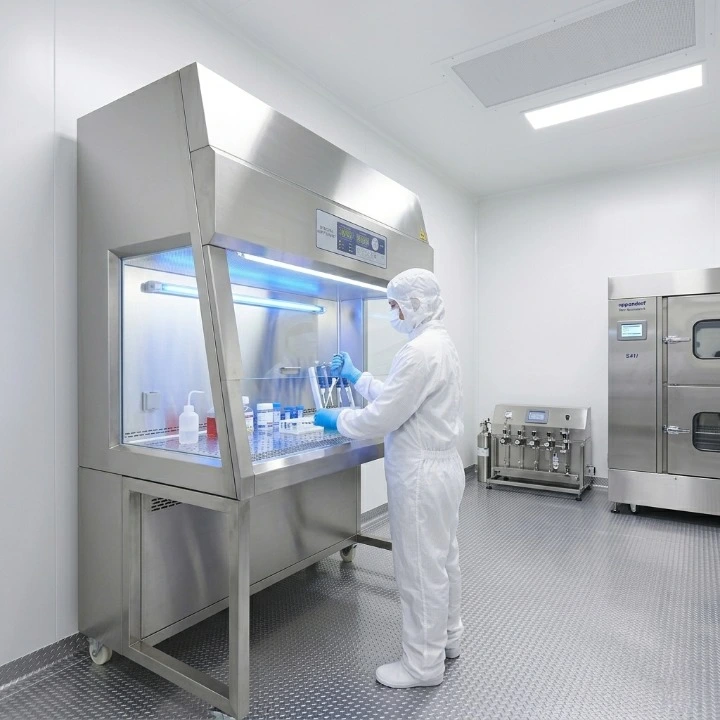
Ergonomic Design — Built for Extended Biological Work Sessions
Biosafety cabinets are used for hours on end. Metrolabs BSC Class II units incorporate ergonomic design features that reduce operator fatigue, improve visibility, and maintain the protective air curtain throughout extended work sessions:
Six Engineering Features of the Metrolabs BSC Class II
Every Metrolabs Biosafety Cabinet Class II is built to these standards — making it a precision primary containment instrument, not simply a ventilated enclosure:
Dual H14 HEPA Filtration — 99.997% — Supply + Exhaust
Two H14 HEPA filters (EN 1822 rated — 99.997% minimum efficiency at 0.3 micron MPPS) are installed in the BSC: one on the supply air path and one on the exhaust air path. Both are installed in gel-seal or knife-edge frames that prevent any unfiltered air from bypassing the filter perimeter. A factory DOP/PAO integrity test is performed on both HEPA filters before the unit is shipped, and the test report is supplied as part of the IQ documentation. Differential pressure gauges across both filters provide visible filter loading indicators. A G4 pre-filter in the intake path extends HEPA service life.
Coved SS Interior — Zero-Joint, Single-Piece Construction
The internal work zone is fabricated from surgical-grade SS 304 (standard) or SS 316L (optional) with a single-piece coved interior — all internal corners and floor-to-wall junctions radiused, with no internal weld joints or seam lines. This eliminates the standard point of microbial colonisation (the weld bead at the floor-to-wall junction), leaving a continuous smooth surface at every corner. The electropolished or mirror-polished internal surface (Ra <0.5μm) makes contamination immediately visible under the LED work zone lighting — supporting visual inspection-based cleaning verification.
Microprocessor Controller — Real-Time Safety Monitoring with Velocity Alarm
The microprocessor-based controller samples inflow and downflow air velocity sensors continuously — at a frequency that detects a transient airflow anomaly within seconds. The inflow velocity alarm activates when inflow falls below the NSF 49 minimum threshold (0.38 m/s / 75 fpm), producing an audible and visual warning before the operator is aware of any change. The display provides real-time readings of inflow velocity, downflow velocity, HEPA filter differential pressure, UV-C lamp cumulative hours, and system status. A USB data port allows logging for GMP environmental monitoring and audit records.
UV-C Germicidal Lamp — Safety-Interlocked Automated Decontamination
The integrated UV-C germicidal lamp provides full coverage of the work surface and side walls during idle periods between work sessions. The lamp cannot be activated when the sash is in the open operating position — the sash-position interlock ensures personnel are never exposed to UV-C radiation. If the sash is opened during an active cycle, the lamp deactivates immediately. The controller tracks cumulative UV-C hours and alerts when the lamp approaches end-of-life (typically 7,000–9,000 hours). It supplements, but does not replace, the manual IPA wipe-down required at the start and end of every session.
VHP Compatibility — All Components Tested for Room-Wide Decontamination
All internal components — silicone sash sealing strips, front viewing panel glazing, UV-C lamp end caps, HEPA filter housing gaskets, and work surface drain valve seals — are specified and tested to withstand room-wide Vaporised Hydrogen Peroxide sterilisation cycles at 1000 ppm for standard pharmaceutical durations. For laboratories using room-wide VHP decontamination, this ensures the BSC can be processed in the same cycle as the room without equipment damage — returning to service immediately after aeration without BSC-specific post-VHP inspection.
Vibration-Isolated Blower — Stable Work Surface for Precision Biology
The motor-blower is mounted with vibration-isolation suspension — calibrated coil springs and damping washers that decouple blower vibration from the cabinet body and work surface. This is essential for two classes of biological work: analytical balance weighing of culture media components (where surface vibration above 0.01g affects repeatability) and high-magnification optical microscopy (where vibration above ~0.5 micron amplitude causes image blur above 200x). The vibration-isolated blower also reduces acoustic noise at the operator position, contributing to a quiet environment for extended concentrated work.
BSC Class II — Standard Technical Specification
Metrolabs BSC Class II standard parameters — customisable at every dimension and feature:
| Specification | Details |
|---|---|
| Classification | Class II Type A2 |
| Compliance Standard✓ Certified | EN 12469 / NSF/ANSI 49 |
| Inflow Velocity | ≥ 0.38 m/s (75 fpm) — NSF 49 minimum |
| Downflow Velocity | 0.25 – 0.38 m/s — Grade A ISO Class 5 |
| Air Recirculation Split | ~70% recirculated / ~30% exhausted |
| Supply HEPA | H14 — 99.997% at 0.3μm — EN 1822 |
| Exhaust HEPA | H14 — 99.997% at 0.3μm — EN 1822 |
| Interior MOC | SS 304 std / SS 316L optional — coved |
| Front Sash | 10° sloped safety glass — recessed grille |
| UV-C Lamp | Standard — sash-interlocked — programmable timer |
| Controller | Microprocessor — velocity alarm — USB log |
| Standard Widths | 900 / 1200 / 1500 / 1800 mm |
| Power Supply | 220 V / 50 Hz |
Optional Upgrades & Configurations
SS 316L Interior Upgrade
Upgrade from SS 304 to SS 316L for superior corrosion resistance against VHP and chloride disinfectants in Grade A/B pharmaceutical BSC applications.
Height-Adjustable Stand
Motorised or manual height-adjustable stand for sitting or standing operation — with integrated ergonomic footrest — for operator comfort during extended sessions.
PAO / DOP Test Ports
Dedicated upstream and downstream sampling ports for PAO filter integrity test during commissioning and routine ISO/GMP annual certification — required for qualification documentation.
USB / BMS Integration
USB port for operational parameter data download — or Ethernet/BMS integration to relay airflow velocity, filter pressure, and UV hours to the facility building management system.
UV-C Hour Meter
Cumulative UV-C lamp hour counter on microprocessor display for planned replacement scheduling — ensuring germicidal output remains above effective threshold throughout service life.
Exhaust Canopy Connection
Thimble connection canopy allowing the BSC to be connected to the building exhaust system for work involving small quantities of volatile chemicals alongside BSL-1/2 biological agents.
Calibration Certificate
Traceable calibration certificate for the airflow velocity sensor and display — required for GMP instrument qualification documentation at installation and annual recertification.
Sash Open Alarm
Audible alarm activated when sash is raised above the safe working height — alerting the operator that the protective air curtain may be compromised before biological work commences.
BSC Class II Applications Across Every Regulated Biological Laboratory
EN 12469 / NSF 49 Class II A2 Biosafety Cabinets for every environment where three-way protection — personnel, sample, and environment — is required simultaneously:
Pharmaceutical QC Microbiology
BSC Class II for sterility testing, microbial limit testing, environmental monitoring plate incubation, and cell culture work. GMP IQ documentation at handover.
Cell Culture & Biotech
BSC Class II for mammalian cell culture, hybridoma work, viral vector production, and primary cell isolation — protecting both the operator and the culture simultaneously.
BSL-2 Microbiology
BSC Class II for work with moderate-hazard agents — Staphylococcus, Salmonella, hepatitis B, HIV — at Biosafety Level 2. WHO LBM and CDC/NIH BMBL compliant.
Hospital & Clinical Microbiology
BSC Class II for clinical sample processing — blood cultures, sputum specimens, MRSA/VRE cultures, and infectious sample handling. NABH compliant throughout.
Food Microbiology Testing
BSC Class II for FSSAI food microbiology — pathogen testing (Salmonella, Listeria, E. coli O157), sterility confirmation, and microbiological quality testing.
DNA & PCR Work
BSC Class II for DNA recombinant work, gene therapy research, and PCR preparation — the downflow clean air prevents amplified DNA from contaminating subsequent reactions.
Pharmacy Drug Compounding
BSC Class II for aseptic pharmaceutical compounding — providing the sterile Grade A environment required while protecting compounding personnel from biological contamination.
Research & NABL Labs
BSC Class II for NABL-accredited biotechnology and microbiology research laboratories. Annual NSF-certified airflow recertification. VHP compatible. Full NABL documentation.
High-Accuracy Fabrication for Long-Term Biosafety Performance
Metrolabs focuses on the high-accuracy fabrication, advanced control systems, and comprehensive documentation that ensures your BSC meets global biosafety standards throughout its service life:
Factory DOP Test on Both HEPA Filters Before Dispatch
Every Metrolabs BSC undergoes a factory DOP/PAO integrity test on both the supply and exhaust HEPA filters — confirming zero bypass at the filter perimeter before the unit leaves the factory. The test report is included in the IQ documentation package. A second DOP test at site confirms integrity is maintained through shipping and installation.
Certified Airflow Velocity — Inflow + Downflow Confirmed at Handover
Airflow velocity measurements at multiple work zone positions are performed and documented at handover — confirming that both the personnel protection threshold (≥0.38 m/s inflow) and the Grade A downflow velocity are achieved and distributed uniformly before the unit enters service.
VHP Compatible Throughout — Every Component, Every Cycle
All components — gaskets, sash seal, UV-C end caps, HEPA housing seals, drain valve — are tested for VHP compatibility at 1000 ppm. Laboratories using VHP room decontamination can process the BSC in the same cycle as the room, returning to service after aeration without disassembly.
Annual Recertification Support — NSF Annual Inspection Requirement
BSCs must be annually recertified by a trained third-party NSF/EN certifier. Metrolabs provides the DOP test ports (optional) and calibration certificates required by the recertification procedure, and can coordinate with accredited recertification services for annual inspection scheduling.
BSC Class II vs Laminar Air Flow (LAF) — Key Differences
A Laminar Air Flow unit must never be used for work with infectious agents, pathogens, or biological material with aerosol hazard potential — it does not protect the operator. Use a BSC Class II whenever the material being handled has any potential to cause infection or allergic sensitisation through the respiratory route. See LAF Units →
From Specification to Factory-Tested & IQ-Documented BSC
Metrolabs manages the complete BSC supply and commissioning process:
Specification & Biosafety Assessment
Biosafety level confirmed (BSL-1 / BSL-2). Agents handled reviewed. MOC (SS 304 / SS 316L), cabinet width (900–1800mm), optional features, and room ventilation requirements confirmed. EN 12469 / NSF 49 compliance confirmed. Dimensioned drawing produced and signed off.
Precision Fabrication
Cabinet body fabricated — SS 304 or SS 316L coved single-piece interior. HEPA plenum and blower installed with vibration mounts. Supply and exhaust H14 HEPA filters installed in gel-seal frames. G4 pre-filter fitted. Microprocessor controller wired. UV-C lamp mounted with sash interlock. LED lighting fitted. Passivated + polished.
Factory Test & Validation
Airflow velocity measured — inflow ≥0.38 m/s · downflow 0.25–0.38 m/s · DOP/PAO integrity test on both HEPA filters · UV-C sash interlock tested · Microprocessor alarm tested at threshold · USB data log verified · Smoke visualisation test. All results documented and test report issued with unit.
IQ Documentation Package
SS MTCs, ASTM A967 passivation cert, H14 EN 1822 filter cert, DOP/PAO test report (supply + exhaust HEPA), velocity measurement grid, alarm test record, UV-C interlock test record, smoke test record, calibration certificates, and installation photographs compiled for GMP/ISO laboratory IQ documentation at handover.
Factory & Office
4, SIDCO-MICRO, Thirumudivakkam, Chennai – 600 132, Tamil Nadu
🗺 Open in Google Maps ↗Ready to Install a Biosafety Cabinet Class II in Your Laboratory?
Contact Metrolabs for a free biosafety assessment. Our specialists will confirm your BSL level, agent type, cabinet width, optional features, and documentation requirements — then fabricate, factory-validate, install, and commission your BSC with complete IQ documentation at delivery.