
Microbiology Room Equipment — High-Accuracy Biosafety & Airflow Solutions
In a microbiology laboratory, the primary objective is to protect the integrity of the sample, the safety of the personnel, and the sterility of the environment. Metrolabs provides high-accuracy biosafety and airflow containment solutions engineered for long-term performance in high-stakes pharmaceutical, biotech, and clinical microbiology research — with a Zero-Ledge philosophy ensuring primary containment zones remain aseptic and easy to decontaminate.
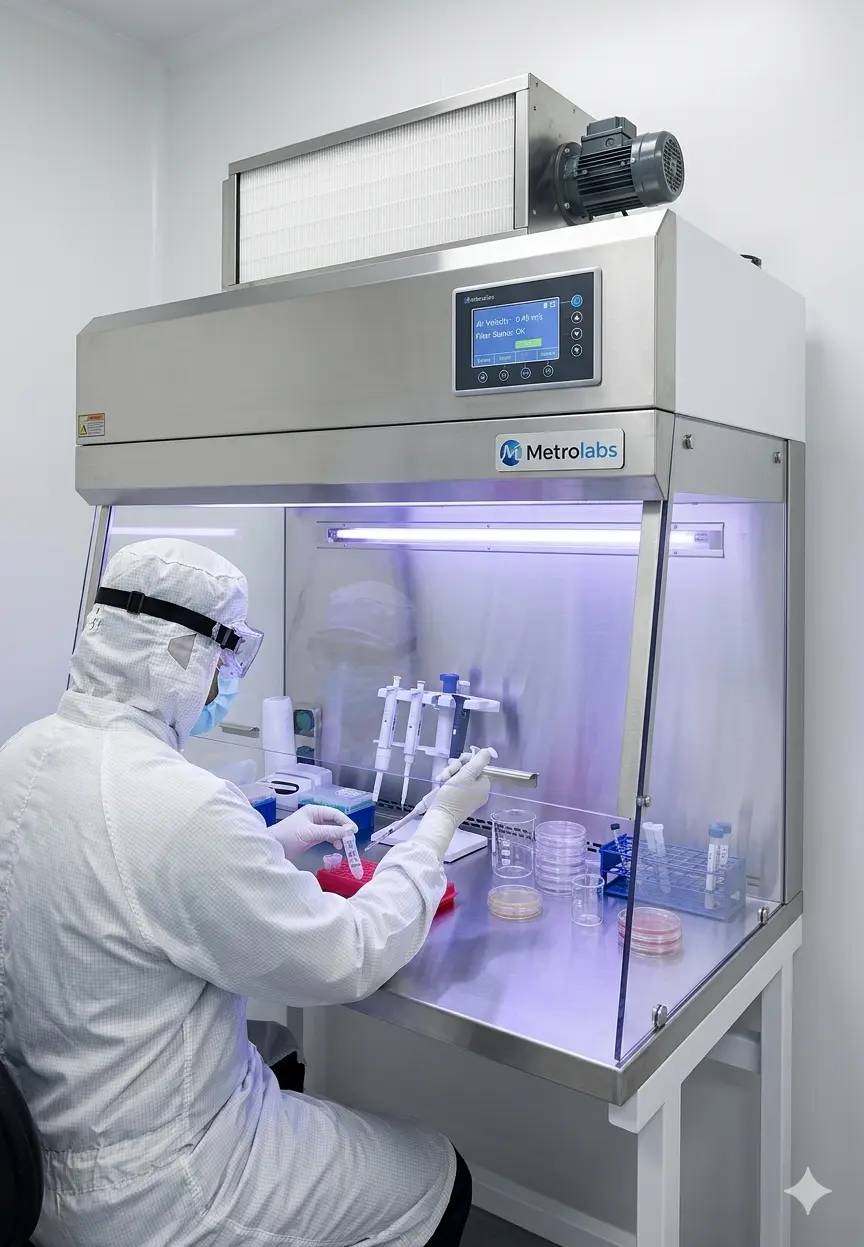
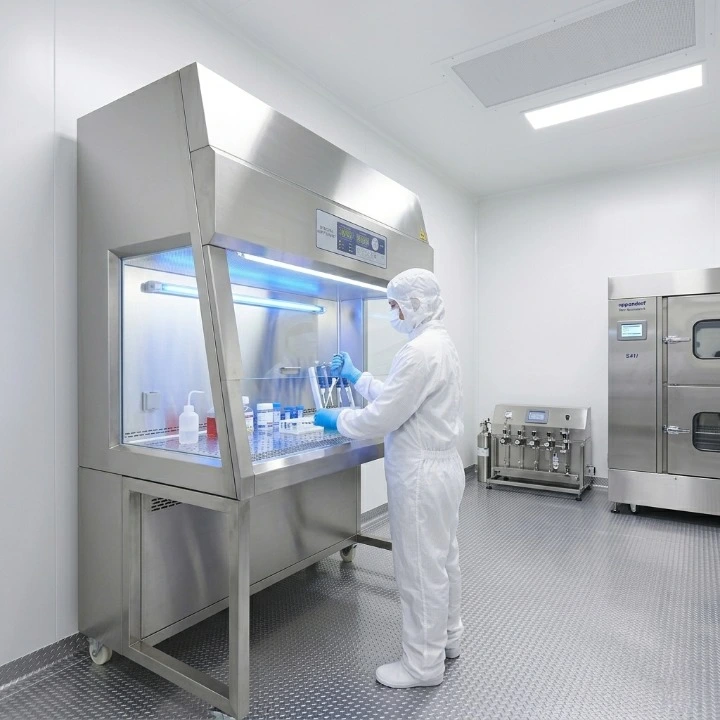
The Class II Biosafety Cabinet is the structural cornerstone of any microbiology room handling potentially infectious agents, biological samples, and cell cultures. It provides a ventilated environment that simultaneously protects the user from bio-aerosol exposure, the sample from cross-contamination by ambient microorganisms, and the surrounding room from exhaust air containing biological hazards. Metrolabs BSC Class II units are fabricated with surgical-grade SS construction, advanced HEPA filtration logic, and microprocessor-based monitoring — engineered for long-term performance in pharmaceutical, biotech, and clinical microbiology environments.
Three-Way Protection — Personnel, Product & Environment Simultaneously
High-velocity laminar downward airflow from the HEPA supply plenum creates an air curtain across the front sash opening — inward air draw from the room prevents bio-aerosols from the work surface from reaching the operator. Recirculated HEPA-filtered air protects the work surface from ambient microorganisms. HEPA-filtered exhaust prevents biological agents from escaping to the laboratory room.
Aseptic Coved Interior — Single-Piece SS Work Zone
The internal work zone is fabricated from surgical-grade SS 304 or SS 316L with a single-piece coved interior — all internal corners radiused, no joints or seams where micro-organisms can colonise. The surface is electropolished or mirror-polished to Ra <0.5μm — bacteria cannot anchor to the surface between cleaning cycles. The work surface is removable for complete access to the under-surface drain pan for IPA wipe-down.
Ergonomic Safety Sash — Protective Air Curtain Maintained
The sloped front sash is designed for improved operator ergonomics — the slope provides a larger clear field of view of the work surface at the correct sitting height, reducing the forward lean that causes operator fatigue during extended pipetting tasks. The recessed air intake grille at the sash base prevents the operator’s forearms from blocking the protective inward air curtain — the critical safety mechanism that protects the operator from bio-aerosols generated at the work surface.
UV-C Germicidal with Automated Timer — Decontamination During Idle
Integrated UV-C germicidal lamp with a programmable timer automatically decontaminates the BSC work zone and HEPA-filtered work surface between sessions. The UV-C lamp is interlocked with the front sash — UV-C cannot activate when the sash is open. The microprocessor controller tracks UV-C lamp cumulative hours and alerts when replacement is due.
Microprocessor Controller — Real-Time Airflow & Filter Health Display
The microprocessor-based controller provides real-time display of inflow air velocity, downflow air velocity, HEPA filter differential pressure (loading indicator), UV-C lamp hours, and any alarm conditions. The controller activates an audible and visual alarm if inflow velocity drops below the minimum safe threshold — a safety-critical alert that indicates a filter loading event or blower failure that has compromised personnel protection before the operator is aware of the change.
For procedures involving non-hazardous materials that require a localised Grade A environment — such as media preparation, PCR setup, sample plating, electronic component assembly, and aseptic dispensing — the Laminar Air Flow unit provides high-accuracy particulate control in the work zone without the containment features (and associated cost and space requirements) of a full biosafety cabinet. The LAF unit bathes the work surface in a constant stream of HEPA-filtered air at a face velocity that establishes a Grade A (ISO Class 5) environment over the work zone — sweeping away particles released by the operator and the work process before they can settle on the sample or the work surface.
Unidirectional Airflow — Horizontal or Vertical Configuration
Horizontal LAF: HEPA-filtered air flows from the back wall of the unit across the work surface toward the operator — the operator is downstream of the work surface, so particles generated by the operator are carried away from the sample. Suitable for work benches and large-format work areas where the operator works from the front. Vertical LAF: HEPA-filtered air flows downward from the canopy across the work surface — similar to a cleanroom ceiling but localised to the work zone. Suitable for taller items on the work surface (flasks, bioreactors) where a horizontal airflow would be obstructed.
Cleanroom Integration — Modular Panel System Compatible
Metrolabs LAF units are designed to sit perfectly within the modular cleanroom partition system — flush-mounted ceiling LAF units integrate into the cleanroom ceiling grid without any external protrusion, maintaining the pressure balance of the room while providing a localised Grade A sterile zone over a specific work area. The bench-top LAF unit is designed with the same dimensional modular spacing as the cleanroom workbench system, allowing it to be positioned at any point in the cleanroom without creating airflow obstruction problems at adjacent work positions.
Vibration-Free Stability — Dampened Motor-Blower
The motor-blower is mounted with vibration-isolation suspension — the same suspension arrangement as the Dynamic Pass Box blower — to prevent the blower’s operating vibration from transmitting through the LAF unit body to the work surface. This vibration isolation is critical for two classes of work: high-accuracy analytical balance weighing (where vibration above 0.01g can affect measurement repeatability), and high-magnification optical microscopy (where vibration above approximately 0.5 μm amplitude causes image blur at magnifications above 200×).
G4 Pre-Filtration — Extended Primary HEPA Service Life
A G4 pre-filter in the air intake path captures large dust particles (above 5 micron) before they reach the H14 HEPA filter. This two-stage filtration system extends the service life of the primary HEPA filter by a factor of 3–5x compared to a single-stage HEPA installation — the G4 pre-filter is replaced at a lower cost than the HEPA, and the HEPA maintains its rated filtration efficiency throughout its extended service life. A differential pressure gauge across the H14 HEPA filter provides a visible loading indicator, and the microprocessor controller alerts when the pressure differential exceeds the replacement threshold.
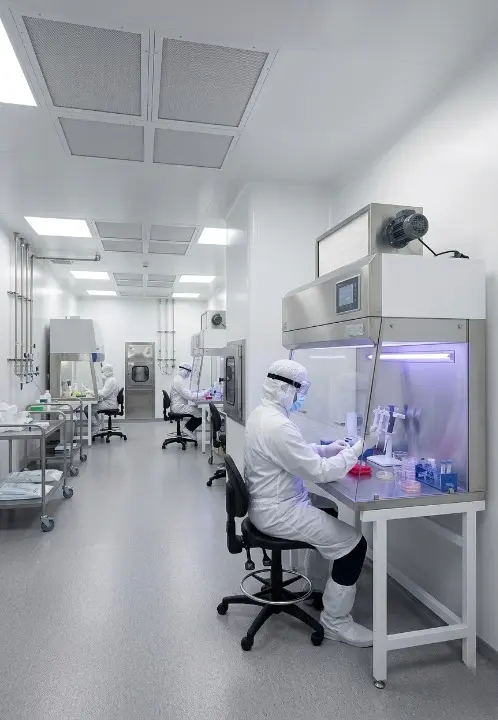
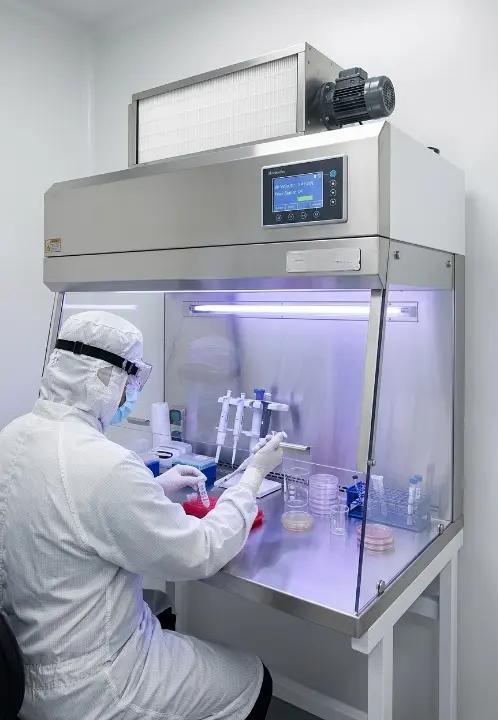
BSC Class II vs Laminar Air Flow — Choosing the Right Unit
The most important selection decision in microbiology room equipment is understanding which unit protects which party — and what each unit cannot protect against:
Six Engineering Features Across All Metrolabs Microbiology Room Equipment
Every Metrolabs BSC and LAF unit shares these engineering standards — making them precision biosafety instruments, not simply ventilated enclosures:
HEPA H14 Filtration — 99.997% at 0.3μm, Gel-Seal Frame
The H14 HEPA filter (99.997% minimum efficiency at the 0.3 micron MPPS — EN 1822 rated) is installed in a gel-seal or knife-edge frame that prevents any unfiltered air from bypassing the filter perimeter. Only air that has passed through the H14 HEPA membrane reaches the work zone. The gel-seal frame is inspectable: each installation includes a DOP/PAO filter integrity test (measuring penetration at multiple points across the filter face and perimeter) before the unit is released from factory. A second DOP integrity test is performed at site installation and included in the IQ documentation. A G4 pre-filter in the intake path extends HEPA service life. The differential pressure gauge across the HEPA filter provides a continuously visible filter loading indicator, and the microprocessor controller alerts at the filter replacement threshold.
Zero-Ledge Coved SS Interior — 100% Aseptic Wipe-Down
The internal work zone of the BSC and the interior surfaces of the LAF unit are fabricated from surgical-grade SS 304 or SS 316L with all internal corners coved to a continuous large radius — eliminating the right-angle junctions where micro-organisms colonise and standard wipe-down disinfection fails to penetrate. The single-piece pressed construction eliminates internal weld joints — the most common colonisation site in standard stainless steel biosafety cabinets fabricated from multiple welded sheet sections. The electropolished or mirror-polished internal surface (Ra <0.5μm) makes contamination — fingerprints, media residue, and disinfectant streaks — immediately visible under the work zone LED illumination, supporting the visual inspection-based cleaning verification required by GMP operating procedures for microbiology laboratory primary containment equipment.
Microprocessor Controller — Real-Time Safety Monitoring with Alarm
The microprocessor-based controller monitors airflow velocity (both inflow and downflow for the BSC), HEPA filter differential pressure, UV-C lamp cumulative hours, and system power supply status — continuously, at a sampling rate sufficient to detect transient airflow anomalies that could momentarily compromise personnel or sample protection. The controller activates an audible alarm and a visual LED alert if inflow velocity drops below the minimum safe threshold (typically 0.38 m/s for BSC Class II, as specified by EN 12469 and NSF 49) — a critical safety alert that protects the operator before they are aware of the airflow change. The real-time display allows operators and supervisors to monitor equipment performance at a glance without performing a manual airflow measurement. The data log accessible via the front panel USB port provides historical evidence of equipment performance for GMP audit and qualification maintenance documentation.
UV-C Germicidal — Safety-Interlocked Automated Decontamination
Integrated UV-C germicidal lamps with automated programmable timers ensure that the work zone is decontaminated during idle periods — automatically, without requiring operator activation at each session end. The UV-C safety interlock ensures the lamp cannot be activated when the sash (BSC) or access door (LAF) is open — protecting operators from UV-C exposure. If the sash or door is opened during an active UV-C cycle, the lamp deactivates immediately. The UV-C hour meter on the microprocessor controller tracks cumulative lamp operating hours and alerts at the end-of-life threshold (typically 7,000–9,000 hours) — ensuring planned replacement before germicidal output falls below the effective threshold. UV-C performance is not a substitute for manual IPA wipe-down decontamination — it supplements it by decontaminating surfaces that the IPA wipe physically contacts less effectively (underside of the work surface, rear corners of the work zone, surfaces of items left in the cabinet).
VHP Compatibility — All Components Rated for Room-Wide Decontamination
All internal components of the Metrolabs BSC and LAF — including the silicone gaskets, the front sash sealing strips, the viewing panel glazing compound, the UV-C lamp end caps, the work surface, and the drain valve seals — are specified and tested to withstand room-wide Vaporised Hydrogen Peroxide sterilisation cycles at 1000 ppm VHP concentration for standard pharmaceutical VHP cycle durations. This VHP compatibility is critical for microbiology laboratories that use room-wide VHP decontamination as part of their contamination control programme — ensuring that a VHP cycle does not damage the BSC or LAF and that the equipment can be returned to service immediately after the aeration period without any disassembly or component replacement.
Vibration-Free Stability — Dampened Blower for Precision Work
The motor-blower in both the BSC and LAF is mounted with vibration-isolation suspension — calibrated coil springs and damping washers that decouple the blower vibration from the cabinet body. This prevents the blower’s operating vibration from transmitting to the work surface — a critical requirement for analytical balance weighing (where work surface vibration above 0.01g affects measurement repeatability), optical microscopy (where vibration above approximately 0.5 μm amplitude causes image blur at high magnification), and micro-injection or electrophysiology procedures (where mechanical stability at the sub-millimetre level is essential). The vibration-isolated blower also reduces the acoustic noise level of the BSC/LAF at the operator position — contributing to the quiet laboratory environment required for extended concentrated work sessions.
BSC Class II & LAF Unit — Technical Specifications Side by Side
Standard specifications for both equipment types — every parameter customisable to your facility requirement:
Microbiology Room Equipment Across Every Regulated Sector
EN 12469 / NSF 49 compliant BSC and ISO 14644 Grade A LAF units for every environment where biosafety and sample protection are the primary engineering requirements:
Pharmaceutical GMP
BSC Class II for aseptic media fill simulations, sterility testing, and microbial enumeration in QC microbiology labs. LAF for media preparation and PCR setup. VHP compatible throughout. Full GMP IQ documentation at handover.
Biotech & Cell Culture
BSC Class II for cell culture work, viral vector production, and ATMP manufacturing. Three-way protection for personnel, cell cultures, and environment. SS 316L coved interior. UV-C idle decontamination standard.
BSL-1 & BSL-2 Labs
BSC Class II (EN 12469 / NSF 49 Class II A2) for BSL-1 and BSL-2 work with bacteria, fungi, and cell cultures. Inflow air curtain protects personnel. HEPA exhaust protects laboratory environment. WHO LBM compliant.
Microbiology Testing
BSC Class II for sterility testing, environmental monitoring plate preparation, and microbial identification. LAF for non-hazardous ELISA and PCR setup. Microprocessor monitoring for continuous GMP documentation.
Hospital & Clinical
BSC Class II for clinical microbiology sample processing, blood culture, and antimicrobial susceptibility testing. LAF for non-hazardous chemistry and immunology setups. NABH compliant. UV-C decontamination standard.
Electronics & Semiconductor
LAF units for electronic component assembly, wafer die bonding, and PCB rework in cleanroom and controlled environments where particulate control — not biosafety — is the primary requirement. ISO Class 5 Grade A environment.
Food & Beverage QC
BSC Class II for FSSAI food microbiology testing — pathogen testing, colony counting, and sterility confirmation. LAF for non-hazardous food chemistry. Coved SS interior for thorough cleaning between sample batches.
Research & NABL Labs
BSC Class II and LAF for NABL-accredited microbiology and biotechnology research. Vibration-free LAF for high-magnification microscopy and analytical balance work. Full NABL documentation package at handover.
High-Accuracy Fabrication for Long-Term Performance in High-Stakes Research
Metrolabs focuses on the high-accuracy fabrication and advanced control systems that ensure your microbiology room equipment meets global biosafety standards throughout its service life:
Advanced Control Systems — Real-Time Air Velocity & Filter Health
Metrolabs BSC and LAF units feature microprocessor-based controllers with real-time displays of air velocity and filter health — providing facility managers and operators with a continuous, visible confirmation that the equipment is performing within its specified safety parameters. The velocity alarm on the BSC is the most critical safety feature — it alerts the operator to a safety-compromising airflow event before the operator is physically aware of the change, preventing potential exposure to bio-aerosols from the work surface.
VHP Compatibility — Every Component, Every Cycle
All internal components, including gaskets and viewing panels, are tested to withstand room-wide Vaporised Hydrogen Peroxide sterilisation cycles — ensuring that a VHP cycle does not damage the equipment and that the laboratory can be returned to service immediately after aeration without any equipment disassembly or component inspection. For pharmaceutical microbiology laboratories that use VHP as part of their validated room decontamination programme, this compatibility eliminates the service interruption that damages from VHP cycle would cause.
Custom Integration — LAF Units Built Into Cleanroom Partition Systems
Metrolabs manufactures specialised LAF units that are integrated directly into the cleanroom partition system — flush-mounted ceiling LAF units that become part of the cleanroom architectural design rather than equipment placed in the cleanroom. These integrated LAF units maintain the pressure cascade of the cleanroom while providing a Grade A sterile zone over specific work areas, without the external protrusions and panel junction concerns that standard bench-top LAF units create when placed on a cleanroom workbench.
Audit-Ready Documentation — Factory-Validated for ISO & GMP
Every Metrolabs BSC and LAF unit is factory-validated with DOP/PAO HEPA filter integrity test (measuring penetration at multiple points across the filter face and perimeter), airflow velocity measurement at multiple work zone positions (confirming Grade A qualification criteria), UV-C lamp intensity measurement, and microprocessor controller calibration. The factory validation report, material test certificates, and all component compliance certificates are supplied at handover for direct inclusion in the facility IQ documentation.
What each unit protects — at a glance
Factory & Office
4, SIDCO-MICRO, Thirumudivakkam,
Chennai – 600 132, Tamil Nadu
🗺 Open in Google Maps ↗
Phone
Website & GSTN
www.metrolabs.biz
www.schoollabfurniture.com
GSTN: 33AASFM3382K1ZT
Ready to Equip Your Microbiology Room with High-Accuracy Biosafety Solutions?
Contact Metrolabs for a free consultation. Our specialists will assess your biosafety level, material type, work process, room dimensions, and documentation requirements — then supply, install, and commission your BSC or LAF with full IQ documentation including DOP test records at delivery.
🧪 Request a Free Microbiology Equipment Quote
Quote Request Received!
Our microbiology room equipment team will contact you within 24 working hours.
Immediate: 9840931231