
Cleanroom Cupboards — Sterile Storage That Never Becomes a Contamination Source
In a high-stakes laboratory or production facility, every storage unit is a potential contamination source — or a contamination control measure. Metrolabs cleanroom cupboards are engineered with the Zero-Ledge philosophy across every surface: no flat tops, no sharp internal corners, no crevices, no particle-trapping hardware. A precision-fabricated storage component that is as integral to your contamination control strategy as the HEPA filter above it.
Why Every Surface of a Cleanroom Cupboard Must Be Engineered — Not Just Manufactured
Standard office or industrial cupboards introduced into a cleanroom immediately create GMP violations — horizontal flat tops, plastic parts, exposed screws, sharp interior corners, and non-shedding surfaces. Metrolabs cleanroom cupboards are designed ground-up to eliminate every one of these risks.
30° Sloped Top — Structural GMP Compliance
The single most important GMP compliance feature in any cleanroom storage unit is the elimination of the horizontal top surface. A flat top accumulates particles at a rate determined by the room particle count — in a Grade D cleanroom operating at 200,000 particles per cubic metre, a 600mm wide flat cabinet top accumulates measurable contamination within hours of cleaning. The 30° slope prevents particle settlement (any particle landing on the slope slides off immediately under gravity) and physically prevents objects from being placed on top of the unit — removing the GMP-prohibited horizontal storage surface that flat-top cabinets create. An inspector can verify top-surface compliance visually in seconds — no SOP review or personnel interview required.
Coved Interior — 100% Wipe-Down Accessibility
A right-angle interior corner is a contamination trap that cannot be cleaned with a standard wipe — the wiping action deposits contamination in the corner rather than removing it. Metrolabs cleanroom cupboard interiors have no right-angle corners anywhere — every floor-to-side, side-to-back, and floor-to-back junction is formed with a continuous R10mm radius that a cleaning cloth follows in a single smooth wipe. The R10 radius is large enough that standard 280mm-wide cleaning wipes can wipe through the corner zone in a single pass while maintaining full contact with both surfaces. The coved junction is formed as an integral part of the pressed SS shell — not a separate corner insert — maintaining the continuous, smooth surface standard throughout.
Perforated Shelves — No Stagnant Air Inside the Cupboard
A solid shelf inside a closed cupboard creates a stagnant air zone below the shelf — an environment where particles generated during access events (door opening, item placement, item removal) accumulate and settle on stored materials rather than being swept by the room’s HVAC airflow. Metrolabs cupboard shelves are perforated to the same ∅25mm / 45mm pitch standard as cleanroom worksurfaces — allowing vertical air movement through all shelf tiers simultaneously. For Grade B environments specifically, perforated shelving ensures that even when doors are closed, the air inside the cupboard remains in environmental equilibrium with the room’s HVAC supply rather than forming a stagnant micro-environment with elevated particle counts.
Flush Hardware — No Protrusions to Snag Cleanroom Garments
Every piece of hardware on a Metrolabs cleanroom cupboard — handles, hinges, shelf supports, and lock mechanisms — is either concealed within the cabinet structure or flush-recessed into the surface with smooth, radius-edged recesses that cannot snag or tear cleanroom garments. Protruding handles on standard storage units are a common cause of cleanroom suit damage — a torn suit is a contamination pathway. Concealed hinges prevent the hinge pin from becoming a particle accumulation point. The flush-recessed handle has a smooth, radius-edged recess that can be fully wiped without the wipe catching on a protrusion edge.
Four Specialised Cupboard Designs — Each for a Specific Cleanroom Function
Beyond the standard cleanroom storage cupboard, Metrolabs designs four specialised configurations to meet specific functional requirements — each maintaining the same Zero-Ledge construction standard as the base unit:
Garment Storage Cupboards — Hanging Rail & PPE Compartments
Dedicated cleanroom cupboards for sterile storage of gowns, coveralls, hoods, boot covers, gloves, and face masks — essential in gowning rooms adjacent to aseptic and pharmaceutical manufacturing suites. The garment cupboard features SS 304 or SS 316L hanging rails with smooth cylindrical profile and coved end-cap welds — no exposed bracket screws or rail-end caps that shed particles from garment friction. The interior is divided into two functional zones: an upper hanging section with sufficient headspace for full coveralls plus a lower compartment with a series of narrow shelves for folded PPE items — gloves, bouffant caps, beard covers, and shoe covers — in the organised sequence required by the gowning SOP. An optional integrated HEPA fan filter unit (FFU) maintains a continuous positive-pressure, Grade A filtered air environment within the closed cabinet — keeping stored garments within the most particle-free air available. UV-C germicidal lamp option provides surface decontamination of stored items between use cycles.
Instrument Cupboards — Reinforced Shelving for Analytical Equipment
Instrument cupboards are designed for the safe storage of high-accuracy analytical instruments — portable balances, handheld spectrophotometers, viscosity meters, calibration standards, particle counters, and reference equipment — that must be stored securely between use cycles without exposure to accidental impact, vibration, or environmental contamination. The reinforced shelving uses 3mm SS 316L flat plate (vs 1.5mm standard) with additional under-shelf cross-bracing — providing a 50kg per shelf load rating for heavy instrument storage. The shelf surface is solid (not perforated) to provide a stable, continuous base contact for precision instruments. Optional anti-vibration shelf mounts — neoprene compression pads between the shelf and the shelf support — protect stored analytical instruments from building vibration during off-shift periods when instruments are stored rather than operated. Vision panel door option allows instrument status LED indicators to be read without opening the cupboard.
Wall-Mounted Cupboards — Flush to Modular Panel System
For cleanrooms where floor space is critical — and in Grade A/B pharmaceutical zones where every square metre of floor area must remain within the laminar flow zone — wall-mounted cupboards provide enclosed sterile storage with zero floor footprint. Metrolabs wall-mounted cleanroom cupboards are designed to integrate directly with the modular cleanroom sandwich panel system — mounted on SS 316L wall brackets that bolt to the panel’s structural steel backing frame, with the cupboard face flush with the room wall surface and no gap between cabinet sides and adjacent panels. The bracket system is concealed within the panel recess — the cupboard appears to emerge seamlessly from the wall surface. The base of the cupboard is a minimum 900mm above the cleanroom floor — providing full access below the cupboard for floor cleaning and eliminating the floor-to-cupboard junction that a floor-standing unit requires. Load rating 120kg per unit for wall-mounted configurations.
Consumable Dispensers — Organised Gravity-Fed Access
Specialised cupboard units for the organised storage and gravity-fed dispensing of sterile consumables — IPA wipes, nitrile gloves, bouffant caps, shoe covers, face masks, and sterile cotton — that must be accessible quickly during cleanroom operations without requiring operators to open a full cupboard and search for items. The consumable dispenser uses a front-access gravity-feed system for each consumable type — items are loaded from the rear of the unit (outside the cleanroom or from the exterior of the gowning room), slide forward by gravity, and are dispensed from the front access opening one item at a time. The front access opening is sized for one item only — preventing bulk withdrawal that generates particle clouds from agitating multiple items simultaneously. The unit exterior is flush SS 316L with the same coved and sloped construction as the standard cupboard. Load dividers between consumable sections are perforated SS 316L — the same material standard as the cupboard shelving, fully removable and cleanable.
Six Engineering Features That Define a Metrolabs Cleanroom Cupboard
Every Metrolabs cleanroom cupboard is built to the following engineering standards — features that make it a structural component of the sterile infrastructure, not a piece of furniture placed inside it:
SS 304 & SS 316L — No Plastic, No Composites
Every component of the Metrolabs cleanroom cupboard — body panels, door, shelves, shelf support pins, hinge assemblies, handle recesses, and any accessory fittings — is fabricated in the same SS 304 or SS 316L specification throughout. No plastic components (which outgas volatiles and shed particles under UV degradation), no MDF or composite panel substrates (which absorb moisture and grow mould), no zinc-plated or painted steel (which corrodes under IPA and chlorine-based cleaners). SS 316L is specified for pharmaceutical Grade A/B applications, providing the pitting corrosion resistance required for repeated exposure to chloride-based disinfectants and VHP at concentrations up to 1000 ppm. Post-fabrication, all cupboards are degreased with IPA and citric acid passivated to ASTM A967, with the passivation certificate supplied.
Fully TIG Welded — Seamless Aseptic Surface
All joints in the cupboard structure — panel-to-panel, door frame perimeter, shelf support reinforcements, hinge mounting plates, and the sloped top-to-body junction — are full penetration TIG welds, ground flush with the surrounding metal and progressively polished to match the specified surface finish. No screw, rivet, or bolt connection exists in any location accessible from the cleanroom interior or exterior. TIG welding eliminates the three contamination risks that bolted construction creates: the crevice at the bolt-face interface (inaccessible for cleaning), the thread space (accumulates particles), and metallic particle shedding from vibration-induced thread loosening. The fully welded surface is continuous and wipeable at every point — the cleaning cloth never encounters an obstruction that would require repositioning the wipe.
Medical-Grade Silicone Door Gasket — Hermetic Seal
The continuous silicone door gasket creates a hermetic seal between the door and the body frame — protecting stored materials from particle ingress during spray disinfection cycles (where aerosol droplets containing disinfectant and displaced particles can otherwise penetrate open or poorly sealed storage units), VHP sterilisation cycles (where H O concentration inside an unsealed cabinet can reach damaging levels for stored biological products), and routine door-opening events (where air displacement generates a brief inward airflow that draws ambient particles into the cabinet). The gasket material is pharmaceutical-grade platinum-cured closed-cell silicone — non-outgassing, VHP-resistant to 1000 ppm, autoclavable (for removable gaskets in highest-grade pharmaceutical applications), and dimensionally stable after 500+ VHP cycles. The gasket is moulded as a single continuous perimeter loop with no joint — a butt-joined gasket creates a potential leak point at the join location.
Viewing Panels — Toughened Glass or Polycarbonate
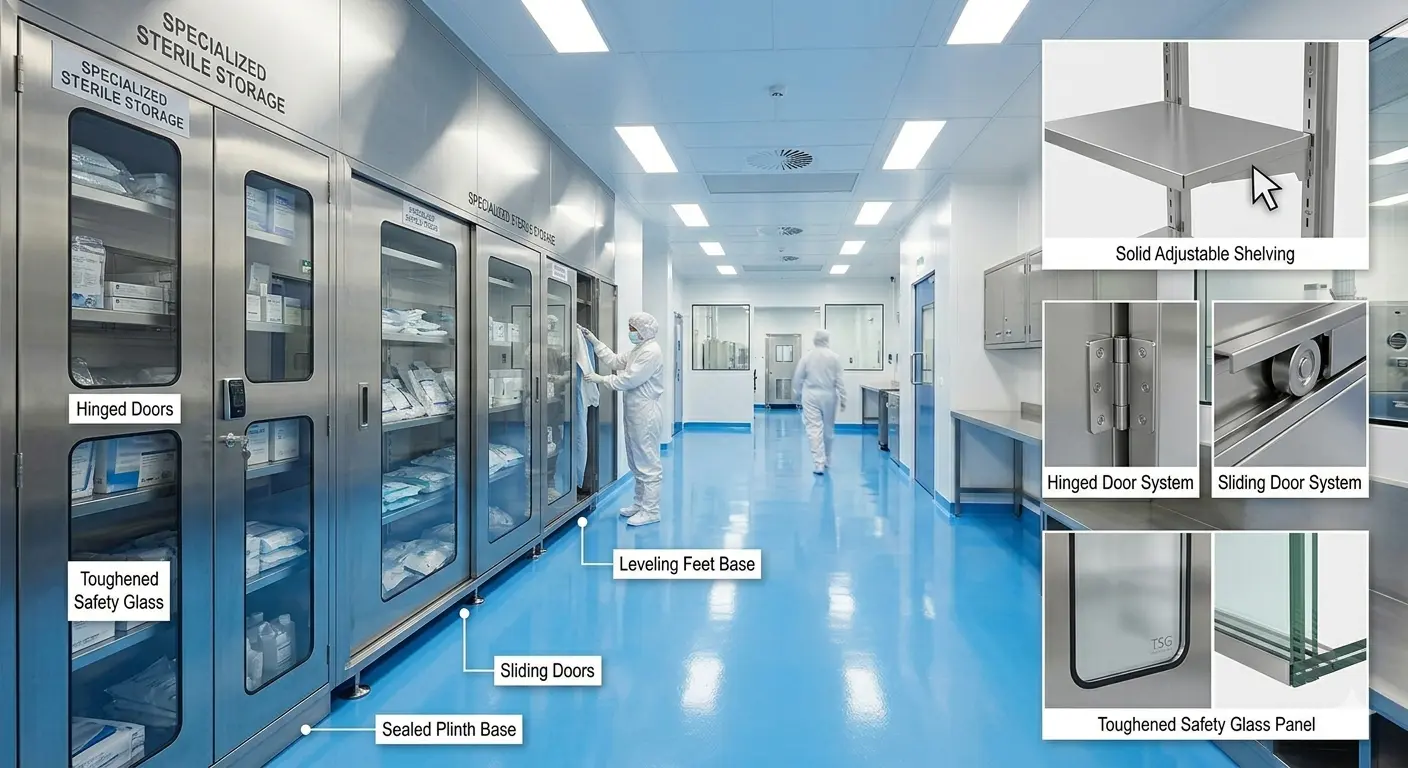
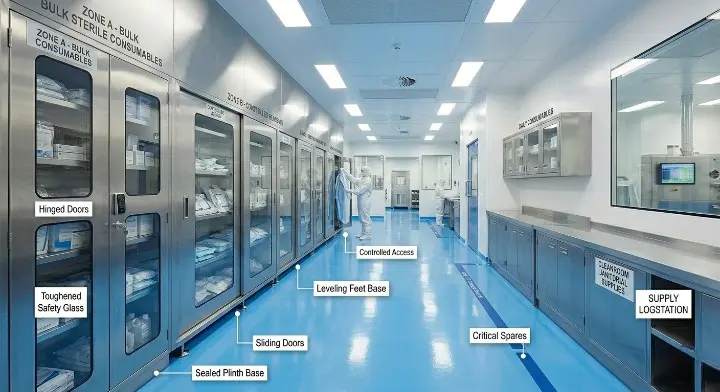
For cupboards housing frequently referenced materials — reference standards, calibration weights, reagent bottles, analytical column inventory, PPE stock level — where personnel must visually confirm contents and stock without opening the door and disturbing the internal micro-environment. Viewing panels are available in two specifications: toughened borosilicate safety glass (7mm thickness, IPA and VHP compatible, maximum chemical resistance, preferred for pharmaceutical Grade A/B environments) and toughened polycarbonate (5mm, IPA compatible, impact-resistant, preferred for Grade C/D and electronic cleanrooms where glass breakage risk is a concern). Both panel options are set into the SS 316L door frame with a dual-layer silicone seal that maintains the door’s gasket-level sealing performance — the vision panel does not degrade the hermetic seal of the door. An integrated SS 316L document pocket on the door exterior (smooth, no adhesive) provides space for cabinet content labels and SOPs without adhesive labels that shed particles.
Base Options — Sealed Plinth or Levelling Feet
Metrolabs cleanroom cupboards are available with two base configurations matched to the cleanroom layout and cleaning protocol. Sealed plinth — a continuous SS 316L perimeter skirting, fully TIG welded to the base of the cupboard body, with a silicone sealant bead at the floor interface — eliminates the gap between the cabinet base and the floor that standard cabinets leave. This gap is one of the most common GMP inspection findings in cleanroom facilities — it accumulates particles, moisture, and microbial growth that cannot be effectively cleaned without moving the cabinet. The sealed plinth prevents any under-cabinet accumulation by eliminating the space entirely. Levelling feet — for cupboards in rooms where under-cabinet floor access is routinely required for mopping and scrubbing — are encapsulated SS 316L adjustable bullet feet with smooth-bore housings and flat SS base discs, providing a minimum 150mm floor clearance for cleaning access while maintaining no exposed thread or horizontal ledge at the foot assembly.
Door Options — Hinged or Sliding for Space-Saving Access
Metrolabs cleanroom cupboards are available with hinged swing doors (standard for most applications — full-face silicone gasket, concealed hinges, flush-recessed handle, 180° opening) or sliding doors (for narrow bay positions where a swing door would conflict with adjacent equipment, personnel movement, or room traffic flow — the sliding door runs on a smooth top-track SS system with no floor track that would create a particle trap, and incorporates a compression gasket mechanism that seals the door hermetically when closed by rotating the flush handle). For double-width cupboards, a dual-panel meeting-stile door is available — two doors meeting at a central rebated SS join that maintains the gasket seal across the full width of the opening without a fixed centre post that would restrict access to either half of the interior.
Metrolabs Cleanroom Cupboard — Technical Standards
Every Metrolabs cleanroom cupboard is fabricated, finished, and documented to the following technical parameters:
| Feature | Metrolabs Standard | GMP Benefit |
|---|---|---|
| Grade A/B Material | SS 316L — electropolished or mirror | VHP & chloride resistant — biofilm inhibiting |
| Grade C/D Material✓ Std | SS 304 passivated — hairline or dull | IPA / QAC / PAA compatible |
| Top Design | 30° slope — structural no-storage | No dust accumulation — GMP inspection ready |
| Interior Corners | Coved — R10mm all corners | 100% wipe-down accessible — no biofilm traps |
| Welding | Full TIG — ground flush | No crevices — no particle-shedding joints |
| Door Seal | Continuous silicone gasket — no joints | Hermetic micro-environment — VHP resistant |
| Shelving | Perforated ∅25mm — adjustable 25mm pitch | Vertical airflow — no stagnant air zones |
| Hardware | Concealed hinges — flush recessed handle | No protrusions — garment-safe exterior |
Cleanroom Cupboards Across Every Regulated Sector
Sterile, garment-safe, and GMP-documented storage for every cleanroom where material integrity and contamination control are non-negotiable:
Pharmaceutical GMP
SS 316L cleanroom cupboards for garments, reference standards, and consumables in Grade A–D suites. Wall-mounted options in Grade A/B filling rooms — zero floor footprint maintained.
Aseptic Manufacturing
HEPA-filtered garment cupboards for aseptic suite gowning rooms. Instrument cupboards for portable balances and particle counters. Consumable dispensers for sterile wipes and gloves.
Biotech & Cell Therapy
SS 316L cleanroom cupboards for ATMP and gene therapy GMP suites. VHP-rated for room-wide decontamination. Garment cupboards with UV-C option for BSL-2/3 containment gowning.
Hospital & Healthcare
SS 316L cleanroom cupboards for hospital pharmacy compounding rooms, CSSD sterile stores, and OT gowning. NABH-compliant construction with electronic lock for controlled drug storage.
Quality Control Labs
Instrument cupboards with vision panel for reference standard storage. Electronic cam-lock with access log for calibration standard custody records. Anti-vibration mounts for sensitive instruments.
Electronics Cleanrooms
SS 304 cleanroom cupboards for semiconductor and electronics cleanrooms — garment storage, instrument housing, and ESD-safe consumable dispensers. Desiccator option for moisture-sensitive components.
Food & Beverage
SS 316L cleanroom cupboards for FSSAI high-care food cleanrooms — PPE storage and consumable dispensers. Antimicrobial surface treatment option. Wet wash-down compatible sealed plinth.
BSL Containment
SS 316L cleanroom cupboards for BSL-2 and BSL-3 labs — autoclave-compatible perforated shelves, UV-C decontamination option, chemical-resistant throughout. Pass-through configuration available.
Airtight Sealing, Flush Hardware & Custom Integration — The Details That Matter
Metrolabs focuses on the fine details of cleanroom architecture. Our cupboards are not storage units placed in a cleanroom — they are engineered components designed for the most demanding controlled environments:
Custom Dimensions — Exact Bay, Alcove, or Wall Fit
Metrolabs manufactures cleanroom cupboards in any dimension required by the room layout — filling wall alcoves exactly, matching panel grid dimensions, or fitting the specific height constraints of under-worktop positions. Custom dimensions eliminate the gaps that standard-size cabinets leave — each gap being a particle accumulation and cleaning access problem that the GMP inspection team will note.
Material Test Certificates — Every Cupboard
Every Metrolabs cleanroom cupboard is supplied with an SS mill test certificate (MTC) and ASTM A967 citric acid passivation certificate — the documentary evidence required for GMP equipment qualification. These certificates confirm the material grade, chemical composition, and post-fabrication passivation treatment, and are included in the standard delivery package for direct inclusion in the facility IQ documentation.
Custom Integration — Flush with Wall & Partition Systems
Metrolabs can manufacture cupboards that recess directly into the modular wall and partition system for a completely flush, Zero-Ledge finish — the cupboard face sits exactly flush with the room wall surface, with no protruding frame, no shadow line, and no gap between the cabinet sides and the adjacent wall panel. This wall-integration option eliminates every particle accumulation site at the cabinet perimeter simultaneously.
VHP Compatible — Gasket, Lock & Vision Panel All Rated
For pharmaceutical facilities with room-wide VHP sterilisation programmes, every component of the Metrolabs cupboard — including the silicone door gasket, the cam-lock mechanism housing, and the borosilicate vision panel — is specified for VHP compatibility at 1000 ppm concentration. The most common VHP failure point in cleanroom cabinets is the door gasket — Metrolabs platinum-cured silicone gaskets maintain sealing performance through 500+ VHP cycles.
Cleanroom Cupboard vs Standard Storage Comparisons
From Space Survey to Installed & IQ-Documented Cleanroom Cupboard
Metrolabs manages the complete cupboard supply and installation process — from initial space survey through custom fabrication, installation, and IQ documentation:
Space Survey & Configuration
Bay dimensions, wall positions, panel grid, and alcove depths measured precisely. Cupboard type, door style, lock type, shelving configuration, base type, and mounting method confirmed. Custom dimensions drawn and signed off before fabrication.
Precision Fabrication
Cupboard body TIG welded. Interior coved and ground R10. Sloped top formed and welded. Door with silicone gasket recess fabricated. Shelves laser-cut and deburred. Electropolishing / passivation performed. Door gasket fitted and compression-tested. MTCs and passivation certs issued.
Installation & Sealing
Cupboard positioned — wall-mounted units secured to panel structure. Levelling feet or plinth adjusted to level and floor-seal. Shelves positioned per configuration plan. All door functions, locking, and gasket seal tested. Any vision panel sealed and tested. Electrical connections for FFU or UV-C made.
Documentation & IQ
Dimensions, material certs, passivation certs, gasket test record, lock test record, FFU/UV-C certs (specialised types), and installation photos compiled as cleanroom cupboard IQ documentation for GMP facility validation submission.
Cleanroom Cupboards Compliant with Every Major Regulatory Standard
WHO & EU GMP
WHO GMP and EU Annex 1 require cleanroom storage to be smooth, non-porous, impervious, and easy to clean — with no crevices or horizontal surfaces where particles accumulate. The 30° sloped top, coved interior, TIG-welded joints, and silicone gasket of Metrolabs cupboards satisfy all requirements. Material and passivation documentation at delivery.
WHO GMP · EU Annex 1ISO 14644-4
ISO 14644-4 (cleanroom design) requires furniture and storage to be compatible with the cleaning and decontamination methods of the cleanroom. SS 304/316L, full TIG welding, ASTM A967 passivation, and VHP-rated silicone gasket satisfy ISO 14644-4 storage equipment requirements across all ISO Class 3–8 applications.
ISO 14644-4ASTM A967 & 21 CFR
ASTM A967 passivation and SS mill test certificates satisfy US-FDA 21 CFR pharmaceutical equipment construction documentation requirements. The cupboard IQ package is structured for direct inclusion in FDA equipment qualification submissions. Electronic lock access logs support 21 CFR Part 11 electronic record requirements.
ASTM A967 · 21 CFRNABH & NABL
NABH hospital accreditation standards require cleanroom storage in hospital pharmacies and OTs to be of non-porous, smooth, hygienic material. NABL ISO/IEC 17025 requires documented material specifications for laboratory storage. Metrolabs MTC and passivation certificates directly satisfy both requirements.
NABH · NABL · ISO 17025Factory & Office
4, SIDCO-MICRO, Thirumudivakkam,
Chennai – 600 132, Tamil Nadu
🗺 Open in Google Maps ↗
Phone
Website & GSTN
www.metrolabs.biz
www.schoollabfurniture.com
GSTN: 33AASFM3382K1ZT
Ready to Install GMP-Compliant Cleanroom Cupboards?
Contact Metrolabs for a free consultation. Our cleanroom furniture specialists will assess your storage requirements, room layout, ISO class, GMP grade, and security needs — then fabricate, supply, install, and document your cleanroom cupboards with full IQ documentation at delivery.
📦 Request a Free Cleanroom Cupboard Quote
Quote Request Received!
Our cleanroom furniture team will contact you within 24 working hours.
Immediate: 9840931231