
Cleanroom Chemical Storage Cabinets
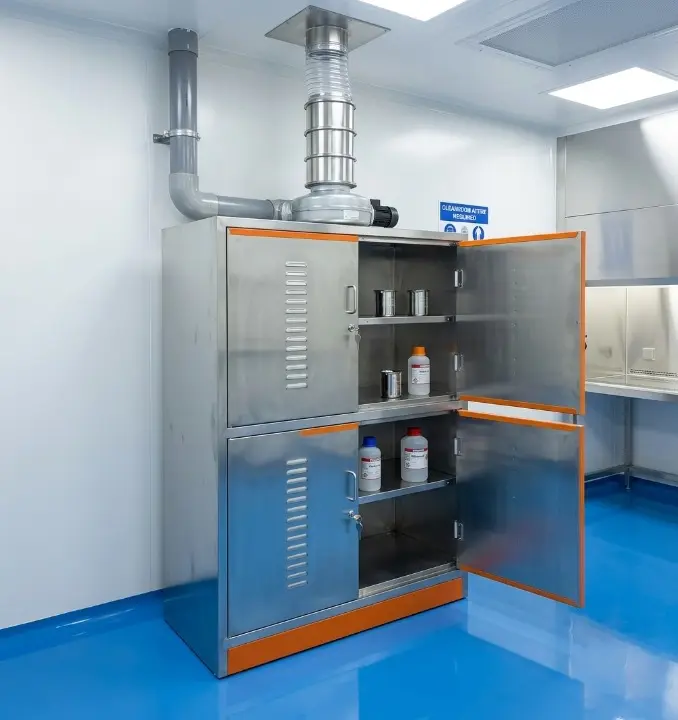
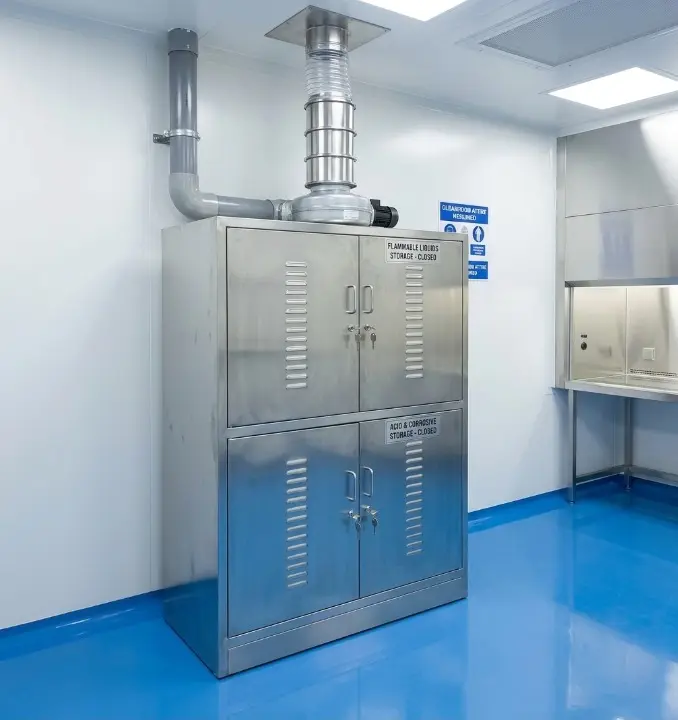
In research and manufacturing facilities, the storage of volatile, flammable, and corrosive reagents requires a specialised balance of containment, safety, and sterility. Metrolabs cleanroom chemical storage cabinets are engineered to safely house hazardous agents while maintaining the particulate integrity of the controlled environment — a structural barrier between sensitive processes and reactive chemicals that satisfies COSHH, BS EN 14470-1, and ISO 14644-4 simultaneously.
Why a Standard SS Cabinet Cannot Store Hazardous Chemicals in a Cleanroom
Standard stainless steel storage cabinets — including standard GMP cleanroom cupboards — are designed for sterile materials storage, not chemical containment. Using them for hazardous reagent storage creates serious safety and compliance violations.
Fume Extraction — Vapour Build-Up Kills Without Warning
Volatile organic solvents — acetone, methanol, ethanol, diethyl ether, dichloromethane — have vapour pressure high enough to reach explosive concentrations within an unventilated cabinet within minutes of a container cap being improperly closed. A standard stainless cabinet has no ventilation pathway — vapour accumulates to the lower flammable limit (LFL) inside the sealed cabinet. When the door is next opened, the vapour cloud is released into the cleanroom breathing zone — a health risk — and potentially ignited by equipment in the room. Metrolabs chemical storage cabinets include dual ventilation ports — a high-level port exhausting light vapours (lighter than air — e.g. acetone, pentane) and a low-level port exhausting heavy vapours (heavier than air — e.g. chloroform, DCM) — both connected to the facility’s dedicated solvent extraction ductwork, ensuring continuous vapour dilution inside the cabinet throughout the storage period.
Flame Arrestors — Preventing Ignition from Outside the Cabinet
Even with proper ventilation, there is a residual risk that flammable vapour concentrations within the cabinet momentarily exceed the LFL — particularly after a container is opened and re-closed imperfectly. If an external ignition source — static discharge from an operator, an electrical arc from a compressor motor, or a spark from a nearby instrument — ignites vapour outside the ventilation port, the flame front can propagate back through the ventilation duct into the cabinet and ignite the stored flammable reagents. Flame arrestors — precision-woven stainless steel mesh installed in both ventilation ports — quench the flame front by absorbing heat below the ignition temperature of the vapour before it can propagate into the cabinet interior. This is the primary fire prevention mechanism of BS EN 14470-1 compliant chemical storage cabinets and is absent from every standard storage cabinet.
Integrated Sump — Containing the Spill Before It Reaches the Floor
A reagent bottle falling from a shelf inside a standard cabinet releases its contents onto the cabinet floor and then onto the cleanroom floor — a chemical contamination event that requires immediate cleanroom evacuation, decontamination, and environmental incident reporting. The integrated liquid-tight sump at the base of the Metrolabs chemical storage cabinet contains any spilled liquid within the cabinet — the volume is specified at a minimum of 20% of the total shelf capacity (a requirement of COSHH and BS EN 14470-1) so that the largest likely spill volume — typically one full-size reagent bottle — is contained within the sump without overflow. Perforated shelves allow spilled liquid to drain from the shelf level immediately through the perforations into the sump, rather than pooling on the shelf where it can be disturbed by subsequent access events.
Earthing — Eliminating Static Discharge Ignition Risk
Flammable solvents with low electrical conductivity — hexane, toluene, diethyl ether, petroleum ether — generate and accumulate electrostatic charge when poured or transferred, because the low conductivity prevents the charge from dissipating through the liquid. When sufficient charge accumulates, a static discharge spark can ignite the solvent vapour above the container. Metrolabs chemical storage cabinets include an integrated earthing terminal — a dedicated bonding point on the cabinet body connected to the facility’s earthing system — that allows an earthing cable (crocodile clip) to be connected from the solvent container being transferred to the cabinet earth, preventing static charge accumulation during the transfer event. The cabinet body is also continuously earthed, preventing charge accumulation on the cabinet structure itself.
SS 316L or Polypropylene — Selected by Chemical Compatibility
The cabinet material is selected based on the specific chemicals to be stored — not one-size-fits-all. Metrolabs offers two primary construction materials, each engineered for a specific chemical compatibility profile:
Grade SS 316L — Acids, Bases & Aggressive Solvents
The standard construction material for pharmaceutical, biotech, and research cleanroom chemical storage — SS 316L provides the highest combination of mechanical strength, corrosion resistance, and cleanroom compatibility. The molybdenum addition in SS 316L (2.1–2.8% Mo vs nil in SS 304) provides pitting resistance specifically against chloride-containing reagents (hydrochloric acid, chlorinated solvents) that aggressively pit SS 304. The passivated SS 316L surface is inherently resistant to a wide range of chemical aggressors encountered in pharmaceutical and research cleanrooms — dilute acids and bases (excluding hydrofluoric acid), alcohols (IPA, methanol, ethanol), organic solvents (acetone, acetonitrile, chloroform, DCM), and oxidising agents (peracetic acid, hydrogen peroxide). The non-porous, electropolished surface finish prevents chemical absorption and ensures that the cabinet interior can be effectively decontaminated with IPA or QAC disinfectants between reagent changeouts without chemical cross-contamination between successive stored reagents. SS 316L cabinet bodies are also fully compatible with VHP sterilisation — the cabinet exterior can be included in room-wide VHP sterilisation cycles without material degradation.
Polypropylene (PP) — Hydrofluoric Acid & Strong Oxidisers
Polypropylene is the material of choice for storage of reagents that attack stainless steel — specifically hydrofluoric acid (HF) and its salts, concentrated sulphuric acid (fuming), concentrated nitric acid (fuming), and extremely aggressive oxidising mineral acids that would pit even SS 316L over time with concentrated or repeated exposure. PP is chemically inert to virtually all acids, bases, and organic solvents — it is unaffected by HF at any concentration, which attacks stainless steel by dissolving the chromium oxide passive layer. PP construction is also specified for PECVD and semiconductor etching chemical storage where ultra-high-purity etchant chemicals (buffered HF, phosphoric acid etch solutions) must be stored in contact with a material that contributes zero metallic contamination to the stored reagent. The polypropylene cabinet body is fabricated by hot-gas welding — a fusion process that maintains the chemical continuity of the PP material at joints without introducing metallic fasteners or adhesive sealants. The PP surface can be cleaned with a wide range of chemical disinfectants but is not compatible with VHP sterilisation (PP degrades under prolonged VHP exposure) — an important consideration for cabinets used in pharmaceutical cleanrooms with room-wide VHP programmes.
Six Critical Safety Features — Each Mandated by COSHH & BS EN 14470-1
Every Metrolabs chemical storage cabinet incorporates six safety engineering features that are legal requirements under COSHH and BS EN 14470-1 for flammable and hazardous reagent storage in occupied facilities:
Dual-Port Ventilation System — High & Low Level
Two independently positioned ventilation ports — one at the top-rear of the cabinet (for vapours lighter than air) and one at the bottom-rear (for vapours heavier than air) — ensure continuous removal of both light and heavy vapour fractions from the cabinet interior when connected to the facility’s dedicated solvent extraction system. Light vapours (e.g. acetone, pentane, diethyl ether — molecular weight below ~44 g/mol) collect at the cabinet ceiling and are exhausted through the top port. Heavy vapours (e.g. chloroform, DCM, DMSO — molecular weight above ~44 g/mol) sink to the cabinet floor and are exhausted through the bottom port. Without dual-level extraction, heavy vapours pool at the base of the cabinet and eventually diffuse out of the door gasket into the room. Each port is a precision-bored SS 316L or PP collar sized for standard 40mm, 50mm, or 63mm flexible solvent extraction ducting, with an adjustable damper to balance extraction airflow between the two ports.
Integrated Flame Arrestors — Both Ventilation Ports
Both ventilation ports include a factory-installed precision-woven stainless steel mesh flame arrestor — a crimped metal ribbon packed to a specific cell geometry that dissipates the heat energy of a propagating flame front below the auto-ignition temperature of the flammable vapour before the flame can reach the cabinet interior. The mesh geometry is specified to the Davy lamp principle — the same operating principle as the miners’ safety lamp, where a fine wire mesh prevents flame propagation through the mesh openings. Metrolabs flame arrestors are tested to BS EN ISO 16852 — the international standard for flame arresting devices — and are rated for the specific flammable vapour groups (Group IIA — propane/acetone; Group IIB — ethylene/diethyl ether; Group IIC — hydrogen/acetylene) appropriate to the chemicals being stored. The flame arrestor cassettes are removable for cleaning and replacement without demounting the cabinet.
Liquid-Tight Sump — ≥20% Volume Spill Containment
The cabinet base is a formed liquid-tight sump — a continuous, leak-free basin that occupies the base of the cabinet interior and is designed to contain the full volume of the largest container likely to be spilled — specified at a minimum of 20% of the total shelf storage volume by COSHH and BS EN 14470-1. In a standard 600mm-wide cabinet with three shelves storing 500ml and 1000ml reagent bottles, the sump volume is calculated to contain the contents of the largest single bottle stored without overflow. The sump is fabricated as an integral part of the cabinet base — not a removable tray that creates a gap or spill path at its perimeter — and is tested to BS EN 14470-1 leak-tightness requirements before dispatch. The sump interior is the same material as the cabinet body (SS 316L or PP) for chemical compatibility. A drain plug allows the sump to be emptied safely into a waste container without removing the cabinet from its installation position.
Chemical-Resistant PTFE Door Gasket — Vapour Seal
The door gasket material is polytetrafluoroethylene (PTFE) — the only gasket material that is truly resistant to the full range of flammable and corrosive reagents stored in chemical storage cabinets. Standard silicone gaskets (used in cleanroom storage cabinets for sterile materials) swell, degrade, or dissolve in contact with concentrated organic solvents — acetone causes silicone swelling and loss of sealing force; chlorinated solvents extract silicone plasticisers and cause embrittlement. PTFE is inert to all common laboratory solvents, acids, and bases at the concentrations used in research and pharmaceutical manufacturing. The PTFE gasket maintains its sealing geometry and compression force after contact with accidental reagent splashes, vapour condensation on the door frame, and repeated cleaning cycles with aggressive disinfectants. The gasket creates a vapour-sealed perimeter around the closed door — preventing the migration of stored chemical vapours into the cleanroom breathing zone during the normal storage period when the door is closed.
Self-Closing Door with Sequential Interlock
The door of every Metrolabs chemical storage cabinet is equipped with a spring-loaded self-closing mechanism — a calibrated torsion spring assembly built into the concealed hinge that automatically closes and latches the door if it is released without being positively held open by the operator. This prevents the most common chemical storage violation observed in laboratory practice: doors left open during work sessions, which converts the cabinet from a closed containment system to an open vapour source. For double-door cabinets, a sequential door interlock ensures that the right-hand door fully closes and latches before the left-hand door can close — preventing the situation where both doors are simultaneously in the partially closed position, which would leave a central gap in the door seal with no overlapping gasket coverage. The self-closing mechanism force is adjustable for personnel ergonomics and is rated for a minimum of 50,000 open-close cycles without spring fatigue.
Perforated Shelves with Safety Lips
Chemical storage cabinet shelves combine the spill management function of perforations (allowing spilled liquid to drain immediately into the sump below) with the mechanical containment function of raised safety lips at the front and sides of each shelf (preventing containers from being accidentally pushed off the shelf during retrieval of adjacent items). The shelf perforations — ∅25mm / 45mm pitch — allow even viscous reagents (glycerol, phosphoric acid, concentrated sulphuric acid) to drain under gravity within a reasonable time after a container failure, preventing pooling on the shelf where the accumulated liquid could overflow the shelf edge and reach the external cabinet base rather than the contained sump. Safety lips are 25mm high SS 316L or PP riser bars at the front and both sides of each shelf — acting as a physical barrier that a bottle must surmount to fall from the shelf. Shelf positions are adjustable on a 25mm-pitch hole system to accommodate different container heights.
Metrolabs Chemical Storage Cabinet — Technical Standards
Every Metrolabs cleanroom chemical storage cabinet is fabricated, certified, and documented to these safety and technical parameters:
| Feature | Metrolabs Standard | Safety / Compliance Benefit |
|---|---|---|
| SS Cabinet Material | SS 316L — passivated ASTM A967 | Pitting-resistant — VHP compatible exterior |
| PP Cabinet Material✓ HF / Acid | Food-grade polypropylene — hot-gas welded | HF / conc. acid inert — zero metallic contamination |
| Door Gasket | PTFE — chemical-resistant | Vapour-proof seal — solvent inert — no swelling |
| Sump Volume | ≥20% total shelf capacity | Full container spill containment — COSHH compliant |
| Ventilation | Dual-port — high & low level | Light + heavy vapour extraction — no build-up |
| Flame Arrestors | BS EN ISO 16852 — both ports | External ignition front blocked — fire prevention |
| Door Mechanism | Self-closing — sequential interlock | Cabinet never accidentally left open |
| Earthing | Integrated bonding terminal | Static discharge prevention — flammable solvent safe |
Chemical Storage Cabinets Across Every High-Stakes Sector
Wherever volatile, flammable, or corrosive reagents must be stored within a controlled environment — a validated safety cabinet is not optional:
Pharmaceutical GMP
SS 316L chemical storage for API synthesis solvents, IPA, acetonitrile, and reagent-grade acids in GMP cleanrooms. COSHH and OSHA compliant. Dual-port ventilation to solvent extraction system.
Aseptic Manufacturing
SS 316L chemical cabinets for sterilising agents (IPA, peracetic acid, H₂O₂) in aseptic suite cleanroom anterooms. Self-closing door prevents vapour migration into aseptic suite during access.
Semiconductor & MEMS
PP chemical cabinets for HF etch, buffered oxide etch, phosphoric acid, and H₂SO₄ in semiconductor cleanrooms. Zero metallic contamination — ultra-high-purity chemical compatibility.
Biotech & Research
SS 316L or PP chemical storage for organic solvents, acids, and bases in biotech, ATMP, and university research labs. Custom multi-compartment segregation for incompatible chemical co-storage.
BSL Containment
SS 316L chemical cabinets for disinfectants, decontamination agents, and fixatives in BSL-2/3 labs. PTFE gasket prevents corrosive fumes reaching containment personnel. Earthing for static-sensitive agents.
Hospital Pharmacy
SS 316L chemical storage for cytotoxic solvents, ethanol, and formaldehyde in hospital pharmacy cleanrooms. NABH and COSHH compliant. Sequential door interlock prevents accidental contamination exposure.
Food & Beverage
SS 316L chemical storage for FSSAI-approved cleaning chemicals, sanitisers, and food-grade acids in high-care food production. Sealed sump for spill containment in food safety areas.
NABL Testing Labs
SS 316L chemical cabinets for reference standards, reagent acids, and analytical grade solvents in NABL-accredited testing labs. Flame arrestors and dual-port ventilation as required by NABL safety standards.
More Than a Box — A Validated Safety Solution
Metrolabs provides more than just a cabinet — we provide a validated safety solution with custom chemical segregation, earthing, and cleanroom integration features that standard commercial chemical storage cabinets cannot offer:
Custom Chemical Segregation — Incompatible Reagents in One Cabinet
Metrolabs designs multi-compartment chemical storage cabinets with internal SS 316L or PP dividers that segregate incompatible chemical families within the same cabinet — acids from bases, oxidising agents from flammable solvents, chlorinated solvents from reactive metals. Each compartment has its own ventilation pathway and sump zone, ensuring that a failure of one chemical container does not allow the spilled reagent to contact incompatible chemicals in the adjacent compartment. Custom segregation reduces the number of separate cabinets required in a small cleanroom while maintaining full chemical incompatibility compliance.
Recessed Label Holders — High-Visibility Hazard Identification
Every Metrolabs chemical storage cabinet includes recessed SS label holders on the door exterior — smooth, flush-mounted pockets that display hazard identification labels and GHS pictograms for the chemical category stored inside. Recessed holders prevent adhesive labels (which shed adhesive and paper particles from the adhesive backing) from being applied directly to the cabinet surface — maintaining the non-shedding exterior of the cabinet while providing mandatory chemical hazard identification for personnel and emergency responders.
Flush Mounting — Recessed into Wall & Partition Systems
Metrolabs chemical storage cabinets can be recessed into the modular cleanroom wall and partition system — with the cabinet face flush with the room wall surface, no gap between cabinet and panel, and the ventilation connections routed through the panel thickness to the solvent extraction system in the ceiling void. Floor-to-ceiling recessed chemical storage eliminates all external cabinet dust traps, reduces the room’s particle load from the cabinet exterior, and makes the chemical storage system invisible from the cleanroom interior — a significant advantage for rooms that undergo regular ISO classification testing.
COSHH Risk Assessment Support — Documentation at Delivery
Every Metrolabs chemical storage cabinet is supplied with a compliance documentation package — material test certificates, flame arrestor test certificates (BS EN ISO 16852), sump leak-tightness test record, and a declaration of conformity to BS EN 14470-1. This documentation is structured to support the customer’s COSHH risk assessment for the specific chemical storage location, providing the engineering controls evidence required to demonstrate that the storage arrangement meets the legal requirements of the Control of Substances Hazardous to Health Regulations without requiring the customer to independently test the cabinet.
Chemical Cabinet vs Standard Storage
From Chemical Compatibility Assessment to Installed & Documented Safety Cabinet
Metrolabs manages the complete supply and installation process — from initial chemical compatibility assessment through fabrication, installation, and COSHH compliance documentation:
Chemical Compatibility Assessment
Chemicals to be stored are reviewed for material compatibility, vapour group (IIA/IIB/IIC), flash point, and incompatibility risks. Cabinet material (SS 316L or PP), compartment segregation plan, sump volume, and flame arrestor group confirmed. Ventilation duct route to extraction system agreed.
Safety-Certified Fabrication
Cabinet fabricated in specified SS 316L or PP. Sump leak-tightness tested. Flame arrestors installed and tested to BS EN ISO 16852. PTFE gasket fitted. Self-closing spring mechanism calibrated. Earthing terminal installed. Recessed label holders fitted. All compliance tests documented.
Installation & Duct Connection
Cabinet positioned and secured. Ventilation duct connections made — high and low port connected to dedicated extraction branch. Extraction airflow balanced between ports with dampers. Earthing continuity tested with resistance meter. Sump drain plug function tested. Door self-closing and interlock verified.
COSHH Documentation Package
Material certs, flame arrestor test certs (BS EN ISO 16852), sump leak test record, earthing continuity test record, declaration of conformity (BS EN 14470-1), installation photographs, and ventilation connection records compiled as the COSHH compliance documentation package.
Chemical Storage Cabinets Compliant with All Major Safety Regulations
BS EN 14470-1
The European standard for fire-resistant laboratory furniture for flammable liquid storage. Specifies the sump volume (≥20%), ventilation requirements, flame arrestors, self-closing door, and fire resistance ratings. Metrolabs chemical storage cabinets are fabricated and tested to BS EN 14470-1 and supplied with a declaration of conformity.
BS EN 14470-1COSHH Regulations
The UK Control of Substances Hazardous to Health Regulations require that hazardous chemicals are stored with appropriate engineering controls — specifically containment, ventilation, and ignition prevention. Metrolabs chemical storage cabinets satisfy all three COSHH engineering control requirements, with the COSHH compliance documentation package supporting the customer’s COSHH risk assessment.
COSHH · OSHA 1910.106BS EN ISO 16852
The international standard for flame arresting devices — specifying the testing and rating requirements for flame arrestors across the three IEC explosive vapour groups (IIA, IIB, IIC). Metrolabs flame arrestors are tested and rated to BS EN ISO 16852 for the appropriate vapour group(s) of the stored chemicals, with test certificates supplied.
BS EN ISO 16852ISO 14644-4 & GMP
ISO 14644-4 requires cleanroom storage equipment to be compatible with the cleaning and decontamination methods of the cleanroom. Metrolabs chemical storage cabinets are designed to satisfy ISO 14644-4 cleanroom equipment requirements simultaneously with BS EN 14470-1 chemical storage requirements — the only cabinet on the market designed for both cleanroom and chemical safety compliance.
ISO 14644-4 · WHO GMPFactory & Office
4, SIDCO-MICRO, Thirumudivakkam,
Chennai – 600 132, Tamil Nadu
🗺 Open in Google Maps ↗
Phone
Website & GSTN
www.metrolabs.biz
www.schoollabfurniture.com
GSTN: 33AASFM3382K1ZT
Ready to Install Validated Chemical Storage in Your Cleanroom?
Contact Metrolabs for a free consultation. Our safety engineering specialists will assess your chemical inventory, vapour group classification, COSHH requirements, and cleanroom ISO class — then fabricate, supply, install, and document your chemical storage cabinet with full BS EN 14470-1 compliance documentation at delivery.
⚠️ Request a Free Chemical Cabinet Quote
Quote Request Received!
Our safety engineering team will contact you within 24 working hours.
Immediate: 9840931231